L. R. CONRADI

10%

Review and Herald Publishing Association · Takoma Park Station, Washington, D. C. · Mar 27, 1913

FromReview and Herald, Vol. 90, No. 13.

Read the full edition

L. R. CONRADI

From Aden to Gendia, British East Africa

L. R. CONRADI
AFTER we had spent five days at Aden, the German East African steamship “Tabora” reached that port Nov. 23, 1912, and we at once took our cabin. This is the latest and the largest of the German East African steamers, being a boat of eight thousand four hundred tons, and in its equipment, especially in the second class, it is fully up to Atlantic steamers.
We were happily surprised to see the change for the better, when the service is compared to what we found on this line eight years ago. The boat was well filled with cargo and passengers. There were about seventy second-class passengers, nearly half of whom were missionaries—German, English, Irish, Dutch, Portuguese, and American. About a dozen of these were Roman Catholics. It was not altogether a happen so that we met two missionaries of the Leipzig Mission, who are our neighbors in the Pare District, and with whom we had corresponded concerning their cooperation with us in the translation of the New Testament.
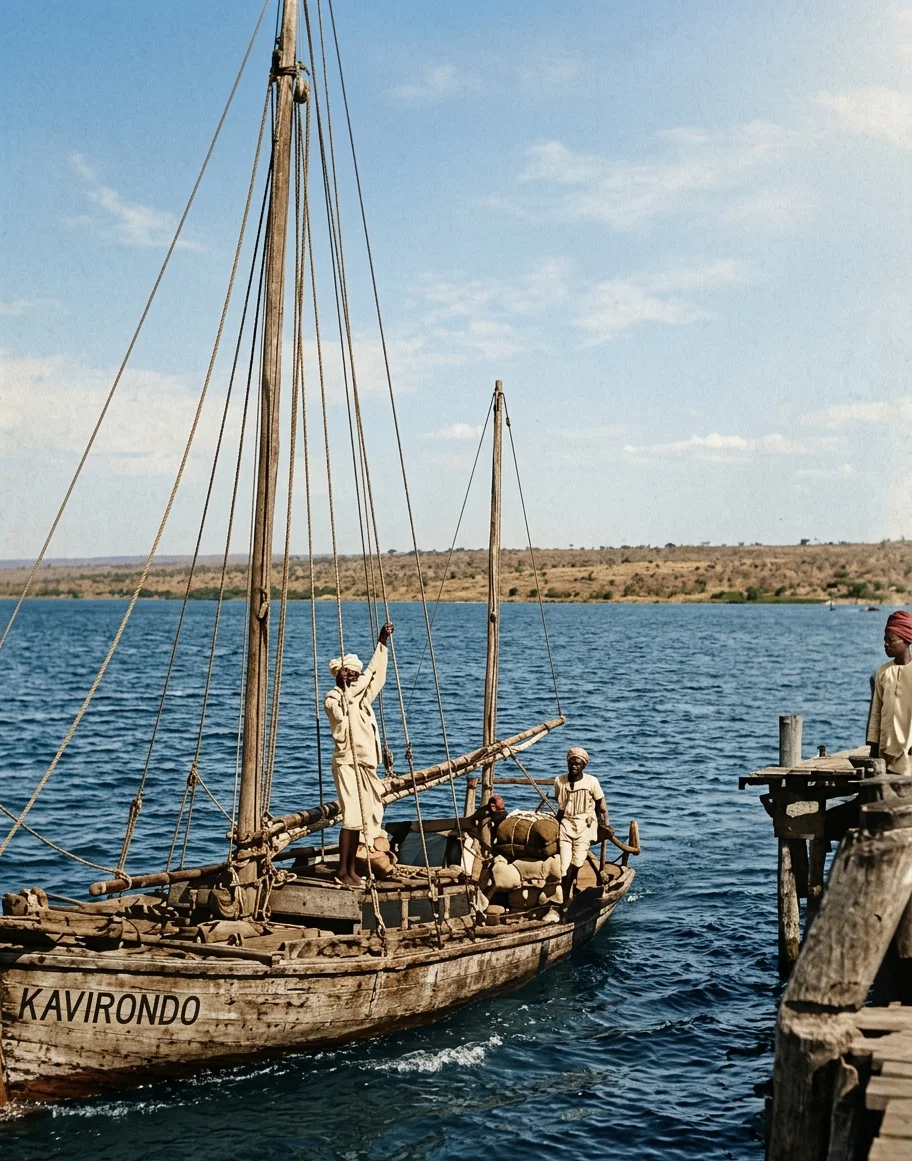
THE NEW BRITISH MISSION SAILBOAT
“KAVIRONDO”
THE NEW BRITISH MISSION SAILBOAT “KAVIRONDO”
Early on the morning of November 28 we reached Mombasa, where Brother E. Kotz and his native teacher came out to meet us on the steamer. We were soon settled in the African hotel, where they had secured quarters for our accommodation. That evening we called on Major Millet, of the East African Industries. I had quite an interesting talk with him and with one of his employees whom I met four years ago, discussing various points of present truth with them. At the major’s invitation we visited their large workshops next morning, where we found an excellent outfit of modern machinery for working up timber, doing blacksmithing, and producing cement, and we were also informed that the company has a good brick-kiln. They still employ a number of Indian workmen, some of whom earn ten dollars a week, but we were told that the natives are rapidly getting hold of the various handicrafts, so that before very long Indian labor can be dispensed with.
At noon the Uganda Railway train left for the lake. A second-class return ticket from Mombasa to Kisumu costs about twenty-seven dollars, and the apartment we had was arranged as a tourist’s sleeper, so we could sleep at night. In about fifty hours we reached Kisumu, where we were met by Brethren A. A. Carscallen, B. Ohme, J. D. Baker, H. J. Sparks, and a number of our mission boys. That evening we were invited to tea by the district commissioner.
Kisumu, formerly known as Port Florence, is quite a growing town. The Uganda Railway has four good steamers on the Victoria Nyanza. One of these plies regularly between Uganda and Kisumu, while the others make monthly trips around the lake in the northern and southern directions. Some of our fellow missionaries remained down in Mombasa, because they could not get a boat leaving for the lake for some days. We were more fortunate in this respect. Brother Ohme had come to Kisumu on the German boat “Harold,” from German East Africa. This dhow carries nearly seven tons. Our British mission had during the last year also built a new dhow, the “Kavirondo.” At Mombasa a man who was an entire stranger to us had told us that the “Kavirondo” is about the best sailor on the lake. It cost seven hundred dollars. During the night we sailed across the bay to Gendia, a distance of about twenty miles. Early in the morning, as we came up to the pier, we were greeted by a number of our native Christians, who sang songs of welcome in their own language. All our British East African missionaries were in, so that, with Brethren Ohme and Kotz, there were fourteen foreign workers in all—eleven brethren and three sisters.
One of the first things we did was to draw up a program for our stay here, and for our trip to German East Africa. We were pleased with the signs of progress about the mission and the hearty welcome accorded us by the brethren. God is surely working in this mission, as will be seen from our next report.