Our Work

8%

Review and Herald Publishing Association · Tacoma Park Station, Washington, D. C. · Mar 13, 1913

FromReview and Herald, Vol. 90, No. 11.

Read the full edition

Our Work

The Philippine Islands — No. 3

Our Work
L. V. FINSTER
[Written for the special Sabbath-school offering for Korea and Philippine Islands, March 29.]
The first worker to visit the Philippine Islands was Elder G. A. Irwin, in 1905, on his way to the General Conference from Australia. He spent but a few days gathering facts and information, preparatory to sending workers there. In August, of the same year, Brother R. A. Caldwell spent about three months canvassing for “Home Hand Book.” After securing seventy orders, he left for China. In April, 1906, Elder J. L. McElhany and wife came from Australia to open up mission work. They had many trying things to encounter in starting work in a strange place. Brother McElhany soon secured a club of five hundred Signs from some of our American conferences, together with a great many other papers. These he sent out from week to week to the school-teachers. Much of the seed sowing done in this way will in time bear its fruit. Some American families took hold of the truth, but returned to the United States. One of the soldiers became interested from studies with Brother McElhany, and is now a worker in our cause. In February, 1908, Brother McElhany left for New Zealand.
In January, 1908, Brother Caldwell and wife arrived, to take up the sale of our literature. They have been wonderfully blessed in this work. They have delivered 1,600 Spanish “Patriarchs and Prophets,” 1,000 “Coming King,” and nearly 1,000 Tagalog “Thoughts on Daniel,” besides many smaller books. These books have nearly all been sold to Filipinos. Who can tell the amount of good these silent messengers may do? But a very small part of the islands has been worked.
Dec. 17, 1908, Mrs. Finster and I arrived to take charge of the work. After looking over the ground, I decided that the first thing to be done was to master one of the languages, as only about ten per cent of the natives read the Spanish language. It is true that a few read Spanish in each province, but the mass of the people do not understand it; so most of our time the first year was spent in study, and in getting out literature in the different languages. We were able to secure the man who had translated the Bible into Tagalog, to translate for us into that language. After translating “Is the End Near?” and “God’s Love to Man,” I gave him the tracts “Is Sunday the Sabbath?” and “Elihu on the Sabbath.” When he brought the translation, he said, “I believe you are right on that subject.” I then began studies with him, and he soon commenced to keep the Sabbath. We have also had the tracts “Who Changed the Sabbath?” “How Esther Read Her Bible,” “The Second Coming of Christ,” “The Immortality of the Soul,” and “Which Is the Day of the Lord?” besides “Thoughts on Daniel” and a small “Bible Readings,” translated and printed in the Tagalog language. We also have a few of the same tracts translated into the Ilocano language.
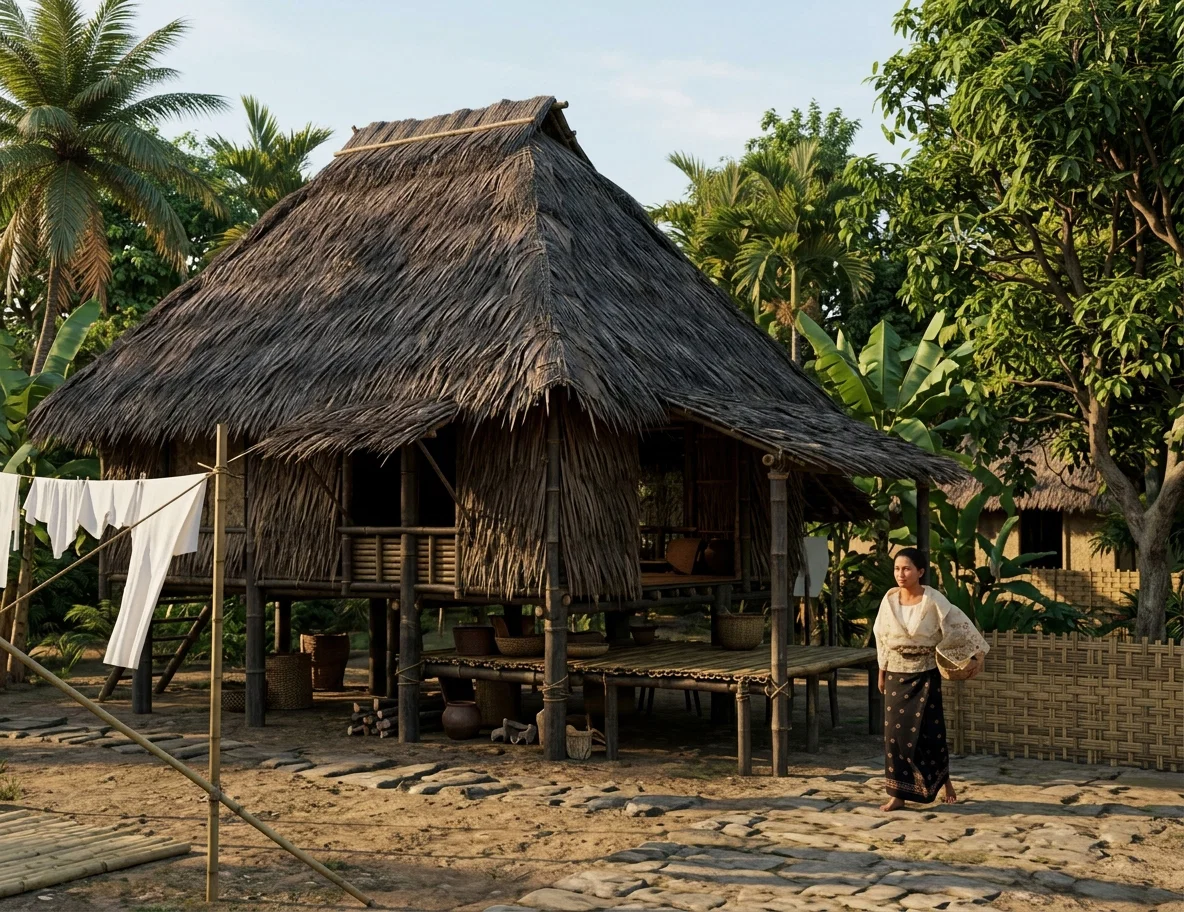
NATIVE HOME IN THE PHILIPPINE ISLANDS
Our public work was commenced with some young men who understood English. They soon became so much interested that they invited many of their friends, and even older people came, although they could not understand anything that was said. Soon one of the young men offered to act as an interpreter. The Lord blessed the feeble efforts, and in a short time we had a Sabbath-school of twenty members. Our first baptism was held in March, 1911, while Elder I. H. Evans was making his first visit to the islands. A church of eighteen members was organized. Our hearts were very glad as we saw our first-fruits in these islands, united with other nations, kindreds, and tongues in giving this last message to the world.
During the next year our work went by leaps and bounds. Every quarter we were able to take into church-membership from twenty to thirty members. When our church was one year old, we had one hundred members. At the present time we have nearly one hundred fifty members.
At the beginning of this year, Elder E. M. Adams and wife, and Brother Floyd Ashbaugh came to assist in the work. They are laboring faithfully and untiringly to advance the work, while we are on our furlough after twelve years’ absence from America. When Elder Adams attended our first meetings and saw the great interest to hear, and the hungry souls with no one to feed them, he remarked, “If such things should happen in America, they would think the ‘loud cry’ had fully come.” It is a common thing to have our tent packed and four or five hundred persons on the outside, and after holding meetings every night for two months our congregations are as large as on the first night. It makes one’s heart sad as he sees hundreds of such openings with no one to fill them. The Filipino, so suddenly liberated from the darkness and gross ignorance of Romanism, is eager for anything that promises enlightenment.
Just now there are opportunities for our work that we may not long have. Thus far we have work started in but one language. We should have five families at once to begin the study of the other great languages of the islands.