Does the History of Turkey and Egypt Since 1798 Fulfill the Prophecy of Dan. 11:40-44?
By Arthur G. Daniells
— No. 6
A. G. DANIELLS
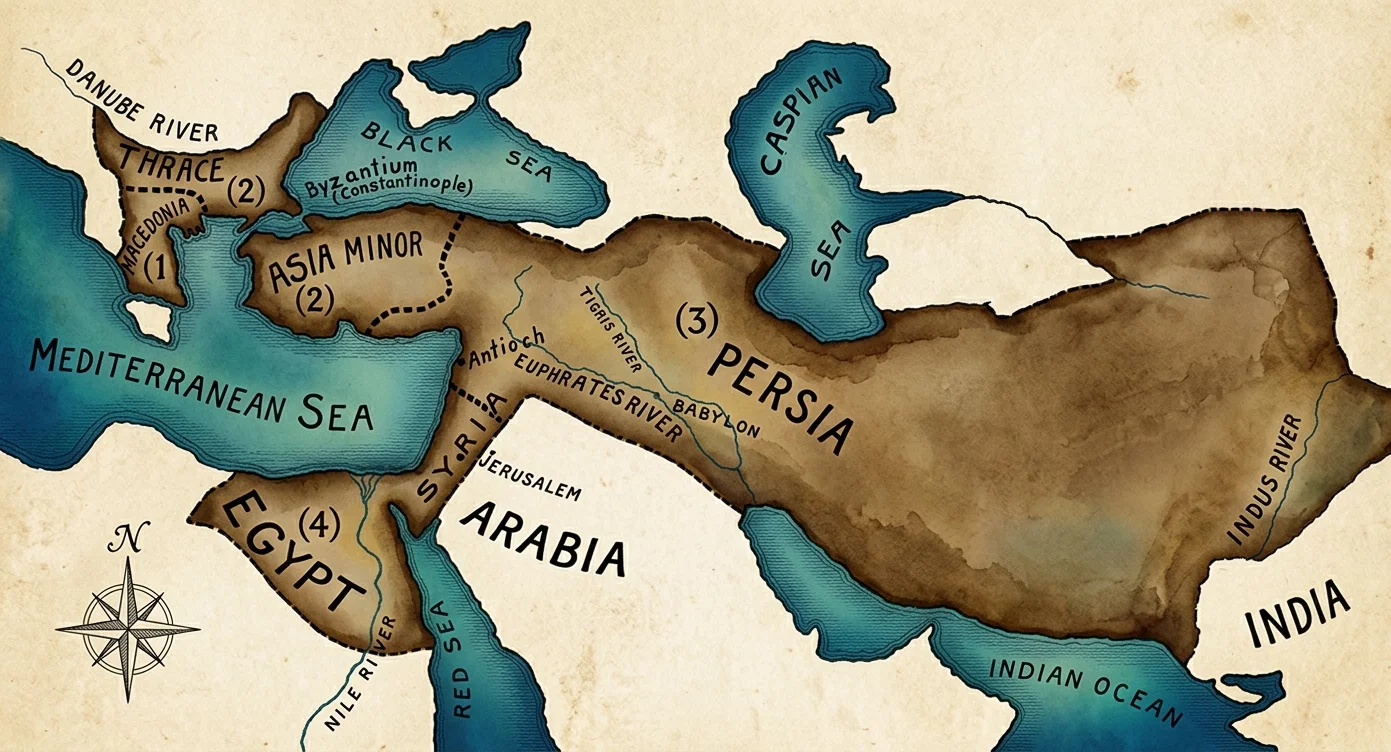
As already shown, it was in the year B. C. 281 that Seleucus, king of Syria, defeated Lysimachus, king of Thrace and Macedon, and added what were originally the western and northern divisions to his eastern division. Duruy tells us that at this point “the number of kings was for the moment reduced to two, by the union of Thrace, Macedon, and Asia in the hands of Seleucus. The former satrap of Babylon [Seleucus] ruled, therefore, over the whole of Alexander’s empire, except Greece and Egypt.” Thus was fulfilled the prophecy of Dan. 11:5, which foretold the dominant place two of the four kingdoms were to reach in the changes that were to take place in the breaking up of Alexander’s empire.
Map showing Alexander’s empire at the time of his death. (1) Macedon, kingdom founded by Cassander; (2) Thrace and Asia Minor, kingdom founded by Lysimachus; (3) Syria and Persia, kingdom founded by Seleucus; (4) Egypt, kingdom founded by Ptolemy.
Seleucus was an old man when he found himself master of the greater part of Alexander’s vast dominions. He made no attempt to govern from his Asiatic capital the European territory which came into his hands when he defeated Lysimachus. The arrangement decided upon was this:—
“Asia Minor was now incorporated into the monarchy of the Seleucidæ; Thrace reserved for the children of Agathocles; while Seleucus, giving up to his son Antiochus all Asia from the Hellespont to the Indus, laid claim to Macedonia for himself. But when he crossed the Hellespont, late in 281, Ptolemy Ceraunus, Philadelphus’s elder brother, who had been, because of his dissolute and savage character, excluded by his father from the succession to the Egyptian throne, murdered the old king in the chersonese, and usurped authority in the European territories of Lysimachus.”—“History of All Nations,” Vol. III, pages 388-395.
“Seleucus appointed his son Antiochus, who had for a long time administered the upper satrapies, regent of Asia, desiring himself to reside in Macedonia, in order to end his days in the land of his birth, while he intended Thrace for the child of murdered Agathocles. He had already landed in Europe, when the dagger of Ceraunus, the very man who had shortly before fled to him beseeching help, struck the unsuspecting old king, 281 B. C. The murderer made himself master of Macedonia and Thrace.”—“The World’s History,” Vol. IV, page 147.
This arrangement left Antiochus, who succeeded his father, Seleucus, in possession of all the Asiatic part of the kingdom. Then in full accord with the prophecy of Dan. 11:6-15 there began, and continued for one hundred sixteen years, a terrible struggle between the dynasties of Seleucus and Ptolemy. The perfect agreement of the prophecy and the history of these two kingdoms until they were absorbed by the Roman Empire, proves beyond all question that they were the kings of the north and the south. In the continuous wars they carried on, their boundary lines were continually changing, but one never exterminated the other. They remained separate and independent until the Roman conquests.
The Kingdom of the South
Egypt, the kingdom of the south, remained under the rule of the Ptolemies until it was taken by the Romans.
“Upon the capture of Alexandria by the triumphant legions of Octavius Cæsar, in B. C. 30, Antony and Cleopatra both committed suicide, and Egypt became a Roman province. Thus ended the Egyptian kingdom of the Ptolemies, after5an existence of almost three centuries (B. C. 323 to B. C. 30).”—“Library of Universal History,” Vol. III, page 799.
The overthrow of Syria, the kingdom of the north, is given in these few words by one historian:—
“In B. C. 65 the Roman general, Pompey the Great, defeated Antiochus Asiaticus and converted Syria into a Roman province.”—Id., page 789.
In 330 A. D. the capital of the Roman Empire was transferred by the emperor Constantine from the city of Rome, on the Tiber, to the city of Byzantium, on the Bosporus. The new capital was named Constantinople in honor of its founder, Constantine.
At the death of the emperor Theodosius, 395 A. D., the Roman Empire was permanently divided between the east and the west, and left to his sons Arcadius and Honorius.
“The eastern half bequeathed to Arcadius included the Balkan Peninsula, bounded on the north by the Danube, Asia Minor, the Taurus Peninsula (Crimea), Syria, Palestine, Egypt, Lower Libya, and the Pentapolis.”—“Historians’ History of the World,” Vol. VII, page 26.
A reference to the map will show that eastern Rome almost exactly covered the territory of the kingdoms of the north and the south, established in 281 B. C. by Seleucus and Ptolemy. It will be helpful to trace very briefly the principal changes that have since taken place in the Eastern Empire.
Decline of Egypt
Egypt, the southern part of eastern Rome, soon fell into the hands of the Arabs. “The decline of Egypt was due to the purely military government of the Romans. . . . At last the country was merely held by armed force, and the authority of the governor was little recognized beyond the capital, where garrisons were stationed. . . . Thus the Moslem conquest was easy.”—Encyclopedia Britannica, article “Egypt.”
“The Arab conquest of Egypt took place in the eighteenth year of the Hegira, or A. D. 639. It was with only a hundred camels, fifty slaves, and thirty horses that the Arab colonization of Egypt was begun by Kaisaby-Ebn-Kelthoom near the spot now occupied by the more modern city of Cairo. Fostat, or the city of the tents, was the name given to this first capital of the Arabs under Amru, and here was reared the first mosque devoted to Islamism.”—“History of the Egyptian Revolution,” Vol. I, pages 7, 8.
This dynasty ruled Egypt a period of two hundred thirty years, when it was overthrown by the Fatimites.
“The establishment of the Fatimite califate happened in this wise:—
“Moezz, the so-called Fatimite, and great grandson of Obeidallah, being in possession of a considerable territory in northern Africa, invaded Egypt, in the year 969 of the Christian era, his force being to a considerable extent composed of Sicilian Saracens, headed by Gohar- el-Caid, also a Sicilian; for in those days, Palermo, instead of being a city of Italian gardens and palaces, with a Corso and an opera, was a Moslem town, with mosques, baths, and bazaars. It was after this important event that Cairo proper was built, to the north of the town of Touloun.”—Id., page 18.
After reigning two hundred two years, the Fatimite dynasty was overthrown by the Mamelukes of Egypt, in 1171.
“As to the Mamelukes themselves, the reader no doubt knows that the word means slave (literally the ‘possessed’), and that they were brought in youth from northern countries to serve in the south. Saladin himself was a Kurd, and long before his accession to power, Turkish and Kurdish mercenaries were employed by the califs of Bagdad and Cairo, as the Pope employs the Swiss.”—Id., pages 42, 43.
The reign of the Mamelukes continued unbroken until 1517 A. D., when Selim, sultan of Turkey, invaded Egypt, and annexed it to his empire. But this did not destroy the power of the Mamelukes nor terminate their rule in Egypt.
“It was after Selim’s conquest that Egypt was divided into twenty-four districts, ruled by twenty-four Mameluke beys, according to the Turkish policy. . . . Seven of the beys formed the divan of Cairo, under the pasha sent by the Ottoman sultan. In the sixteenth and seventeenth centuries the pashalic was a reality, but after that period, when the power of the Porte began to decline, and Austria and Russia pressed hard upon her northern frontiers, her government of Egypt became more or less nominal, and such was the state of affairs up to the period of the French invasion. . . . The pasha resided in the castle. His political power was entirely nominal, while all the efforts that had been made to divide these haughty and rebellious vassals [the Mamelukes], and turn the shadow of power into a reality, had been unsuccessful. . . . The pasha of the rich realm of Egypt was rather the servant of the Mamelukes than the substitute of the sultan.”—Id., pages 70, 71, 74, 75.
Thus, with only a slight and short interruption, Egypt remained under the rule of the Mamelukes until Napoleon’s invasion, in 1798 A. D.
The Kingdom of the North
As to the northern division of eastern Rome, it gradually passed into the hands of the Saracens and Turks. Beginning with the conquest of Persia in 637 A. D., they steadily extended their conquests westward through Syria, Asia Minor, Thrace, Macedon, and Greece. Constantinople, the capital of eastern Rome, was taken by the Ottoman Turks in 1453. This brought to an end all pretense of government by eastern Rome.
Thus the whole of the territory over which Seleucus had made himself master, at the time of his death passed into the hands of the Turks. Turkey became the kingdom of the north, and still holds the territory of “the king of the north” of Dan. 11:6-15.
Thus we find that when, in 1798 A. D., Napoleon began his invasion of Egypt and Syria, these countries which were originally the “king of the south” and the “king of the north” were under the dominion of the Mamelukes and the Turks.