A Visit to the Abyssinian Mission

7%

Review and Herald Publishing Association · Takoma Park Station, Washington, D. C. · Feb 6, 1913

FromReview and Herald, Vol. 90, No. 6.

Read the full edition

A Visit to the Abyssinian Mission

L. R. CONRADI
At Suez we had to wait until November 3 for the Italian boat “Etrurea,” from Naples, to take us to Massaua on the Red Sea. Although the Italian-Turkish war was in reality over, yet its restrictions were still to be felt. The Khedivial line, whose steamers touch on both sides of the Red Sea, during the blockade had not been running farther than Port Sudan, and therefore the Italian line, with its monthly service, was our only means of reaching Massaua from Suez.
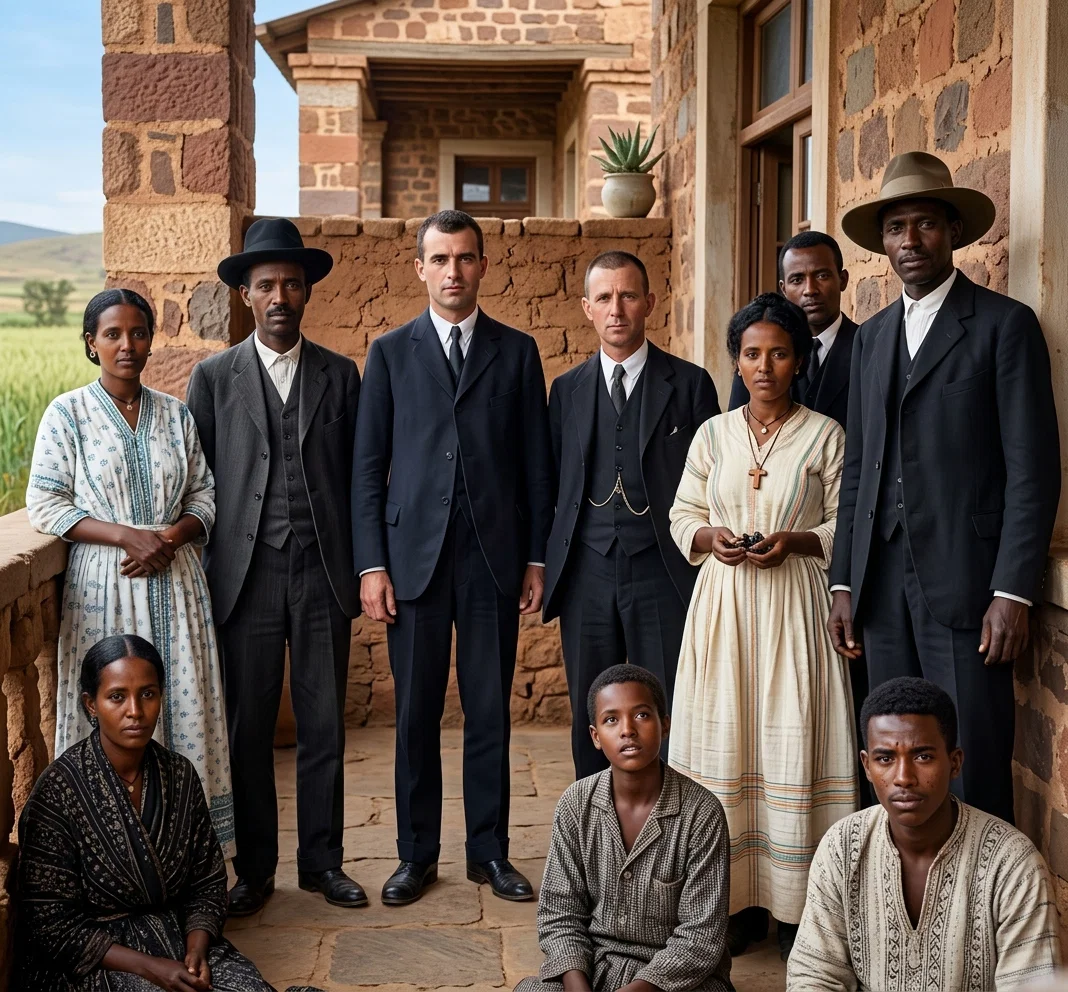
OUR MISSIONARIES AT ASMARA
On the sixth, we stopped a few hours at Port Sudan, and on Friday, the eighth, we reached Massaua, where Brother P. N. Lindegren met us. There were several Italian men-of-war in the harbor, and several good-looking Turkish steamers that the Italians had captured, one of which was already doing Italian transport service. As there were several car-loads of Italian officers and soldiers on board for Asmara, a special train left Friday noon.
The distance from Massaua to Asmara is about seventy-five miles, the last thirty miles being up a grade of four thousand feet. The ascent from the coast to Asmara is over seven thousand feet. There are no less than twenty-nine tunnels, and the solidity of the road surely does credit to Italian engineering. In five and one-half hours we were transported from the hot shores of the Red Sea to the Abyssinian plateau, where a heavy overcoat is necessary to sufficiently protect one from the chilly evening air. All the workers met us at the train, and took us over to the mission, which is one and one-half miles from Asmara.
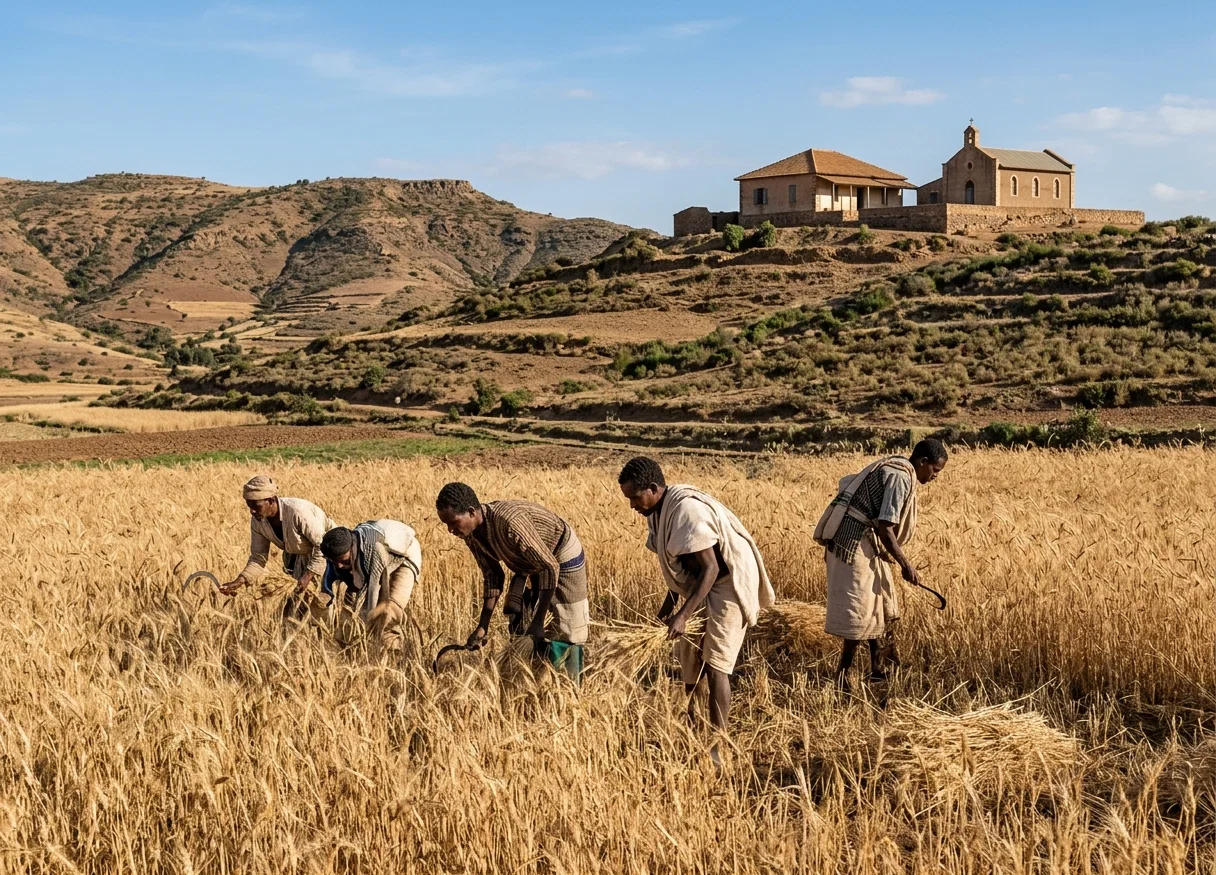
When we left Asmara three years ago, we had only secured the land and planned the buildings. Now the buildings are all complete and the land under quite good cultivation. We have about thirty acres of good wheat land, one of the best wells, a dwelling-house with lodgings for two missionary families, a schoolhouse with three rooms, and good buildings for barns, wagon sheds, storage-rooms, etc. God’s providence indeed led us in securing this property, and we should not know to-day where to secure a more favorable site for the mission.
The six days which Brother Guy Dail and I spent with the brethren were very busy ones indeed. We had councils with the workers, and laid still broader plans for the future. Our most efficient means for mission work here is the school, which has been in operation during the past two years, with from fifteen to thirty boys as pupils. Instruction is given in the Tigrinja language, which is spoken here, also in Italian and Amharic, and in the common branches and Bible. Many of the boys seem eager to attend the school, but they rather shirk heavy work. In planning the school for the coming year some important changes were made, and special stress was laid on the most efficient means of conversion, the work done with the boys in the missionary’s home. No visible results in conversion have appeared thus far, but we feel sure that if all work in unity and with due consecration and zeal, we shall soon see a change in this respect. Some time was also given to arranging for further language study for our own workers, and in preparing translations of our publications in these various languages.
HARVESTING ON THE ASMARA MISSION FARM
During our stay we had the privilegeof again calling on His Excellency, the governor of the colony, Marchese Raggi, and were received very cordially by him. He told us that an official of another European government, while visiting him, had, upon seeing our mission station, informed him that we were forbidden in his state because of trouble in the military service. This gave us a good opportunity to place the matter before him in its proper light, and at his own request we were able to present to him some of the distinguishing features of present truth.
We also called on the secretary of agriculture and upon the Swedish Lutheran Mission. This mission was established through great sacrifice on the part of those first connected with it, and has been actively at work in the colony for the past forty years. Its influence has been extending throughout Abyssinia. But trouble in the home church over higher criticism has also had its effect on the mission forces, causing a division, which surely can be only a detriment to the Protestant cause, especially where the Roman and Greek Catholics are doing their utmost to hinder the advance of Protestant missions. The Swedish missionaries have made the best progress in the Tigrinja language. Their small printing plant has produced a New Testament in that tongue, and quite a number of publications in five of the Abyssinian languages. The Roman Catholics have also recently opened a printing plant at Asmara.
Before we left Asmara, all the workers joined in the ordinances of the Lord’s house. We believe the outlook for the future is brighter. Elder Steiner, who will take charge of the mission, has a good knowledge of French. He intends soon to begin the study of Italian, and will gradually get hold of the native languages. Brethren Lindegren, Lorntz, and Öhmann will assist in the school and farm work at the station. The new school term runs from December till next autumn.
On the fifteenth of November, Brother Dail and the writer returned to Massaua, whence we sailed the next day on the Italian mail-steamer for Aden. For about thirty hours our boat followed the coast of Eritrea, touching at Assab, the second Italian seaport of the colony and of Abyssinia. This port evidently carries on a good trade with the natives of both the colony and Abyssinia. After a rough journey, we were only too glad by noon of the eighteenth to reach Aden.
From reliable sources we learn that King Menelik is still alive, but seems totally paralyzed. According to indications, there may be expected some changes in political affairs, and when they come they will surely tend toward the opening of closed Abyssinia to the truths of the everlasting gospel. Let us pray that this may soon be brought about, and that our workers may have much of God’s grace in pushing forward unitedly the work entrusted to them. Personally, we feel very grateful to God for the help he has rendered us.