The Biennial Conference of the India Union Mission
By J. L. Shaw
The second biennial conference of the India Union Mission was held in the city of Calcutta November 14-28. Nearly every foreign worker both in India and in Burma was present, several of them coming ten hundred and even fifteen hundred miles to attend the meeting. When missionaries have been working almost alone for one or two years in India, battling against what seems the almost impenetrable wall of heathenism, such occasions are times of great moment to the work and workers in the field. The meeting in Calcutta was no exception. From the beginning the Spirit of the Lord was present. The first four days were given almost wholly to spiritual interests. Prof. H. R. Salisbury, representing the General Conference, was with us throughout the meeting. He arrived in India nearly three weeks before the conference, and was able to visit four mission stations before and several after the meeting. His studies with the workers were very helpful and encouraging, and were highly appreciated by all. Eleven papers, carefully prepared by different workers representing various phases of mission work, were read, and considerable time was given to their discussion, which proved exceedingly helpful.
Some progress was shown to have been made during the past two years. The little band of foreign workers has been increased until, counting the wives of missionaries, there are seventy in the field. During a period of eighteen months not a worker, either by sickness or otherwise, was compelled to return home. So wonderfully has God sustained the lives of our missionaries that it was hoped we should be able to report the death of none; but our oldest worker, Elder G. K. Owen, having spent more than eleven years in India without change, in the fulness of old age was stricken down and taken from us just before the conference began.
Reports presented at the conference showed that in nine different tongues work is going forward. Workers are becoming more familiar with the languages, and this is bringing them nearer to the people, and better plans and methods of approach are being formed. Some are accepting the truth, and workers in various languages have united with us and been trained by us until the force of Indian workers numbers seventy-six.
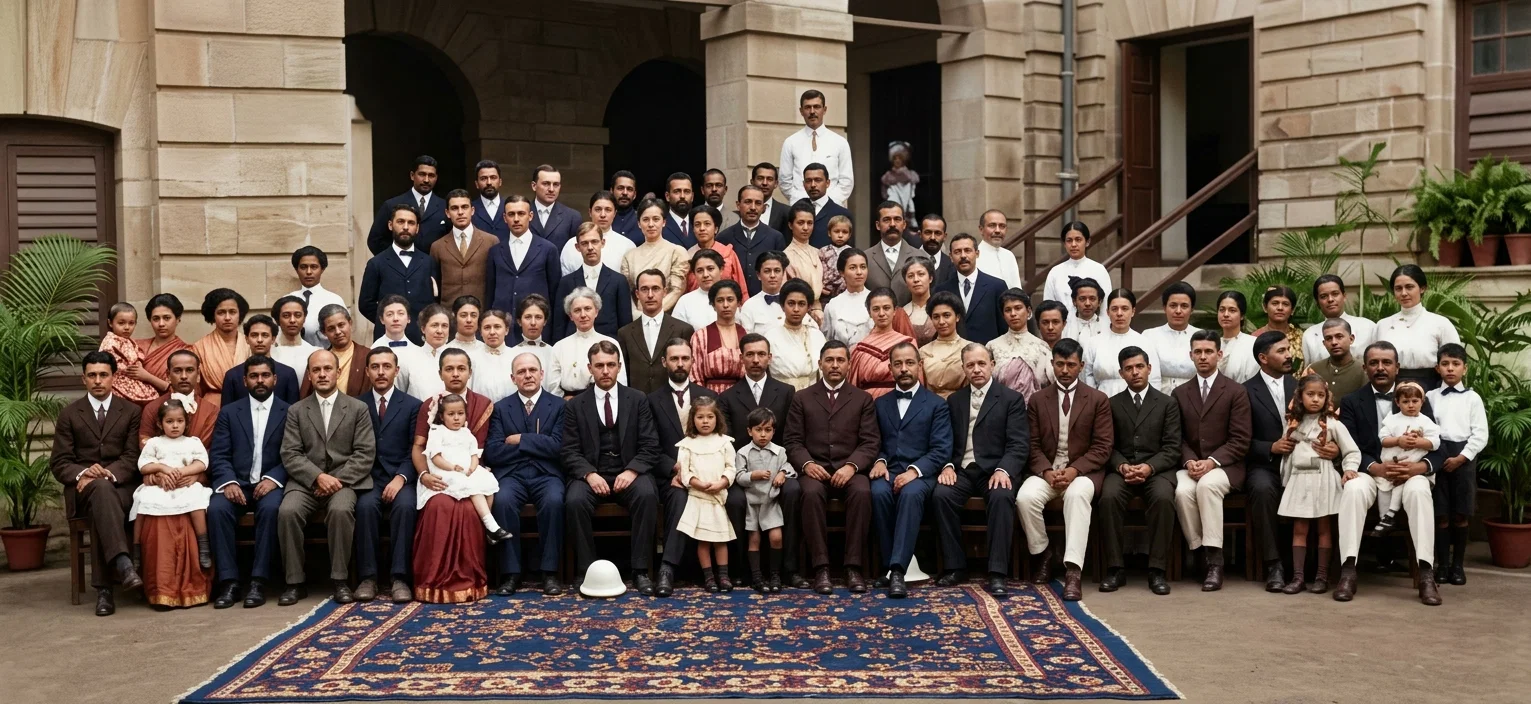
DELEGATES AND WORKERS IN ATTENDANCE AT THE INDIA UNION MISSION CONFERENCE
Some advancement was shown in evangelistic work, though in this we have been handicapped. Ministers and Bible workers have been mostly engaged in language study, so that less has been done in preaching the word by foreign workers both in English and in the vernacular. It was the feeling of the conference, however, that we have now reached the time to push forward the evangelical work more urgently than ever before. Workers sent out for English work began meetings in Calcutta before the conference, and a good interest was in progress. Professor Salisbury spoke one night on the Balkan crisis to a large audience in one of the theaters in the city. Reports of it went through the papers to various parts of India. Evangelical work in the vernacular has been in the past mostly dependent upon Indian workers, but henceforth European workers will be able to do more. The preaching of the word and the training of workers are surely the great concern of our mission force in India; and while giving of their means and sending their sons and daughters to this land of need, our people at home should pray that neither heat nor sun, heathen caste nor customs, may hinder their representatives in the mission field from the one great business of preaching the Word of God in the power of the Spirit.
The educational work showed some signs of growth. The fourteen village schools in operation have an enrolment of 615; these, with four boarding-schools having an enrolment of 243, make, in all, 858 pupils under our religious training.
The conference manifested its interest in the English school children of missionaries and English-speaking believers, and about six hundred dollars was pledged toward a fund for the erection of a dormitory and school building.
In the medical work, the treatment-rooms at Calcutta and Mussoorie and our different dispensaries revealed an increase of patronage. The treatment-rooms after paying all expenses showed a balance in their favor. It was the opinion of the conference that we have demonstrated that treatment-rooms can be carried on in a number of large cities and be entirely self-supporting. A resolution was passed favoring the opening of treatment-rooms in Rangoon, with the understanding that the treatment-rooms in Mussoorie and Calcutta donate their profits the coming year to that end.
The publishing work showed an encouraging growth. A property purchased, with additions made to it, has provided a permanent home for the International Tract Society. The English journals, the Oriental Watchman and the Herald of Health, have been enlarged and improved, and the circulation has more than trebled. Two vernacular journals, one in Tamil and the other in Burmese, started the past year, together with Juga Lakhyan, the Bengali journal; all show a growing circulation. In all, five journals are published by the International Tract Society of India, the combined circulation of which through the sale of canvassers is about twenty thousand each issue. It was also decided to137start two more journals in the vernacular, one in Urdu and the other in Hindi.
There has been a small gain in the tithe during the last two years. The tithe for the year ending October, 1912, was $6,677, or $1,501 more than for the year ending October, 1910. The Sabbath-school donations have also gained, and the number of Sabbath schools has nearly doubled.
The India Mission Field has been materially benefited by the donations which have come from the $300,000 Fund. Nearly thirty thousand dollars has been received. With this have been purchased ground and a building for the India Union Mission and International Tract Society; a church and school building at Tinnevelli, a mission bungalow at Meiktila, Burma; a mission property at Gopalganj, East Bengal; and a mission house and school and dispensary buildings have been erected at Karmatar. There still remains money for mission stations at Sahibabad, in north India, and at Kalyan, in west India.
Calls for consecrated workers come from different parts of the field. For the work already in hand it was voted to ask the Mission Board to send out two families for the work in Bengal, two canvassers for the circulation of English literature, a lady Bible worker, and two couples for treatment-room work. Looking out upon the many millions of other tongues among whom no effort has ever yet been made, the following resolution was passed:—
“Whereas, The Telugu people, numbering more than twenty million, have shown a readiness to respond to Christian effort beyond that of most other nations of India, and,—
“Whereas, There are seventeen million Punjabis without a representative of the third angel’s message, and among whom statistics show that during the last decade the percentage of increase of the Christian population has been greater than in any other language area, therefore,—
“We recommend, That work be opened next in these two language areas, and that we petition the Mission Board to send us two families each for this work.”
I have not seen our workers at a previous meeting return to their fields with better spirit and courage. The closing meetings were seasons of refreshment long to be remembered. J. L. SHAW.