Romanism, Protestantism, and the Threefold Message
W. W. PRESCOTT
THIS reading may be fittingly introduced by a paragraph which appeared in the Examiner (Baptist) of New York, and was quoted in the Christian Herald of Sept. 4, 1912. Its view of the present situation is thus set forth:—
“In America just now we are facing many peculiarly perplexing questions, and Rome—the same Rome that wanted to burn Martin Luther—is an element in the situation. It would be well, therefore, if every citizen were informed as to the mind and might of Rome. Although freed from the outward scandals and corruptions of Luther’s time, and curbed by the larger knowledge of our day, at heart it is the same Rome that Martin Luther faced with such uncompromising courage and audacity. It craves and demands mastery—absolute, unquestionable mastery. With its power and prestige tottering in the Old World, it is making a bold stand here in America. Its powerful hierarchy is demanding special recognition and special privileges, in defiance of American ideals and constitutional restrictions. We shall have to meet this demand. It is useless to try to evade it. In the light of the past, it is clear that we can not hope to escape it.”
Those who have for years looked forward to present conditions as being certain to come, ought now to recognize in them the fulfilment of prophecy, and to be thoroughly in earnest in giving the message due at this time.
Romanism, that ancient apostasy, is fiercely aggressive; apostate Protestantism is weak and compromising; it is not difficult to forecast the result.
The threefold message exposes the departure of both Romanism and Protestantism from the truth, and proclaims the original gospel to meet the need of the hour. It is the call to every believer in the message to do his utmost for its advancement.
Romanism is fiercely aggressive. A leading English Baptist clergyman, John Clifford, of London, wrote recently of “the invasion of Protestant lands by Rome in a spirit of fierce aggressiveness, resolute determination, infinite craft, rigid exclusiveness, and uncompromising intolerance. . . . The forces of Roman Catholicism,” he declared, “are now directed to the conversion of the Anglo-Saxon race. That is the goal of the policy of the Pope. With absolute devotion and splendid zeal, the leaders and representatives of Rome are dedicated to the capture of the progressive peoples. Enormous sacrifices are being made. Nothing is held back. No effort is too great. No expenditure of time and money is regarded as too costly to win the young men from their allegiance to Protestantism. The machinery of education is worked with sleepless vigilance. Superstition is welcomed. The arts of magic are employed to win the unreflecting, and a low morality follows in their track; for as Lecky says, ‘When credulity is inculcated as a virtue, falsehood will not long be stigmatized as a vice.’ It is an hour of special danger to the gospel of Jesus Christ, a menace to the spirituality and power of religion.”
The purpose of the Roman hierarchy “to make America Catholic” has been announced over and over again. A few statements to this effect made by Roman Catholics are appended:—
“The moment is ripe to build a Catholic America, broader and stronger, and nobler and truer, than any empire the world has yet seen, and strong men are now laying the foundations.”—The New World (Chicago), Oct. 21, 1905.19
“The church is making advances only in America. . . . The outlook across the water is very discouraging to any but those of the strongest faith. In the midst of the gloom, abandoned by those who should stand by him in his agony, the Holy Father appeals to this country for comfort and support. And he appeals not in vain. American shoulders are to-day holding up the Vatican. Its revenues are largely derived from this country; and what is now a steady stream will soon be an onflowing river.”—The Western Watchman (St. Louis), Oct. 29, 1908.
In an explanatory statement concerning missions to non-Catholics found in “The Mission Movement in America,” issued from the Catholic University of America at Washington, D. C., June, 1909, these words are found: “Our motto is, ‘We come not to conquer, but to win.’ Our purpose is to make America dominantly Catholic.”
“From a strategic point of view, America—the United States of America—is our best missionary field.”—“Church Extension and Convert Making,” by Rev. F. C. Kelley, president of the Church Extension Society, printed in the same pamphlet.
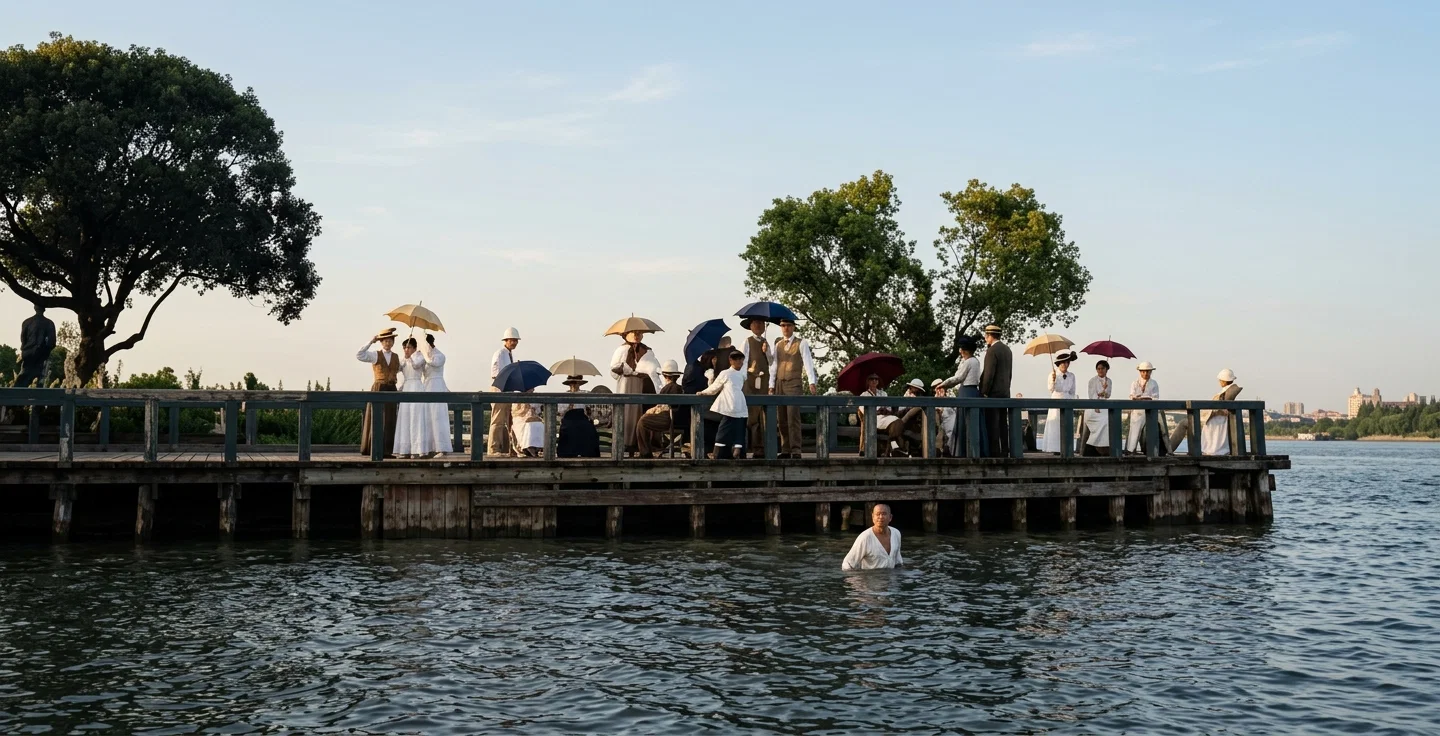
BAPTISMAL SCENE IN THE HWANGPU RIVER, SHANGHAI, CHINA
“If we put an end to this effort [to keep Protestantism alive] in England and the United States by making these nations predominantly Catholic, we will have removed the chief obstacle to the conversion of the whole world to the true faith. . . . A vigorous effort in the United States at this time will reduce the opposition to an insignificant condition. . . . In the course of another century, the [Protestant] sects will be a study for the historian and antiquary along with Arianism.”—Extract from a letter in the Missionary (Roman Catholic), Washington, D. C., May, 1910.
“It [the Catholic Extension Society] may in a quarter of a century prevail over all the other confessions combined; it may make of the United States, according to a dream that is no longer visionary, the first Catholic nation of the world.”—Abbé Feliz Klein, in “America of To-Morrow.”
“‘To make America Catholic,’ is the watchword of this general apostolate, on the part of religious and secular priests combined.”—The Missionary (Roman Catholic), October, 1911.
“Catholicism is in a fair way to conquer the United States. It is making extraordinary progress in that young, rich country, where the number of Catholics is daily increasing, and where a French priest cried, ‘In twenty years, more than one half of America will belong to the Catholic Church.’ . . . This may sound fanciful, but to-day New York is the strongest Catholic city in the world, and the United States has become the fourth Catholic power.”—Extract from a translation of an article in the French magazine La Revue, written by G. Saint-Aubin, appearing in the Boston Transcript of Jan. 7, 1911.
Archbishop John Bonzano, recently appointed papal delegate to the United States, when asked if Rome expected this nation ever to be Catholic, answered most positively in the affirmative, adding: “The time and manner are with God.”
Until recently the United States of America has been classed by the Roman hierarchy as a missionary country, and the affairs of the church in this country have been under the direct supervision of the Roman Catholic missionary society, the Society for the Propagation of the Faith; but by a decree dated June 29, 1909, this country was placed on the same footing as that occupied by the Catholic nations of Europe, and since that date the activities of the Roman hierarchy in the United States have greatly increased. The appointment of three additional American cardinals, the spectacular church functions attended by leading representatives of the government, the public celebrations of memorial masses, the great parades of Roman Catholic societies, and the many missions to non-Catholics,—all these testify to the increasing aggressiveness of the Roman hierarchy, and are indications of the determined purpose to carry out the announced program “to make America Catholic.” These are some of the proofs that Romanism in this country is fiercely aggressive.
Apostate Protestantism is weak and compromising. The results of the more or less wide acceptance of the principles of the new theology are now all too apparent. While there are many individual Protestants who regret a departure from the old standards, and who do not receive the modern views concerning the inspiration and authority of the Scriptures, and the consequent substitution of human philosophy for the revealed gospel, yet official Protestantism, as represented by the leaders in religious thought, has abandoned the old ground, has undermined the foundations of Christian belief, and has put forward a system of doctrine which a half-century ago would have been stigmatized as rank heresy.
SEVENTH-DAY ADVENTIST INDIAN SISTERS, RESCUED FROM THE DARKNESS OF CATHOLICISM, LAKE TITICACA MISSION, PERU
The following doctrines seem to have been explicitly or implicitly denied:—
1. The infallibility of the Scriptures as the rule of faith.
2. The essential deity of the Lord Jesus Christ, and his consequent headship over the church.
3. The virgin birth of our Lord, and the miraculous conception.
4. The death of Christ in place of the sinner, to meet the demands of the law, and to reconcile man to God.
5. The resurrection of our Lord from the grave.
6. The efficacy of the all-prevailing name of our Lord in prayer,—in fact, all phases of his priestly office, the sacrificial, the reconciling, and the intercessory.
7. The fall of man.
8. The Bible doctrine of sin.
9. Salvation by grace through faith in the Lord Jesus Christ as an atoning Saviour.
10. Regeneration by the power of the Holy Ghost.
11. Miracles as the direct manifestation and interposition of the supernatural.
That it may be clear that this picture of Protestantism is not overdrawn in the interest of private interpretation, the view of the matter taken by a Protestant clergyman and printed in a Protestant religious paper is herewith given:—
“Fifty years ago Protestant Christianity was so powerful and influential in the public life of America and in the public daily press that Christian doctrines and Christian sentiments were pervading in many ways the public thought and the collective life of this great nation.
“This Protestant influence exerted a controlling and uplifting effect upon the foreigner and even upon the Roman Catholic Church. . . .
“But to-day it is not so. Protestantism is being set aside in the public press and in public life. Look carefully through the best-known magazines and daily papers, and tell me, for instance, what were the denominational religious issues for the last year and for this year. Were they not Roman Catholic? . . . Is it not true that space is always given to the speeches and utterances of Cardinal Gibbons, Archbishop Ireland, Cardinal Farley, of New York, Cardinal O’Connell, of Boston, etc? And this space is granted to them in our most reliable magazines and papers. . . .
“Protestantism is no longer the uncompromising religious system of the Pilgrim Fathers. It is no longer the stern gospel affirmation of the Puritans. It is no longer the vivid and militant preaching of Luther, Calvin, and Knox. It is no longer the brave and burning teaching of Paul. . . . American Protestantism, I say, appears to-day a timid and compromising religious system, ready to be silent on fundamental doctrines20for the sake of peace and mutual tolerance. . . .”
“What will be the final result?—So far as I know the problem, the results will be the paralyzing more and more in public life of Protestant influence, the increase of Catholic influence, and the spread of socialism, anarchy, and unbelief.”
Having abandoned the original Protestant ground, and having, in harmony with the Roman Catholic principle, substituted creed and tradition for the inspired Word of God, Protestants find themselves to-day shorn of their power to resist the onward march of Rome. Having cast away the sword of the Spirit, they have no effective weapon with which to fight the battles of the Lord. Instead of being able to carry to its logical conclusion the Reformation of the sixteenth century, the descendants of the Reformers seem likely to compromise with Rome, and to join with them in the effort to bring in the kingdom of God through the gateway of politics.
The threefold message exposes the departure of both Romanism and Protestantism from the truth, and proclaims the original gospel to meet the need of the present hour. God makes no mistakes. He foresaw the condition of things in this last generation, and through his servants, the prophets, he outlined the situation and foretold the movement in which the final gospel message was to be proclaimed to call a people out of Babylon, and to prepare them for the second advent of Christ. In this movement the everlasting gospel is to be preached “to every nation, and kindred, and tongue, and people.” This is not a new gospel, but the old truths in a new setting, with a special emphasis upon such truths as have been hidden or discarded, and upon the development of gospel truth, and the whole presented in such a way as to meet the requirements of the present crisis.
Prominent in the teaching of this second advent movement is the warning against the worship of the beast and his image. When this warning is fully given, it sheds the light of prophecy upon both Romanism and apostate Protestantism; it makes clear their perversions of doctrine; it places in a clear light the mediatorial work of Christ as High Priest in the heavenly sanctuary; it restores to its proper place the law of God as originally spoken at Sinai; it emphasizes anew those doctrines that have been denied in the twofold apostasy; it announces to the world that the hour of God’s judgment is come, and it will make ready a people prepared for the Lord.
In the words of a recent writer, “the Roman Catholic Church, with its grievous perversions of Christian truth, does but exhibit in extreme form permanent tendencies of human nature.” To combat these tendencies, it is not sufficient merely to have a nominal connection with the movement which proclaims the warning against them. There must be a personal experience in that working of the grace of God in the heart which enables one to overcome evil with good, and to reveal a Christlike character in his own life. This personal experience on the part of each member of the Seventh-day Adventist Church is the foundation of all success in the movement to expose apostasy, and to establish the truth of God again in the hearts of the people. The present twofold apostasy of Romanism and Protestantism is therefore the most emphatic call to personal consecration, to a higher type of personal experience, and to a devotion of both money and effort to the proclamation of the threefold message.
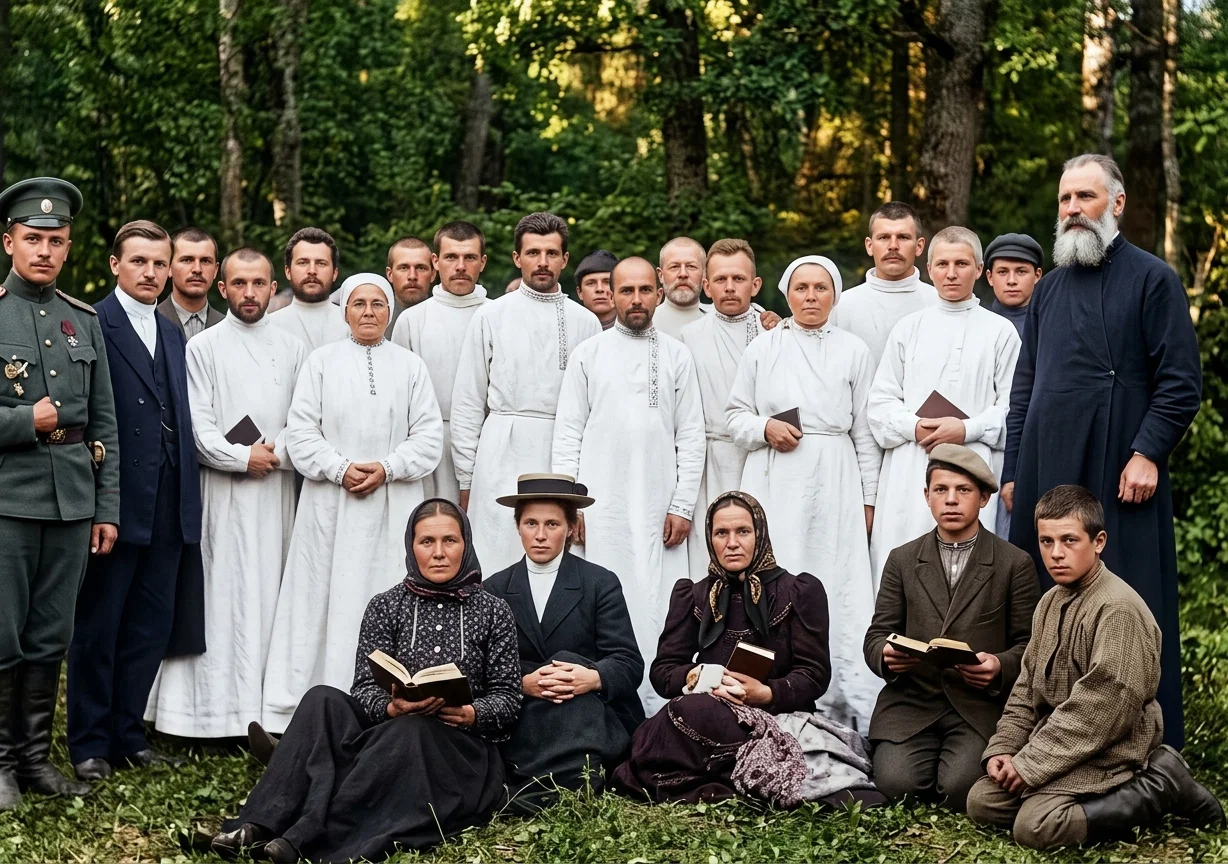
BAPTISMAL GROUP IN A RUSSIAN FOREST. ELDER O. WILDGRUBE AT RIGHT, WHO WAS ARRESTED, CHARGED WITH SPEAKING AGAINST THE STATE CHURCH
Those who respond to such a call as this will find blessing in their own experience, and will be used of God in proclaiming his last message to the ends of the earth, that an end may be speedily brought to the reign of sin, and that the announcement made by the voices in heaven, under the sounding of the seventh angel, may be fully realized in the earth: “The kingdom of this world is become the kingdom of our Lord, and of his Christ: and he shall reign forever and ever.” May this grand consummation be speedily brought about.