A Converted Battle-Field

8%

Review and Herald Publishing Association · Takoma Park Station, Washington, D. C. · Oct 10, 1912

FromReview and Herald, Vol. 89, No. 41.

Read the full edition

A Converted Battle-Field

HERBERT J. EDMED
The onward march of the third angel's message is the one theme of interest which this world offers to Seventh-day Adventists. The rainbow that John saw (Rev. 10:1) casting its varied hues around the angel's head was not without meaning, and its interpretation is read to-day in the faithfulness of a covenant-keeping God who is causing the words of the “little book,” like the sun, to flash and reflect their light so that “there is no speech nor language, where their voice is not heard.” True, the feet of the messengers must tread the path of trial. Yet there is no faltering nor uncertainty in their step. In the fire they are made “pillars” of deep spiritual strength, and nothing thwarts the purpose of those who to-day are whole-hearted in God's work.
Ladysmith is the third largest town in the colony of Natal. For many years its strength lay in its railway workshops, but in the meanwhile the surrounding country has developed into one of the richest farming districts of South Africa. This little town became famous in history during the conflict between the British and the Boers in the years 1899 and 1900, having been besieged by the Boers, and ably defended by a small untrained force within, until relieved by British forces under Buller. From Waggon Hill the Boer guns poured in a continual stream of shell, and the damaged buildings may still be seen, many having been preserved to remind the visitor of the fierceness of the struggle.
Eighteen miles from the city is a mountain called Spion Kop. It was here that the deadliest battle was fought, on Jan.24, 1900. Up to that time this beautiful mountain had been held as a Boer stronghold. On the southwestern side there are beautiful, but precipitous slopes, while at the back of the mountain there is a wide plateau which slopes gradually toward the town. On this plateau the Boers were strongly entrenched. The British general gave command to seize the hill from the precipitous side, with the result that his forces were mowed down like the wheat of the field. However, the hill was finally captured by the British, and to-day the boundaries of the farm of which the mountain forms a part are marked by monuments that have been erected in memory of the British soldiers who were willing to spill their blood for the glory of their king. What an example of fidelity to the children of God, the soldiers of the King of kings!
But this historic place had then only begun to lay the foundations of its fame.
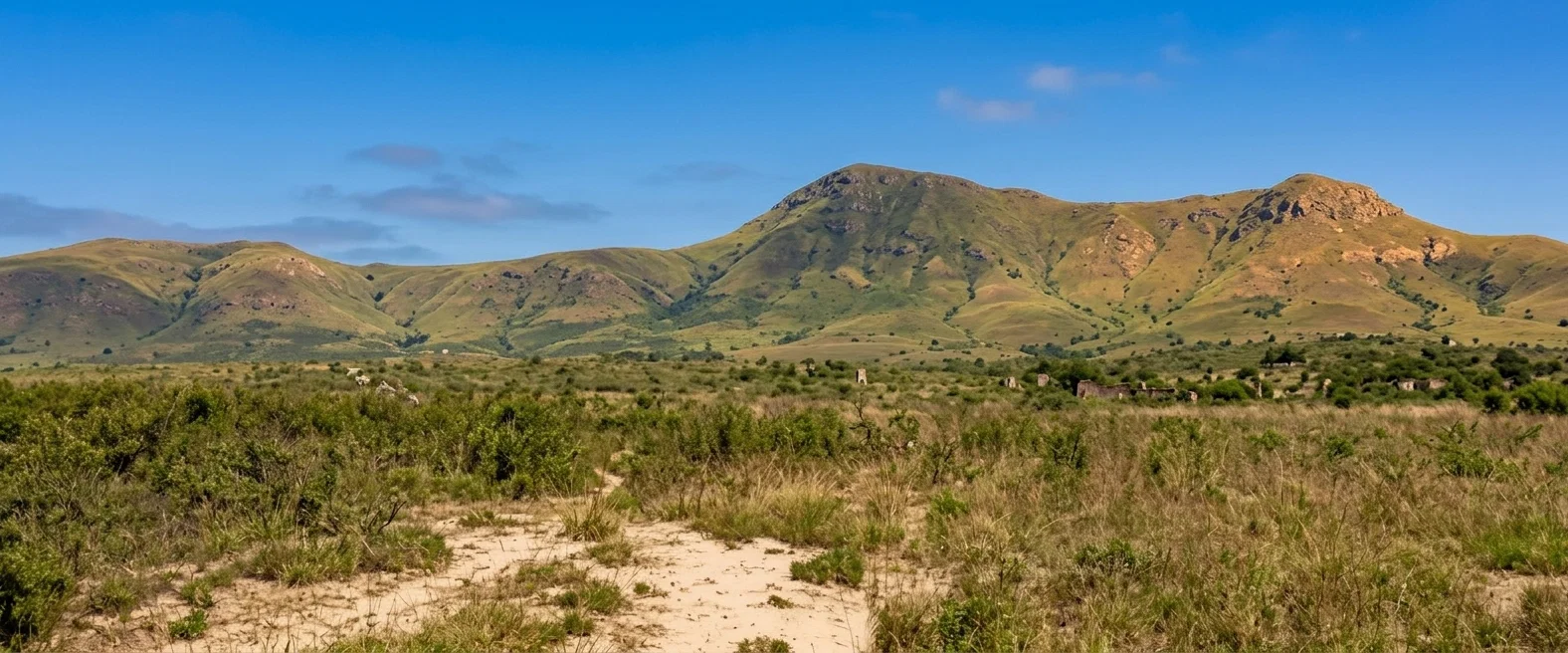
SPION KOP, A SOUTH AFRICAN BATTLE-FIELD, NOW A SEVENTH-DAY ADVENTIST ZULU MISSION FARM
The providence of God had destined that a still more glorious and triumphant battle should be fought on the slopes of that mountain; and by a series of circumstances in which we see God's hand, that mountain, with its blood-stained slopes and with its monuments to the dead, has passed into the hands of Seventh-day Adventists, who have purchased the two thousand two hundred acres of which it is composed, for the purpose of establishing a mission for the Zulu race in Natal.
The circumstances, in brief, were these: Elder F. B. Armitage for two years had patiently traversed the country, seeking for a suitable farm for this mission. In the meantime a company of Zulus accepted the truth, thus forming the nucleus of a school for teachers, among whom is Jeremiah, a faithful and devoted believer in the message, as well as a capable preacher.
But while natives were accepting the truth, there seemed to be no suitable place on which to locate the new mission. The last time I saw Brother Armitage before this site was purchased, he seemed much depressed and disappointed. But he little knew how God was working things out for him. At that very time a canvasser, Brother van der Molen, had been out toward Spion Kop selling the book 'Patriarchs and Prophets.' A copy was purchased by Mr. Stockill, who, with his family, soon embraced the truth.
To Brother Stockill's farm Brother Armitage was led, and while there, learned of the possibility of buying Spion Kop. His spirits rose higher and higher, and his faith deepened and broadened, until he grasped the idea that God was pointing us to this battle-field. Pacing the land, he found that with the beautiful historic mountain at the back, good for sentiment, the slopes were bounded by the great Tugela River for about three and one-half miles—good for utility. All the slopes of the farm are capable of cultivation, and along the river, about forty rods wide, is a belt of the finest alluvial soil. Here was an asset that, if placed in wise hands, would promise self-support from the first year. The only question was, Would the brethren consent to the purchase? In a few days Elder W. S. Hyatt (in the absence of Elder R. C. Porter) and I accompanied Brethren Armitage and Stockill to the farm, and decided—subject to the consent of the union conference committee—to make the purchase.
The accompanying picture gives some idea of the entire property, which is one of the finest in the district. There are several springs on the place, and an abundant supply of water. The white path to the left shows the location of the future mission home. The promise of God gives us faith that prosperity will attend Brother Armitage in his work with the Zulus, and that our people will send in their offerings to help speed on this glorious work, so soon to be consummated in victories far more reasonable, glorious, and triumphant than the victory of Spion Kop.