On April 16, during the consideration of the Post-office Appropriation Bill (H. R. 21279) in the Committee of the Whole House on the State of the Union, Representative Mann, of Illinois, introduced the following amendment to the bill:—
“Provided, that hereafter post-offices shall not be opened on Sunday for the purpose of delivering mail to the public.”
In the previous session of the present Congress, Mr. Mann introduced a measure (H. R. 9433) that had for its object the closing of the post-offices on Sunday. This measure was referred to the Committee on Post-offices and Post-roads. The committee evidently did not intend to consider the bill, for no hearing was announced.
The discussion that took place on the above-mentioned date is of interest, so we take the following excerpts from the Congressional Record of April 16. Speaking to an amendment to Mr. Mann’s amendment, Mr. Fowler said:—
Discussion in the House
“Mr. Chairman, I desire to say that I have as great reverence for Sunday, the day commonly known as the Lord’s day, as any man. We are commanded to keep it sacred as a day of rest and spiritual worship. I believe all men should heed this divine injunction; but to close up the post-offices throughout the country all day on Sunday, and deprive the public from getting the Saturday and Sunday mail, in my judgment, is a very unwise provision. Nine tenths of the laboring people of this country are so employed during the week in making a living for themselves and their families that they do not have time to get their mail and read it until Saturday night and Sunday. If they are deprived of the privilege of getting it on Sunday, it will work a hardship upon them of doubtful propriety, which I do not believe this House can afford to indorse. The rights of the people in the country are just as sacred to them as are the rights of those living in populous cities. In the rural districts the daily papers in many instances come through the post-offices and are delivered on Sunday. Now, if the post-office should be closed on Sunday, these people would not have an opportunity to read them until Monday. The same logic that closes the post-office on Sunday, would close the telephone and telegraph offices of the land on Sunday. We all know that the news is as eagerly sought on Sunday as it is on any other day. It is sought by the layman in the cross-road districts the same as it is by the politician or the professional aristocrat in the most populous district of the country, and to close the mails all day on Sunday so that the public can not have access to these avenues of ordinary information and intelligence, in my opinion, is very unwise. I would have no objection, Mr. Chairman, to closing the mails the greater part of Sunday, and I grant that they ought to be closed for the purpose of giving the people an opportunity to attend Sunday-school and church, places where everybody ought to have the privilege of going on Sunday; but I grant, Mr. Chairman, that to take away from the public the right to get the newspapers on Sunday morning, and get the other mail that is important to the individual and often to the public, is, in my judgment, a very unwise course to pursue.”
“Mr. Tribble: Will the gentleman yield for a question?”
“Mr. Fowler: In just a moment. I have had a contest in my district upon that proposition recently (laughter and applause)—
“Mr. Kendall: We can not legislate for the gentleman’s district.”
The Common People Affected
“Mr. Fowler: I do not want you to legislate for me. I want you to legislate for the American people of this republic. (Applause.) Mr. Chairman, I say I have had a contest of the strength of the common people on the question of Sunday closing in one of the towns in my district recently, in which an order had been given by the First Assistant Postmaster-General to close the post-office entirely on Sunday. A petition was circulated requesting the office to be kept open, and 191 business men and citizens of that little town signed that petition to have the post-office open for one hour on Sunday. . . . The postmaster circulated a remonstrance to this petition, and he secured only 26 names. I want to say to you, gentlemen, that if you put that question to the common people of this country, I have no doubt but that the result will be in the ratio 191 to 26. The people are not dreaming now, and can not be fooled. They well know that the price of liberty is eternal vigilance. They are self-armed ‘as a strong man to run a race’. . . .”
“Mr. Powers: If I understand it, this closing of the mails on Sunday applies to all the different classes of post-offices throughout the country?”
“Mr. Fowler: I so understand it.”
“Mr. Powers: The first, second, third, and fourth classes?”
“Mr. Fowler: All of them.”
“Mr. Powers: And, if strictly construed, would apply to locking the doors so that the men who have boxes could not get to their mail?”
“Mr. Fowler: I so understand it. I17now desire to yield to the gentleman from Missouri (Mr. Dyer).”
“Mr. Dyer: As I understand the gentleman, he said that this change in the bill would strike at the common people. I want the gentleman to state who are the common people in this country.”
“Mr. Fowler: The common people of this country are the 90,000,000 people of this country. . . .”
“Mr. Fowler: Mr. Chairman, so far as I am individually concerned, if I wanted to be selfish for my own district, I would agree to that proposition, because there is not a first-class post-office in my district. They are second, third, and fourth classes. But I want to be fair to the people in this republic in whatever legislation I may take part. And, Mr. Chairman and gentlemen, I trust that in the wisdom of this House you will pass my amendment, and not close the door of the post-office to every man, woman, and child in this country on Sunday. (Applause.) . . .”
“Mr. Mann: Mr. Chairman, I know by personal experience that one can get along all right without Sunday mail. I believe that the House will agree that I do my fair share of work in the House, but for years I have declined to receive or open mail on Sunday (applause), not from a religious standpoint, but because I thought there was one day in the week when I was entitled to be free from any requests coming through the mail. (Applause.) If I could have my way about it, I would take my way on Sunday where no one could reach me with any kind of request, and that which I would do for myself, I would do for the employees of the Post-office Department.”
“Mr. Mondell: Mr. Chairman, will the gentleman yield?”
“Mr. Mann: You can not open the post-office for delivery of mail to the public without requiring the presence of the employees of the office, not merely for one hour, but for many hours. I can see no reason why they should not have an opportunity to rest, and I can see no reason why delivery of mail should be made on Sunday any more than why dry-goods stores should keep open to sell calico on Sunday. Now I will yield to the gentleman from Wyoming.”
“Mr. Mondell: I just came into the chamber, and perhaps I am laboring under a misunderstanding. The gentleman referred to the mail delivery, as I understand it, which involves the keeping of the post-office open?”
“Mr. Mann: The amendment, which has already been agreed to, provides that post-offices shall not be kept open on Sunday for the purpose of delivering mail to the public.”
Sunday Newspapers
“Mr. Mondell: The gentleman says he does not answer or receive letters on Sunday. Does he read the Sunday newspapers?”
“Mr. Mann: Well, I do not see what that has to do with the question.”
“Mr. Mondell: In all the country towns the people receive their newspapers through the post-office.”
“Mr. Mann: In very few country towns do the people receive their papers on Sunday. They have their Sunday papers delivered. They do not do it in the gentleman’s town. I know how papers are received in the country.”
“Mr. Mondell: I know how I receive my papers better than the gentleman from Illinois does, and I know I receive them in the post-office in wrappers.”
“Mr. Mann: If the gentleman receives his Sunday papers wrapped up, he had better wait until Monday to read them. Then he can not read the Sunday papers on Sunday in that way, I take it.”
“Mr. Mondell: We have no Sunday daily in our town.”
“Mr. Mann: Why do you not force them to publish a Sunday daily? They have not a Sunday daily there, but you want to force the post-office to keep open on Sunday so that you can read the Sunday papers published elsewhere.”
“Mr. Mondell: The gentleman lives in Illinois, and he does not care what the people in the country suffer from.”
“Mr. Mann: I admit with a certain degree of shame that I do more or less read the Sunday papers, and I know I would be better off if I did not. (Laughter and applause.) . . .”
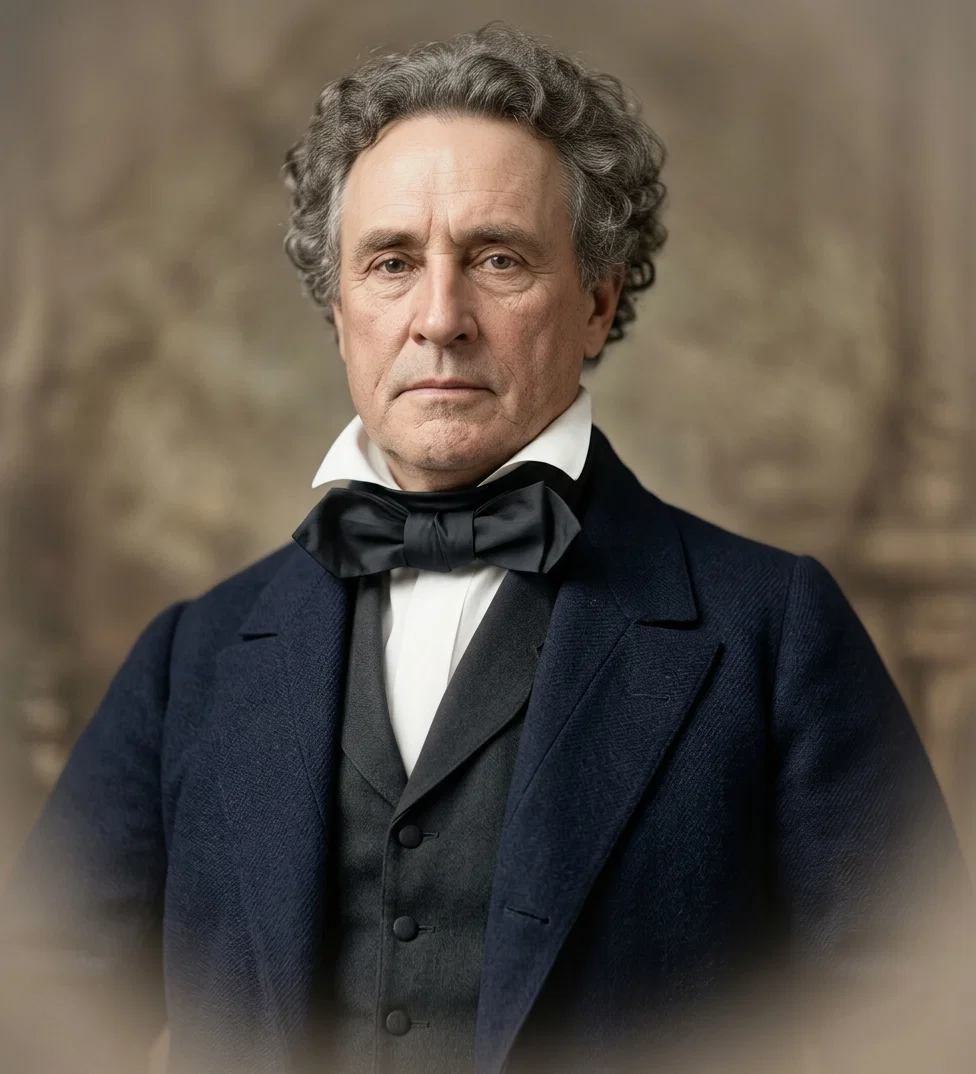
COL. RICHARD M. JOHNSON
“Mr. Fowler: I believe my colleague says he reads the newspapers on Sunday?”
“Mr. Mann: To a certain extent.”
“Mr. Fowler: Does the gentleman want to deprive the people in the country of the same right he claims for himself?”
“Mr. Mann: I wish somebody would deprive me of the chance of seeing any paper on Sunday.”
“Mr. Butler: We will put an amendment in the bill.”
“Mr. Mann: I will not raise any point of order against it. I am unwilling that the post-office employees should be kept at work on Sunday in order that somebody may have a Sunday newspaper, and every one knows that the bulk of the Sunday newspapers does not go through the post-offices.”
“Mr. Fowler: I desire to ask the gentleman, further, if he has not the power within himself to restrain himself from reading the Sunday papers?”
“Mr. Mann: Well, I will say to the gentleman that in the main I do restrain myself on Sunday. I think I have not read a Sunday paper through in five years.”
“Mr. Berger: No one ever did.”
“Mr. Fowler: Does the gentleman know of any man who has read a Sunday paper through in five years or ten years?”
“Mr. Mann: I have no doubt my colleague has.”
“Mr. Fowler: I have never read one through in my life.”
“Mr. Mann: Then my colleague ought not to be so anxious to give other people the opportunity to do it.”
“Mr. Fowler: I select what I want to read.”
“Mr. Mann: How can you tell until you see it?”
“Mr. Fowler: Aye, there’s the rub. I want every man to have an opportunity to tell by seeing.”
The Principles Involved
It is unfortunate that opposition to Mr. Mann’s amendment does not proceed entirely upon the principles involved in that kind of legislation. It may be shown very clearly that Sunday legislation is religious legislation. The early Congresses of this nation held that compulsory observance of Sunday by act of Congress was contrary to the spirit and letter of the Constitution, and antagonistic to the fundamental principles upon which this government was founded; namely, the total separation of church and state. Said the Twentieth Congress, on Jan. 19, 1829:—
“Under the present regulations of the Post-office Department, the rights of conscience are not invaded. Every agent enters voluntarily, and it is presumed conscientiously, into the discharge of his duties, without intermeddling with the conscience of another. Post-offices are so regulated that but a small proportion of the first day of the week is required to be occupied in official business. . . . Religious persons enter into the business without violating their own conscience or imposing any restraints upon others. While the mail is transported on Saturday, the Jew and the Sabbatarian may abstain from any agency in carrying it, on conscientious scruples. While it is transported on the first day of the week, another class may abstain, from the same religious scruples. The obligation of government is the same on both these classes; and the committee can discover no principle on which the claims of one should be more respected than those of the other.”
A little investigation will convince a reasonable mind that, inasmuch as the general Post-office Department is encouraging by its own regulation the closing of post-offices to the public on Sunday, legislation by Congress seems unnecessary. Behind this whole movement is the design to commit Congress to the enactment of Sunday laws.
The bill above referred to will have to pass the House, then be sent to the Senate and considered there, before it can be enacted into law. The Appropriation Bill, of course, will pass, for it is necessary to make provision for the post-office service for the next fiscal year, ending June 30, 1913. In the meantime, all who believe that the principles of religious liberty should be perpetuated in this country, should write at once to the congressmen from their respective districts, protesting against the enactment of the proposed law with the amendment incorporated in the same.