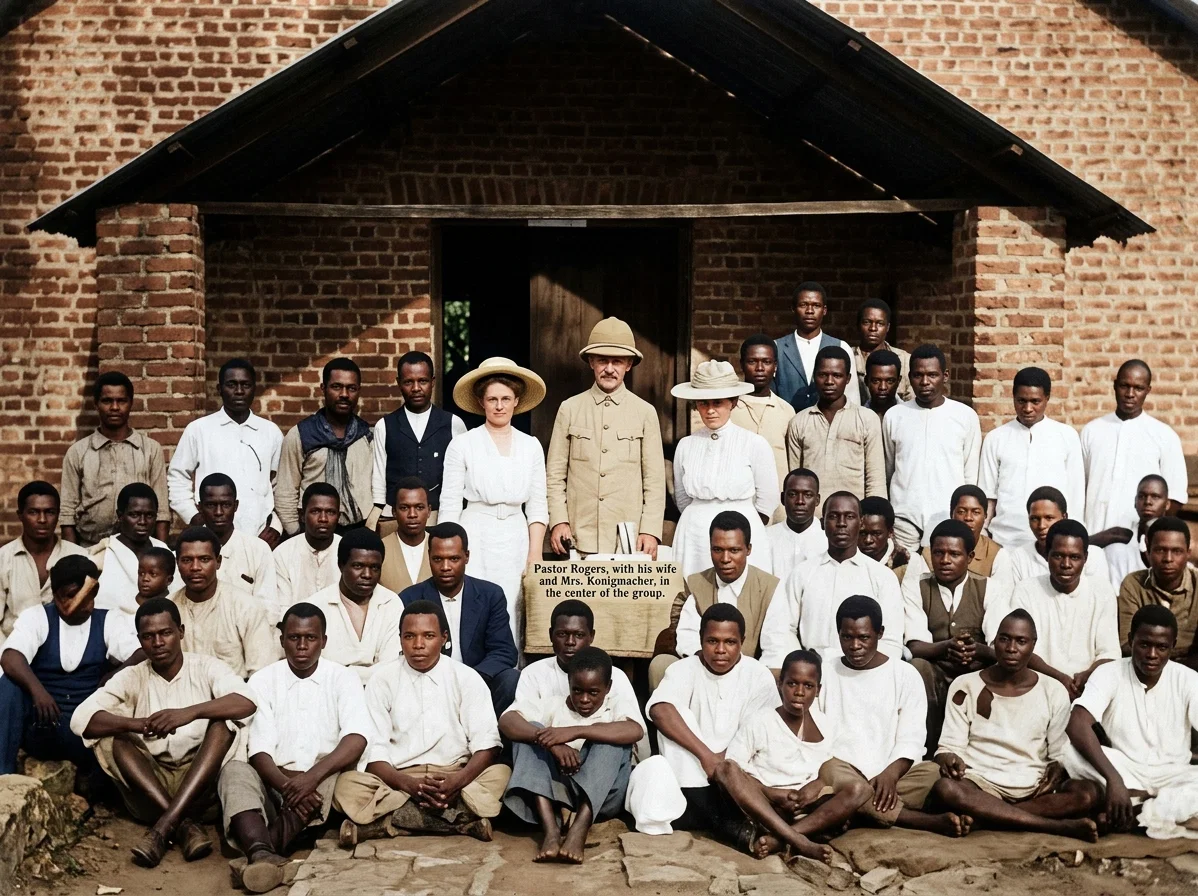
Our Nyassa Training-School

6%

Review and Herald Publishing Association · Takoma Park Station, Washington, D.C. · Apr 18, 1912

FromReview and Herald, Vol. 89, No. 16.

Read the full edition

Our Nyassa Training-School

In our Nyassa mission we are trying to strengthen constantly the educational feature of our work. We realize that our hope of getting this message into the hearts of the masses of Africa will depend largely upon our success in training native evangelist-teachers. I believe our people in America will be glad to hear how we are doing this.
From our school at the main station we find a few each year who are capable of joining our teaching force. Some of these two hundred students come from distant parts of the country. They have heard about the school from friends, and come to give us a trial. Others come from our own village schools, of which we now have about forty around our main station and our principal out-station.
The main station’s training-school is made up of several divisions: First, the beginners, consisting of children coming from the villages on the mission land and those near by. In this school we enroll about one hundred each year. The work is carried on in an outbuilding, which is simply made of grass and poles, with a brick floor, and rough board seats. Only the native language is taught, by four or five native teachers, with one of our European laborers to oversee them. In this, as in all our village schools, simple Bible lessons are given from outlines prepared at the mission. We have no printed lessons nor text-books except the Bible. We find that we can not use the same text-books as in our American schools, as our lessons must be of the very simplest nature, each covering perhaps only five or six verses. We have reading-books in the native language, which we purchase from other missions, and the lessons in arithmetic are copied on the blackboard from a teacher’s text-book. The individual student has no text-book in arithmetic.
The second part is called the English Vernacular School. In this we teach English up to second-grade work, and drill the students constantly in advanced reading in the native tongue. We try to keep them on their own language as long as possible. These natives will sometimes tell us that they know it, and do not need to study it any more. They think they must take up the English, and all of them are very anxious for it. No doubt some of them come to us with the selfish motive of merely learning it. However, we discourage this as much as possible.
Most of our text-books in this division are also obtained from the other missions. We have just published a new book of our own, which is a simple story of the Old Testament record up to the deliverance of the Israelites from Egypt. This will be a great help to us. It is printed only in the Chinyanja language, but we shall use it in all divisions of our schools.

[[FIGURE]]

The teaching in the English Vernacular School is done mostly by our advanced teachers with one of our mission staff always present. Mrs. Rogers has had charge of this division, and has given her best attention to it. Here we train our young men. After finishing in it, they are ready to go out as village-school teachers. Our many village schools and our vernacular station school give us a good opportunity to employ young teachers as fast as they are ready. Of course, only a small part of the whole number become teachers. But up to the present time we have been able to employ all whom we could train.
The two divisions which I have described have their sessions in the forenoon.
We also have another, which we may call the English Bible School, occupying the afternoon period. This is made up principally of the native teachers who are engaged in the village work and in the station schools which I have mentioned. Besides these, there are some older men, who work in the forenoon and attend the classes in the afternoon. Some of these married men also become teachers. Many of our village schools are too far from the main station for the instructor to go and return every day. For those we always try to provide a married native who goes to live at the school.
In the school held in the afternoon we have classes in the second, third, and fourth grades. All the teaching here is done by members of our European staff. The Bible is made a prominent study, including lessons in Old Testament history, New Testament, the prophecies, and the Revelation. Before sending out any native teacher, we try to give him a thorough understanding of the simple Bible doctrines, especially the third angel’s message. We endeavor to keep before him the desirability of going on learning more and more of the Bible.
Our natives take a special interest in such study, and we are often surprised at their efficiency in presenting our doctrines. They seem to have an intelligent grasp of the message, and are always able to find plenty of texts for their arguments.
Besides the training which our teachers are given in the divisions mentioned, we give them from one to three months for special study at the main station. For the past few years this special school has had a session of only one a month; but we have felt that they need a more thorough training, and this year we have arranged for a three months’ teachers’ school. This session began February 1 and will continue to the end of April, when all will go out and open their village schools May 1. While Mrs. Rogers and I are away from the station on furlough, Brethren C. Robinson, S. M. Konigmacher, and G. A. Ellingworth are in charge of the training-school. Last year we had about fifty enrolled, and it is probable that there are seventy-five this year.
At our out-station called Mantandane, Brother and Sister Konigmacher have for four years been doing a work similar to that of the main station, so far as the circumstances admit. Our plan is to have most of the teachers trained at the main station, as we have a larger staff there and better facilities.
The industrial feature is also made prominent. All the food supplies of the main station are grown on the farm. This requires cultivation of about one hundred acres, which are planted with Indian corn, sweet potatoes, peanuts, and beans. All students do from three to four hours’ work each day. We also have a good dairy at the mission, and are able to pay a small wage to those who help in it. There are always some boys who must earn a little money to help their parents pay taxes, buy clothing, etc. Our dairy has an income of from fifty to one hundred dollars a month, and is the best in Nyassaland. We also cultivate some cotton and rubber. About twenty acres have been planted to rubber, and it is our plan to go on increasingthis crop as we are able, hoping to obtain a good income from it a little later.
With these various divisions of the station school, and the industries, we are all kept busy from morning till night. For the last three years we have generally had four European laborers, and more could find employment. We have not been able to do very much for the women and girls of the villages. Our woman is needed to give her whole time to this work, and we hope that soon the Mission Board will be able to provide some one suitable for this. We also hope that at least one new station can be opened in Nyassaland the present year.
J. C. ROGERS.
THE NYASSA TRAINING-SCHOOL.