Little Russia

8%

Review and Herald Publishing Association · Takoma Park Station, Washington, D. C. · Sep 28, 1911

FromReview and Herald, Vol. 88, No. 39.

Read the full edition

Little Russia

JOHN PERK
THANKS be to our Heavenly Father for the blessings we have enjoyed during the last two years in the Little Russian field, which consists of five large governments, and lies near to the heart of Russia. It has a population of about sixteen millions, most of whom are Germans, Poles, and Jews. The nickname for Little Russia is, in the language of the people, “Chohol,” which means “many-haired.” In literature the Little Russian is known as the “boundary inhabitant.” The language is Low Russian.
As far as education is concerned, most of the people can neither read nor write. They have literature in their own language, but it is very rarely read by them. The people are, nevertheless, very hospitable, and are simple in their dress. They make their clothes themselves, of hemp and wool. More attention is being given now to schooling. The soil and the climate are well suited to agricultural pursuits. The chief industry is, therefore, the cultivation of the land, special attention being given to the raising of beets. On the Russian market alone over sixteen million dollars’ worth of beet-sugar is sold. The region is also well wooded.
In the Little Russian field is the town of Kief, where the Russian empire was founded, and where, also through Vladimir, the religion of the Greek Catholic Church was adopted. For this reason Kief is called the mother town of Russia. About two hundred years ago, a kind of mausoleum was built by a priestnamed Antonie. In it are two subterranean passages, with about eighty open coffins, covered with red cloth, containing dead men’s bones. Such mausoleums as this are places of honor for the bones of the saints, and many thousands make pilgrimages to them, in order to worship and kiss the remains of their saints, thus looking for life among the dead. Kief, with its twenty churches, is called the Jerusalem of Russia.
The railway service is very poor, and one can reach most of the small towns only by wagon, and even the important city of Tobolsk has no railway as yet. However, many lines are now under process of construction.
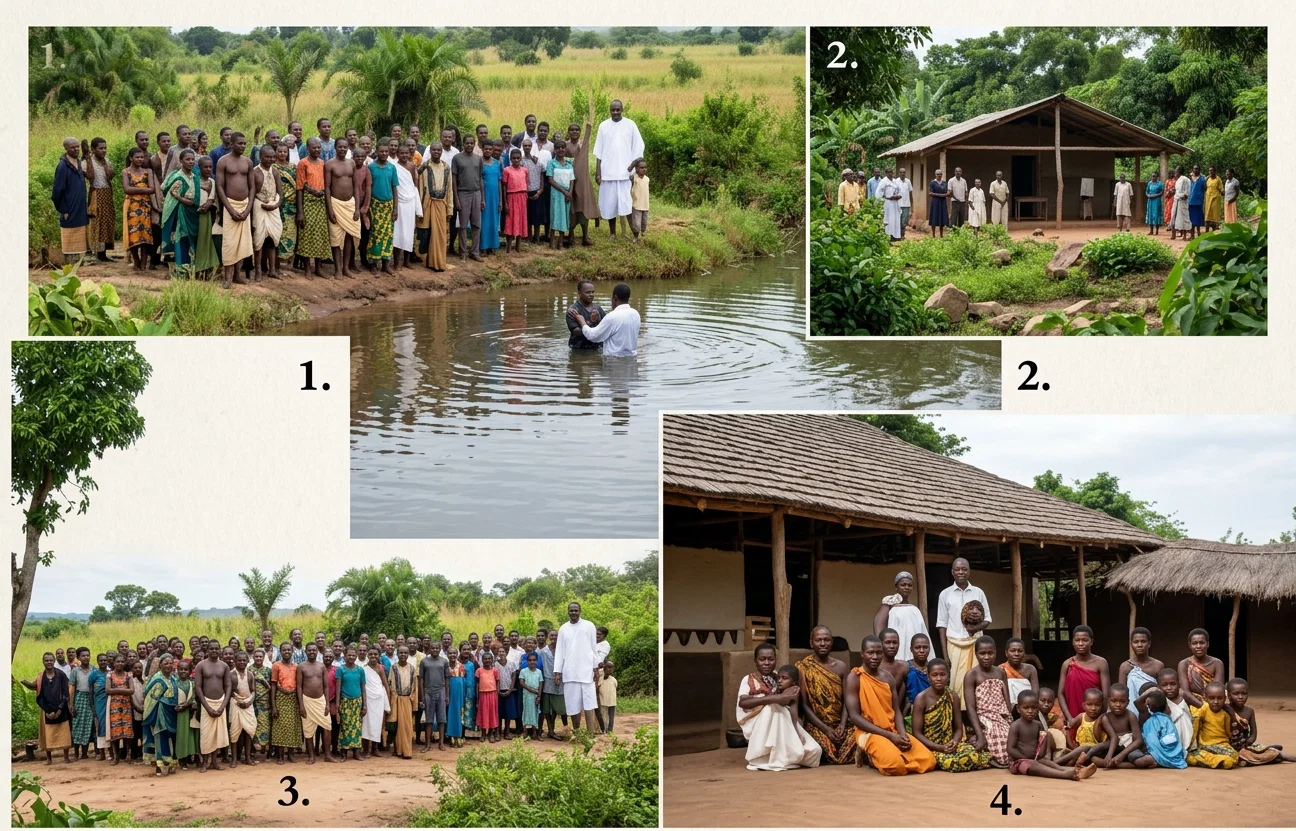
1. BAPTISM OF TWENTY-SIX CONVERTS AT AN OUT-SCHOOL.
2. PETER NYAMBO'S NEW OUT-SCHOOL.
3. CHIEF PROVERA AND FAMILY, SABBATH-KEEPERS.
  1. BAPTISM OF TWENTY-SIX CONVERTS AT AN OUT-SCHOOL.
  2. PETER NYAMBO'S NEW OUT-SCHOOL.
  3. CHIEF PROVERA AND FAMILY, SABBATH-KEEPERS.
The work in the Little Russian field was started in 1909; that is to say, it was then separated from the Middle Russian field. It then had 250 members, divided among ten companies, most of which are located in the Kief government. At that time, the call of the Lord came to me to work in this field. With one ordained minister and three Bible workers, we looked trustingly through many difficulties into the future. Instead of getting more workers, we lost one Bible worker, Brother Pilkewilsch, who was sentenced to two years’ imprisonment,—one year and five months of which he has already served,—on the charge of having offended the saints. Our licentiate Brother Prowalowsky, was also deprived of his freedom for some time, so that the number of our workers was very small indeed. Later, thanks be to God, we received a substitute, so that we now have two ordained ministers and two licentiates.
It is deeply to be lamented that we have no canvassers. We gave the work a trial, and found that it was very difficult to get permission to sell books. Our solicitation was often rejected without cause. And then the Russians do not purchase very readily, for, as already mentioned, most of them can not read, and colporteurs are looked upon with suspicion. The priest soon learns of the proximity of a canvasser and makes it his business to see that the police get the canvasser into trouble. We hardly dare, therefore, to send out colporteurs. In most cases, seed is sown in the following manner: Church-members begin to speak to the people about the truth, which often arouses the whole neighborhood, and thus the way is opened for the worker. We can show, however, as the result of tract society work, a sale of 450 rubles’ worth of literature, and are in hopes of soon being able to send our canvassers into the different towns.
Two hundred fifty members were taken into the church by baptism during the last two years. We have lost some by removal, death, and apostasy. Ten new churches have been organized recently, making the number of churches and companies twenty, and the membership 514.
The majority of our people are poor. Several had their property valued, and sold a tenth in order to pay their honest tithe, and these are much happier than those who have not yet done so.
O that it were possible for us to send out more workers! I receive invitations daily to give the people more light, but it is impossible for me to answer all the calls. A whole government is untouched by the workers of the third angel’s message. From other places we hear of people who have not yet been visited, but who have begun to keep the Sabbath. We are convinced that God will give success to his faithful workers.