Among the Aymara Indians

5%

Review and Herald Publishing Association · Takoma Park Station, Washington, D. C. · Apr 27, 1911

FromReview and Herald, Vol. 88, No. 17.

Read the full edition

Among the Aymara Indians

F. A. STAHL
“Thirty more ready for baptism!” With these words I was greeted by the Indian brethren at Chucuito, Peru, just four months after the visit reported in the Review of December 29.
I found that this good news was true.
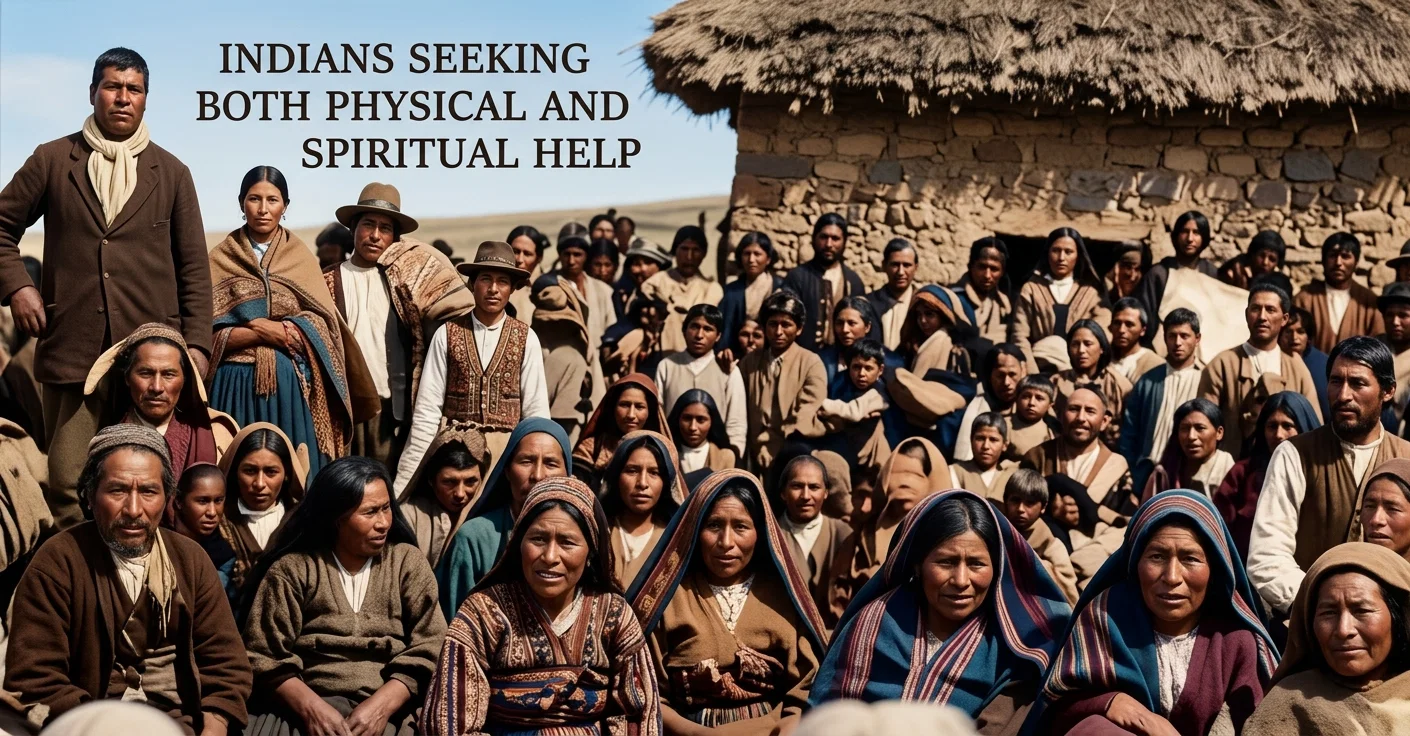
Photo by F. A. Stahl
Thirty more have put off Catholic darkness and are walking in the light of present truth. Thirty more meet around the family altar every morning and evening, and on the true Sabbath day worship the Lord. How these things inspire one to make greater sacrifices, and endure with patience and joy the hardships that come in the way!
The priest of Chucuito had threatened to kill me if I returned; but on my return I found that he had been removed, and that the fifteen young men who were arrested for meeting us with flags on our former visit had been released, and the authorities punished for arresting them. All this greatly strengthened the faith of these people.
Among the first to greet me were some whom the Lord had restored to health during our first visit. I found many more awaiting treatment and instruction. Besides those who came to Brother Comacho’s home for help, I received many calls to visit the sick at the homes of the people. This work and the meetings kept me very busy.
Among those who called for aid were three shepherds living on the farm of a priest, far out upon the mountains, eighteen thousand feet above the level of the sea. They brought the priest’s best horses for my use. This priest is an enemy to us and to the truth, but he was powerless to refuse these people medical attention, or the use of his horses for this purpose. When I came to the homes of these people I found, instead of one sick person, five or ten others brought in from a distance. After attending the sick, the people would call for a meeting. They never tire of hearing that Jesus is soon coming.
At one of these places, a boy eight years old was brought to me. Disease had destroyed the sight of both eyes, and he was sobbing as if his heart would break. I drew the little fellow close to me, and explained to him that the time of the end is indeed near, and that, if we remain faithful, Jesus will soon take us to our new home. I told him if the Lord did not see fit to restore his sight here, it would be restored in the new earth.
The child stopped weeping, and his face lighted up as this new hope came to him—“the blessed hope,” the same hope that fills our hearts, and gives us courage to press on to win souls for Christ.
Every day more people came from greater distances, often two or three days’ journey, bringing their sick; but the sad part of it was, we had no place to keep them, nor had we the proper food for them. Twenty-two patients were compelled to lie on the bare ground, without sufficient covering, in a school building. I had used up everything available of which to make bandages and compresses. Finally, I asked Brother Comacho, our chief brother here, if the people would soon stop coming. He said: “No, they will return to their homes, and tell others in still more distant parts.” I told him that it was better I should leave for the present; that I would present their needs to our conference brethren; and that, the Lord willing, I would soon return to fit up a place where the sick among them could be cared for.
All we need here is a plain two-story building, where the most simple treatments can be given; board beds, which we will make; and clean, well-cooked food.
What an opportunity to give the message! These people will come a week’s journey to a place of this kind. The power of the priests will be broken, yea, it has already been broken in this vicinity; already people are saying, “I want to know more about these people; for they have helped my mother, father, sister, or brother.” A place of this kind would soon be more than self-supporting, as the people are willing to pay for the treatment and care; and as the running expenses would be small, the charges could be made small. Workers could be trained from among this people, and thus the message be carried to the remotest parts of Peru and Bolivia.
Some may wonder why there is so much sickness among these Indians. The answer is simple: The people perish for lack of knowledge. In the first place, most of them cook, eat, and sleep in one small room. There are no windows, and only one small door. There is no outlet for the smoke except the door; consequently the huts are full of smoke all the time.
Ninety per cent of the people drink alcohol and have the cocaine habit. When they receive an abrasion or a wound, it is neglected; or, worse still, filthy powdered herbs are bound on the affected part. They eat with fingers which are never washed. They are clothed insufficiently, men, women, and children going barefooted in a climate where shoes and stockings are a positive necessity. They bring their drinking-water from the place nearest to their hut, without regard to its purity. The men wear around the waist a band so tight that it is with difficulty one can force the fingers underneath. The women wear from three to seven heavy skirts, tightly drawn around the waist. Last, but not least, the babes are given all kinds of solid food to eat. No physician is needed to tell the ills these wrong habits will surely bring on.
These people are very appreciative, always showing true courtesy. It is a real pleasure to teach them, but they must be taught with patience. For several evenings we held washing classes. It was amusing, and at the same time pathetic, to see them scrub one part of their face or hands until told to move on. Would we do any better if we had never been taught to wash, or had never seen any one wash?
At one of our large meetings, I told them of the sacrifices some of our brethren and sisters in other parts of the world are making, and that they were in part recipients of these kindnesses. They all arose, and said, Diospakgertum. This means not only thanks, but also, God will repay them.
May we continue to have an interest in your prayers as we work for this neglected people?
La Paz, Bolivia.