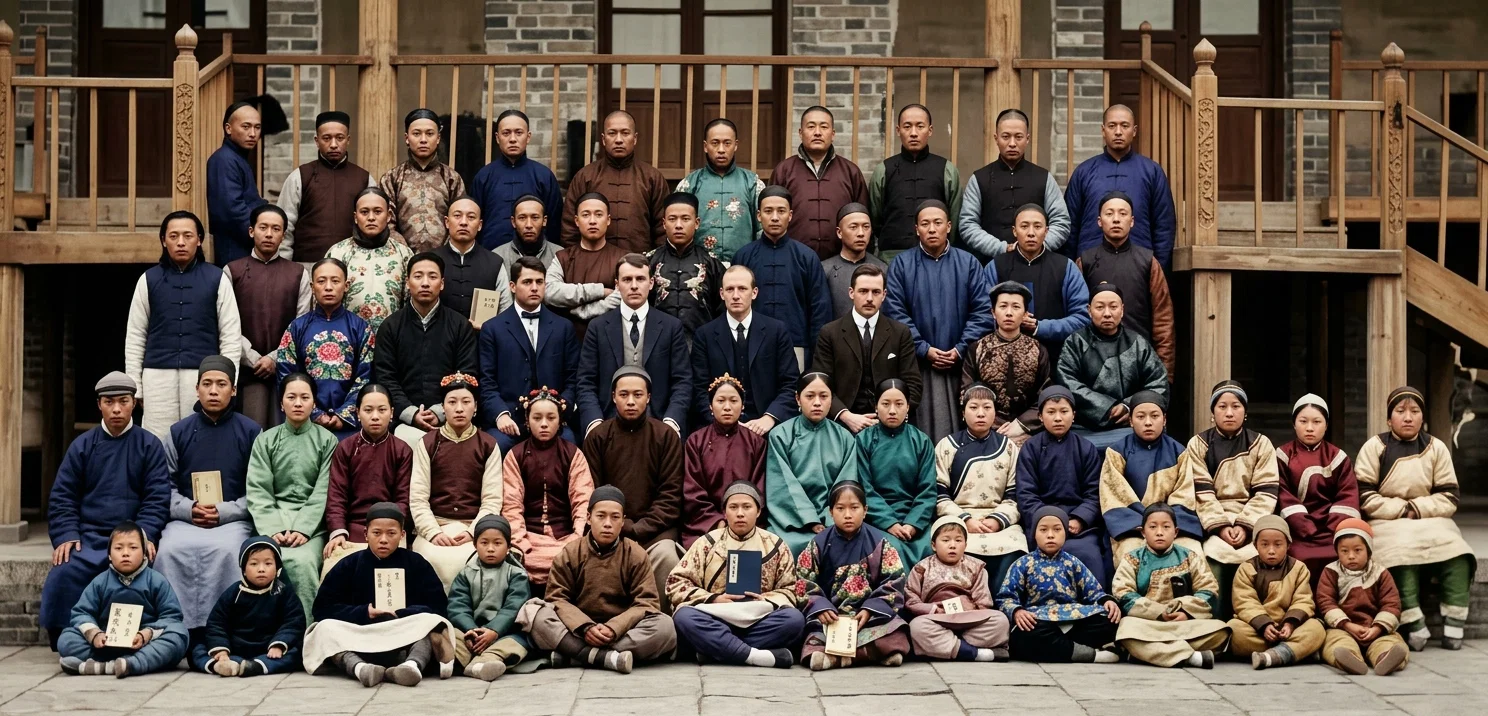
THE name of this school is doubtless new to most of our people at home, so we will offer a word of explanation. The word Mandarin is incorporated into the name of the school to designate the language in which its work is conducted, and the territory from which it expects to draw its students. Three hundred eighty-five millions of people, from fifteen provinces of China, besides Manchuria, speak the Mandarin language. While there are some changes in different parts of the Mandarin-speaking territory in the pronunciation of the language, they are not so marked but that it is possible for one having a command of the Mandarin of any part to make himself quite well understood wherever he may go.
Calling this school a Mandarin school will serve to differentiate it from schools in the southeastern provinces, where the spoken language is decidedly different, such as the Shanghai dialect, spoken by some twenty millions, also the dialects of Amoy and Canton.
As the China Union Mission at present comprises eight mission fields, five of which and part of another are in Mandarin territory, this school, drawing its students from six of these mission fields, is called the Mandarin Training School.
It is the usual plan, in connection with mission stations in Mandarin, China, to have boarding- and day-schools for boys and girls; but this school just established has for its object the training of men and women to go forth as evangelists and colporteurs, also to give a medical training to those qualified.
We believe that the message must be carried to the towns and villages of China through the efforts of our Chinese brethren and sisters. All the training that our colporteurs and evangelists have had in the past is what they have received through Bible studies given by the workers at the mission stations, and some of these brethren are doing valiant service; but the work of training them has been a heavy strain on those in charge of the stations, whose time was more than occupied by the routine work, and answering the questions of inquirers. While this method of training workers answered for a time, it had its drawbacks, among which might be mentioned a lack of uniformity in the subject-matter presented and in the methods of presenting it. There was also the almost certain impossibility of regularity, as other duties were sure to press in at the time of the study hour.
As the message is growing, and believers have increased, it was felt that our constituency was sufficiently large for the establishment of a union training-school in Mandarin-speaking territory.
At a meeting of the China Union Mission Committee held in Mokanshan in August, 1910, action was taken to the effect that a union mission training-school be temporarily located at Cheo Chia K'o, Honan, in connection with the mission there, until a permanent and suitable location could be secured in North China.
In harmony with this action, word was sent to the several mission stations announcing the school, and on October 7 about twenty men and women gathered here from the field to form the nucleus of the first central training-school for workers.
Some of these were men who had been working as evangelists, but whose training was not considered sufficient for the work they were doing; some were Bible women; others were colporteurs; still others were those who had lately accepted the message, and who desired to obtain a knowledge of the truth and fit themselves for work. In addition to these were the children of believers, who were sufficiently advanced in their studies to enter the classes of the advanced school.
The announcement of the school being somewhat late, quite a number were enrolled after the first week who could not reach here by the date set for the opening. This gives us a total enrolment of thirty-two at this time of writing.
In addition to these, there are twenty-one boys and girls in the station, or boarding-school; these come under the rules of the training-school, attending chapel exercises and boarding in a common dining-room, thus giving us a total of fifty-three in training here at present.
Associated in giving instruction and looking after the work of the school are Elder O. A. Hall, Miss Pauline Schilberg, Mr. Henry Lam, and three native teachers.
To those acquainted with the opportunities for an education offered by China's educational system, or lack of system, of the past, the perplexities and difficulties connected with the establishment of a training-school will be apparent. However, the difficulties and the sad lack of education among them only emphasize the more the importance of such a Christian training-school in China. If we ever have successful leaders among the Chinese Christians, they must be trained, and receive a thorough knowledge of the message and its organization. The students in the school range in age from seven years to sixty-one, and their capabilities for learning vary about as widely as their ages. Some who are above forty and fifty years of age have never been to school before, although they have considerable knowledge of the Scriptures and are quite capable. Others have been to school, but have received only a memory drill, and so as far as real knowledge goes, they are not in advance of those who have not gone to school, except that they can read more characters. Then there are about twenty young people who have had a training in our boarding-schools and in other Christian schools; these are able to do high-school work, and make good progress in their studies. An effort has been made to classify the students, so as to give them work that they can understand and that will be of the most value to them; this has at times been quite a problem with our limited number of teachers. We feel that the Lord has helped us in arranging their course, and that his blessing is upon the school.
The lack of suitable buildings and facilities for teaching has rendered discipline difficult, and has made it almost impossible for us to bring the standard to that which we desire to maintain. It has been necessary to place from six to ten students in a room, with a thatched roof and dirt floor, and having for furniture one small table in the center. This crowded condition, with each one studying in an audible tone, after the Chinese custom, has added to the confusion. I fear that if our students at home had to go to school under such conditions, their lessons would not be very well prepared from day to day. It is surprising to us to see how, under these conditions, the students do so well in their studies, and that we have so little difficulty in discipline. One reason is that they are a patient people, and have much respect for their teachers; but above all, they have an intense desire to learn and a sincere love for the truth, and are anxious to fit themselves to herald it to their countrymen.
The majority of the students have nothing to pay toward their support, so we furnish them with four hours' work a day. Some sell literature in the city; others make Chinese pens; some help in the kitchen; some do mason work, repairing the buildings; miscellaneous jobs around the mission compound are assigned to others. A number of the girls in Miss Schilberg's school do embroidery, and this gives promise of being a source of some income. These girls make mottoes that can be sent through the mail by post at little expense, and which can be procured by addressing the school.
The home training, which requires the students to be punctual to their classes, as well as to sit down and eat together as a family, is by no means of small importance to a people that have never19been used to any order or system in their homes.
From the results so far apparent, we feel encouraged, believing that the blessing of God has been and is resting upon the school.