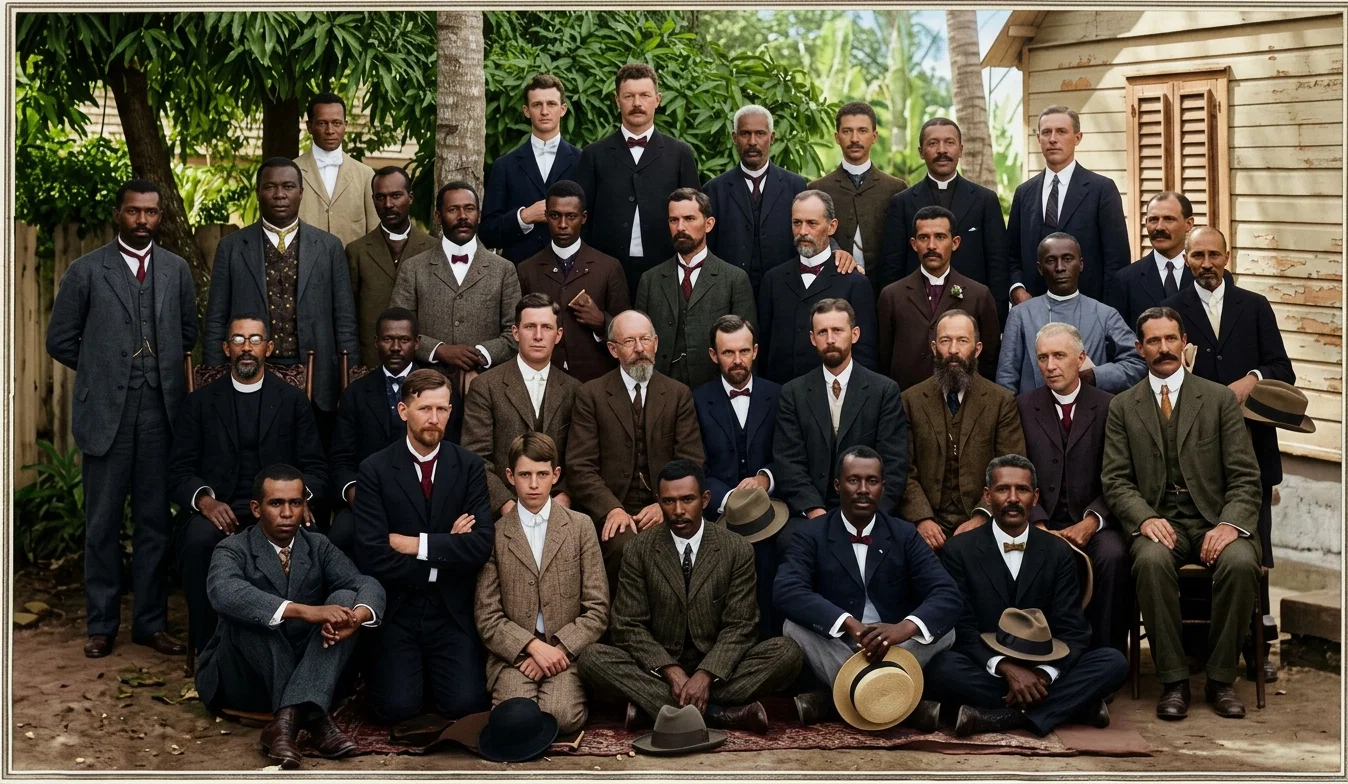
THE third session of the West Indian Union Conference was held at Kingston, Jamaica, January 7-15. I also had the privilege of attending the annual meeting of the Jamaica Conference, which was held immediately preceding the meeting of the West Indian Union. It means much to hold a conference in this island field; for not only are the distances considerable, but the lines of traffic do not all converge at any one point, so that most of the delegates were obliged to go roundabout ways to reach Kingston.
To illustrate: It is less than two hundred miles from Haiti to Jamaica, yet Brethren Tanner and Isaac were obliged to travel fifteen hundred miles to reach the meeting, going from Haiti to South America, where the steamer stopped at several ports to take on cargo, then to Colon, and from there by direct boat to Kingston.
Notwithstanding the hardships of travel, and the circuitous routes which many had to take to reach the meeting, a full delegation was on hand to take up the work. Every conference and mission field was represented, except Venezuela, which had been entered only a few months. It was a cheering experience to listen to the reports from the fields; for from all parts came the good news that additions were being made to the churches, and new companies were being raised up.
It was two decades ago that the first workers went to the West Indies, and since that time, there has been a steady growth, until now there are over four thousand three hundred Sabbath-keepers in the union conference, two thousand of these being on the island of Jamaica. This union, which is composed of the West Indies, the states of Central America and those in the northern part of South America, contains twelve million inhabitants. Only about one fourth of these, however, are English-speaking people, and it is in this part of the field that the most of our work has been done, and where we have the greater number of the four thousand Sabbath-keepers.
In giving the field careful study, it was the mind of the brethren that the time had now come to make a greater effort to take the message to the Spanish-speaking people and to the French islands, and plans were laid to that end. The Central American Conference was divided in such a way as to place the English-speaking part in the conference, and Guatemala and San Salvador were set aside as mission fields. All but two of the countries within this union have been entered—Colombia and San Salvador. Plans were made at this meeting to send a worker to San Salvador; and I hope before the year 1911 is past, we shall also be permanently established in Colombia.
DELEGATES ATTENDING THE WEST INDIAN UNION CONFERENCE
The financial report was very encouraging. For the first time, two of the conferences—Jamaica and the West Caribbean—reported that their tithes and offerings were more than their expenses, so that they would ask for no more help from the Mission Board. There was also a general advance in the finances in all parts, so that for the coming year the appropriation called for from the Mission Board was considerably reduced from that of last year; yet, on the other hand, plans were made for advanced moves in all the different conferences and mission fields. There is every reason to believe that in a little time the West Indian Union, which has in the past received considerable help from the Mission Board, will be self-supporting, with the exception, perhaps, of some aid necessary to carry the work to some Spanish territory which is difficult of access, such as, for example, the interior of the states of Venezuela and Colombia.
In the early days of the West Indian field, much faithful work had been done by canvassers, especially in the English, and plans were laid at this meeting for a revival of that important work. Several canvassers were called for, to take up the work in Spanish countries, and among the French islands. Most encouraging reports were received of the canvassing done in these countries where it had been thought little could be accomplished. Brother H. H. Cobban, the manager of the publishing department, was able to give an encouraging report, showing that the past year the institution had a net gain of eleven hundred dollars on its operating account.
Many schools are in successful operation in the islands and on the mainland, and are proving a blessing.
Elder U. Bender was again elected president for the coming term, and Brother H. H. Cobban, secretary and treasurer. When the session closed, the delegates expressed themselves as full of courage for the future, and went back to their fields with the determination of putting into operation the plans which had been recommended, that the coming year might be the best in the history of the West Indian Union. I greatly enjoyed these meetings with the brethren and sisters—both the old friends I had known in America, and the new friends whom I met for the first time. May God bless their earnest labors, and give them physical endurance and spiritual strength to carry out his purposes in that field, where much faithful effort has already been put forth.
H. R. SALISBURY.