Sanitarium Work in England and Ireland

7%

Review and Herald Publishing Association · Takoma Park Station, Washington, D. C. · Jan 26, 1911

FromReview and Herald, Vol. 88, No. 4.

Read the full edition

Sanitarium Work in England and Ireland

THE health and medical missionary work is conducted in the British Isles through various agencies, but particularly through sanitarium work, our Good Health magazine, our Good Health League, and lectures before health culture, temperance, and vegetarian societies.
The Drs. D. H. and Lauretta Kress made the first beginning of institutional work in England in 1899. They rented a commodious mansion house, beautifully situated at Meadvale, near Redhill, among the charming hills of Surrey; but on account of the temporary illness of Dr. Kress, it was necessary to relinquish this effort the following year.
In the autumn of 1902, a small sanitarium was started in Belfast by Dr. J. J. Bell. The house used was not a large one, and they had only eight or nine rooms available for patients; nevertheless the institution met with considerable success. Later, however, it was moved into the country at Rostrevor, near Warrenpoint, a beautiful estate consisting of a mansion house, lodge, and several outbuildings, and a farm of one hundred thirty acres, which was secured on a long lease. The institution, which is known as the Rostrevor Hills Hydro, is situated on the southern slopes of the Mourne Mountains, about four hundred feet above Carlingford Lake, which it faces.
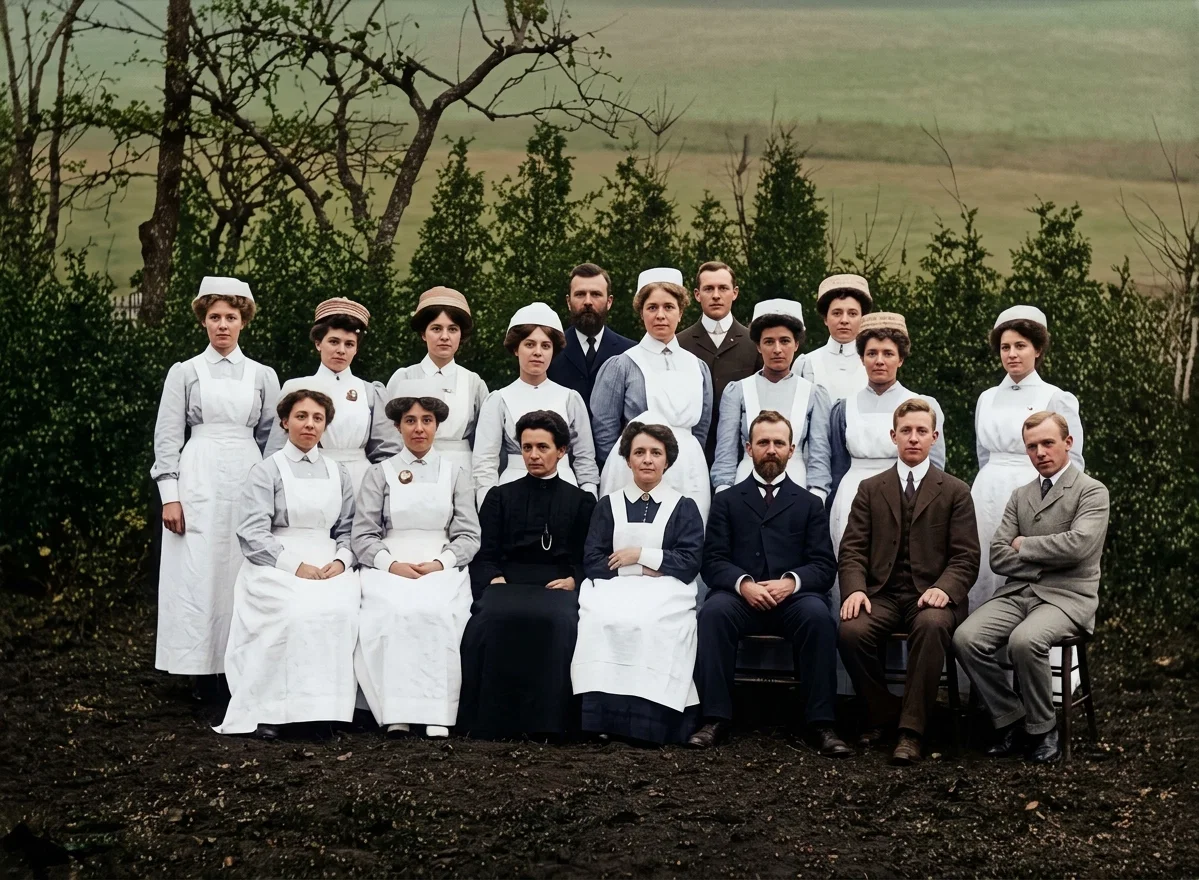
NURSES AND FACULTY, CATERHAM SANITARIUM
The mountain scenery, the delightful grassy meadows, the beautiful garden, and the proximity to the sea, make the location an ideal one in many ways.
The institution has been fitted out with modern bath-rooms, and has its own electric and central heating plant. It is an ideal place for invalids, for those who are tired of city life, and for those suffering from fatigue and overwork. Here they come in contact with the great outdoors, with plenty of bracing air, and many delightful walks. There could be no better place in which to take the fresh-air cure than at Knockbaragh, which is the name of the estate.
The Rostrevor Sanitarium is in charge of Brother and Sister E. H. Brown, both graduate nurses. Mrs. Brown was trained at the Swiss sanitarium, when it was still located at Basel. She has had a large experience in teaching in connection with the London County Council schools. Since taking up her work at Rostrevor, she has been successful in organizing a considerable number of good health schools, with marked success. The last one was conducted this autumn at Kilkeel, a village thirteen miles from the sanitarium. This class was under the patronage of Lord and Lady Kilmorey. The earl of Kilmorey took the chair at the preliminary meeting when the class was organized, and spoke very favorably of the school. Lady Kilmorey joined the school, and attended the classes regularly. The fee for the entire course of six classes was only $1.25. Nearly forty persons joined. This effort was so successful that Mr. and Mrs. Brown are now planning to open a new school this month (January) in the same district, and under the same patronage. After paying the out-of-pocket expenses, which were small, there was a net profit of thirty-five dollars to compensate the workers for the time spent in conducting the school.
Similar classes have been organized at Rostrevor and Warrenpoint, each time with increasing interest and success. Brother and Sister Brown have found these good health schools a great advantage. This advantage in promulgating the principles of life and health, and in educating the public on matters pertaining to diet, hygiene, sanitation, and the care of the sick.
The staff of workers at Rostrevor numbers eight,—the manager, the matron, the head bath-man, the head nurse, and four nurses in training.

A Sanitarium Free From Debt

The Caterham Sanitarium was purchased in March, 1903, the entire purchase money being paid in cash, through the liberality of our American friends and our people in the United Kingdom. Roughly speaking, the cost was about sixteen thousand dollars, including about one thousand dollars spent on decoration, repairs, and medical equipment; consequently, the Caterham institution enjoys the unique reputation of being started without debt, and of never involving itself in debt since its opening. It was dedicated May 30, 1903, and since opening its doors many hundreds of patients have received its benefits. The last year has been by far the best of its experience, and the patronage for a period of something like six months was so largeas to require renting extra rooms in order to provide for the guests. With only thirty-six bedrooms for patients and guests, it had a patronage averaging fifty or more, even reaching sixty-five during the height of the summer season. The large patronage has enabled the institution to make some material improvements. Hot-water radiators were provided nearly two years ago, and since then the drawing-room has been enlarged, a solarium and veranda have been added, and other material improvements have been made.

The Institution in Leicester

The Leicester Sanitarium was acquired through the generosity of one of the leading citizens of Leicester, Mr. J. W. Goddard. After attending a good health school conducted in Leicester in the winter of 1903, Mr. Goddard offered the free use of a large double villa, furnished throughout, including bed and table linen, silver, cutlery, crockery, etc., and he further offered to build and equip suitable bath-rooms. This offer was accepted, and the new institution was opened by the mayor of Leicester early the following year. At the present time it is in charge of Brother and Sister W. M. Scott, both graduates of the nurses' training-school at Caterham. It has a capacity for twelve or more resident patients, and ample facilities for treating a large number of outside patients. On going to Leicester, Brother and Sister Scott made a personal canvass of the leading physicians in the place. They made an appointment to call upon these doctors, and told them of their bath- and treatment-rooms, and of their desire to co-operate with the doctors in treating their patients. The success of this canvass was manifest from the beginning, and the institution now enjoys a good outside patronage, which depends largely upon the local doctors. The corps of workers at Leicester numbers nine.
A. B. OLSEN, M. D.