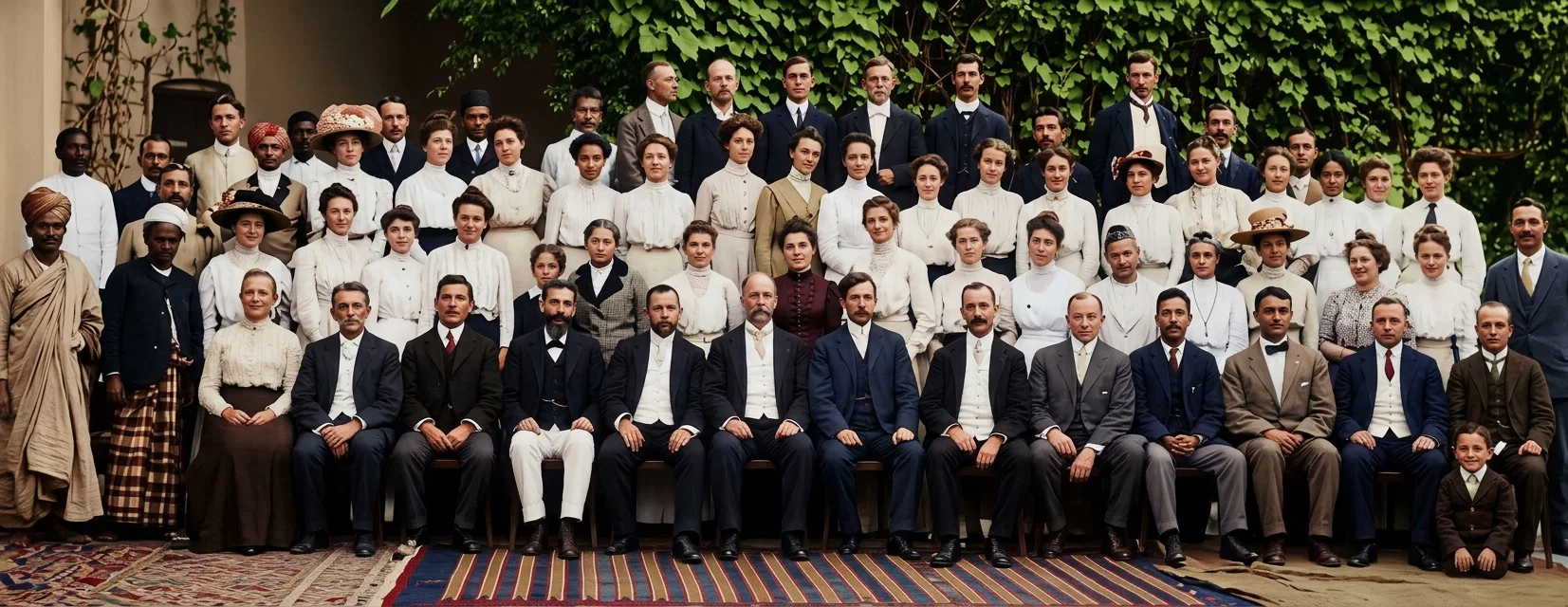
The fourth biennial meeting of the Indian Mission field was held at Lucknow, North India, October 21 to November 3. Workers from thirteen mission stations located in different parts of India and Burma, and representing eight different languages, were in attendance. For months our workers and isolated Sabbath-keepers had been looking forward to this meeting. Some came as far as eighteen hundred miles, that they might have the benefit of this occasion.
GROUP OF WORKERS ATTENDING THE INDIA MISSION CONFERENCE AT LUCKNOW
The presence of the Holy Spirit was manifest from the first. Prof. W. W. Prescott conducted throughout the entire meeting a very helpful line of Bible study, which was much appreciated by all. Only those who are continually fighting against the false ideas of paganism know how strengthening and inspiring is a study of the Word of God with those of like faith. Professor Prescott’s studies seemed especially adapted to present needs, setting forth as they did the place of Jesus Christ in the doctrine of present truth. We are sure our workers in India feel as never before like “knowing nothing among” the peoples of India “save Jesus Christ, and him crucified.” Our hope of winning souls in this land lies in holding forth Jesus, who of truth is the all and in all.
India, Burma, and Ceylon were set off as a separate union mission field, to be known as the India Union Mission. This great field has five divisions,—Bengal, North India, West India, South India, and Burma. It seemed wise to follow language areas quite largely in making the division of the field. Bengal includes Bengali, Oriya, Santali, and Assamese language areas. North India comprises Hindi, Bihari, Rajasthani, Punjabi, and Sindhi language areas. West India comprises Marathi and Gujerat language areas. South India comprises the Tamil, Telugu, Kanarese, Malayalam, and Singhalese language areas. Burma includes the country of that name.
Reports of work in various parts of the field show a steady advancement in the different vernaculars in which work is being carried on. The mission among the Tamils has baptized twenty persons during the past year; the dispensary has been treating from fifty to one hundred patients daily; and a school of one hundred eleven has been organized. The mission now owns a substantial bungalow, located in a healthful place, for its workers. We now have Elder J. S. James and wife and Elder G. G. Lowry working for the Tamil people.
The workers in the Marathi language have not yet found a suitable location for a mission. Several places have been under consideration, and definite decision as to a location was to follow this conference. Several English-speaking people living in that part of India have recently become interested in the truth. A Sabbath-school has been organized. A day-school for native children, attended by twenty-eight pupils, has also been started. Elder G. F. Enoch and wife and Brother A. G. Kelsey and wife comprise our workers for the Marathi people.
The advancement of the truth in Burma presents many encouraging features. The church in Rangoon is growing. In tithes and offerings these believers present a worthy example. During the last year a school for Burmese boys has been opened at Meiktila, North Burma. Sixty pupils attend. Several thousand rupees have been given to the school by interested Burmans and others, for the purpose of providing buildings and facilities necessary for an industrial school. Elder H. H. Votaw and wife, Elder R. B. Thurber and wife, Brother R. A. Beckner and wife, Dr. Ollie Tornblad [formerly Oberholtzer], and Miss Mary Gibbs make up the list of workers in Burma.
Among the Hindustani people, considerable work has been done in producing literature along evangelical and health and temperance lines. Three canvassers have been engaged in selling tracts and pamphlets, and good results have followed this work. Two training-schools have been conducted,—one in Mussoorie for men, and one in Dehra Dun for women and girls. Eight persons have been baptized. Two dispensaries, one at Mussoorie and the other at Najibabad, have treated a large number of sick people.
The Garhwal school was opened a year ago, and has sixty students, most of whom are boarders. A suitable house for our workers has been built on land donated by the government. Two dormitories are now under process of construction. Our mission located among the Garhwal people is very fortunately situated. Being in the mountains, the hot weather is never oppressive; and as it is somewhat remote from other mission stations, no counter-influences from other societies are experienced. In close proximity to the present location are excellent openings for mission work, and from the near-by villages come urgent requests from parents for the admittance of their children into the school. Brother L. J. Burgess and wife, Sisters Bertha Kurtz, Belle Shryock, and Mrs. O’Conner constitute our European force of workers among the Hindustani people. Elder S. A. Wellman and wife are studying the language; but owing to his doing editorial work on the Oriental Watchman, he has not been able to put in full time in language study.
The reports from Bengal, where our work first began in India, show marked evidences of advancement, especially in East Bengal. One hundred Sabbath-keepers are reported from that part of Bengal. Twelve Sabbath-schools were organized the last year. Workers have had good success in selling the monthly journal, Signs of the Times, started two years ago. It now has a circulation of twenty-five hundred copies monthly. Aside from East Bengal, mission work is now being successfully carried forward at Calcutta, Karmatar, and Babulmohal. Each station reports several baptisms and interesting experiences showing the advancement of the work in Bengal. Our present force of workers consists of Brother L. G. Mookerjee and wife [Sister Mookerjee has since died], Brother A. G. Watson and wife, Brother W. A. Barlow and wife, Brother R. A. Leech and wife, and the Misses Della Burroway, Louisa Scholz, and Caroline Brunson. Elder French and wife are now joining the Bengal force.
Bengal has been the field of our largest effort in India. More work and money and sacrifice have been put into this field than in any other part of India. Here, too, we have buried Elder J. C. Little, who died August 10. A memorial service was held during the conference in his memory. As fellow laborers, all felt it a privilege, though it be in sadness, to pay this last tribute of esteem, love, and affection for our comrade, who fell while courageously standing at his post. He filled a large place in the hearts of the Indian workers and in our work in India.
The medical work carried on at Mussoorie and at various mission stations makes very manifest the importance of this work as a factor in evangelistic work in India. Owing to the unsuitable quarters now occupied by the Mussoorie Sanitarium, action was taken providing for the purchase of a property suitable for sanitarium work. A resolution was also passed for the opening of a school for the children of missionaries and other English-speaking children of Sabbath-keeping families in India. The publishing work also received consideration.
A number of helpful papers on various phases of the work were read by different workers. These, with the discussion growing out of them, formed an important and instructive feature of the conference, giving the combined experience of different laborers in meeting conditions which obtain in climate, customs, languages, literature, and religious beliefs of the people among whom work is being carried forward. Experience in India, as in every other land, is a valuable asset.
As we looked into the faces of the earnest and substantial company of workers convened in conference, our minds went back fifteen years, when one lone worker, Sister Georgia Burrus, who was forbidden by her physician to come to India, landed in Calcutta without any visible means of support. Since then God has provided, the health of this sister has been wonderfully maintained, other workers have come to the field, and money from thousands of believers in America and other lands has been given for the work in this field. Now our mission force, counting the wives of missionaries, numbers more than seventy, not including native workers, of whom there are about twenty-five. For what God has wrought during these fifteen years, so much of which has been spent in wrestling with unknown conditions peculiar to a heathen, tropical land, and for the souls who have found the way of truth during these years, we feel profoundly thankful, and give God the praise.
Of the calls for more men and means to strengthen the work already begun, and to fill the numerous openings many times before presented, we can at this time say nothing.
Near the close of the meeting four persons were baptized by Elder W. W. Miller in the Gumpti River.