Southern Siberian Meeting

4%

Review and Herald Publishing Association · Tacoma Park Station, Washington, D. C. · Dec 22, 1910

FromReview and Herald, Vol. 87, No. 51.

Read the full edition

Southern Siberian Meeting

MRS. J. T. BOETTCHER
The second Siberian meeting was held July 1-4, at the settlement called Petropanloosk, which is located in the Attai Mountains about thirty miles from the Tartar town of Kokpoktinsk, almost on the border of China.
The city of Omsk, a thousand miles or more away, is the nearest railroad station; but the river Irtysh, eighteen hundred miles long, is, in summer, navigable almost its entire length. We took the boat at Omsk, and were surprised to find ourselves on board a ship built according to the American style, about as large as the steamers which ply our Northern lakes, and furnished with all modern improvements, such as electric lights, electric fans, and bath-rooms.
As the river in most places is not very wide, it seemed like taking a sea voyage overland, with no danger of getting seasick. The contrast between the modern ship and the country itself was very striking. On one side of the river are the Cossack-lands, with now and then a primitive town or village, devoid of anything that looks like comfort; and on the other side live the Kirghizen in their dilapidated mud huts.
But even to this far-off country, Russian and German emigrants are finding their way, and bearing severe hardships in trying to establish new homes for themselves and their children. The third-class passengers of our ship were largely composed of these “home-seekers.” These brave men and women are also bringing with them a part of Western civilization. At almost every port, our ship unloaded American farming machinery of all sorts,—hay-rakes, self-binders, mowers, etc.
At the ports, while the boat was stopping, we often got out and mingled with the people, and sometimes Brother Loebsack talked with the Russians, and left them one of our Russian papers. As we left, we could see the people gathered in a group back on the shore, while one of them read aloud from the paper.
It took us five days to go from Omsk to Semipalatinsk. As our steamer did not go any farther than this place, we were obliged to transfer to a smaller boat. The heat was intense, the thermometer in our cabin often registering as high as 100° F.
Early in the morning, while we were still lying at anchor, we heard some one going through the corridor, and saying, “Are there any Germans aboard this ship?” We thought at once it must be one of our brethren searching for us, so we called out, “Yes, here we are!” There were three of them, and they had come fifty miles to see us, knowing that our boat would stay some time in the harbor.
We had expected that one of them, Brother Title, would go on with us to the meeting; but he told us that the drought was so great, and the times so hard, and he was needed so much at home, that he had decided he could not possibly go. My husband began to tell about the progress of the cause, and of how the Lord had blessed the people at the previous meeting, explaining to him that his soul was as much in need of heavenly showers as was his land in need of rain. Tears came into his eyes, and in a few moments he said, “Forgive me; I will go with you to this meeting.” He did go, and as an ordained local elder will help carry forward the work in this part of Asia. Brother Title is a man of ability, speaking both German and Russian well. He has been in the truth about eighteen years.
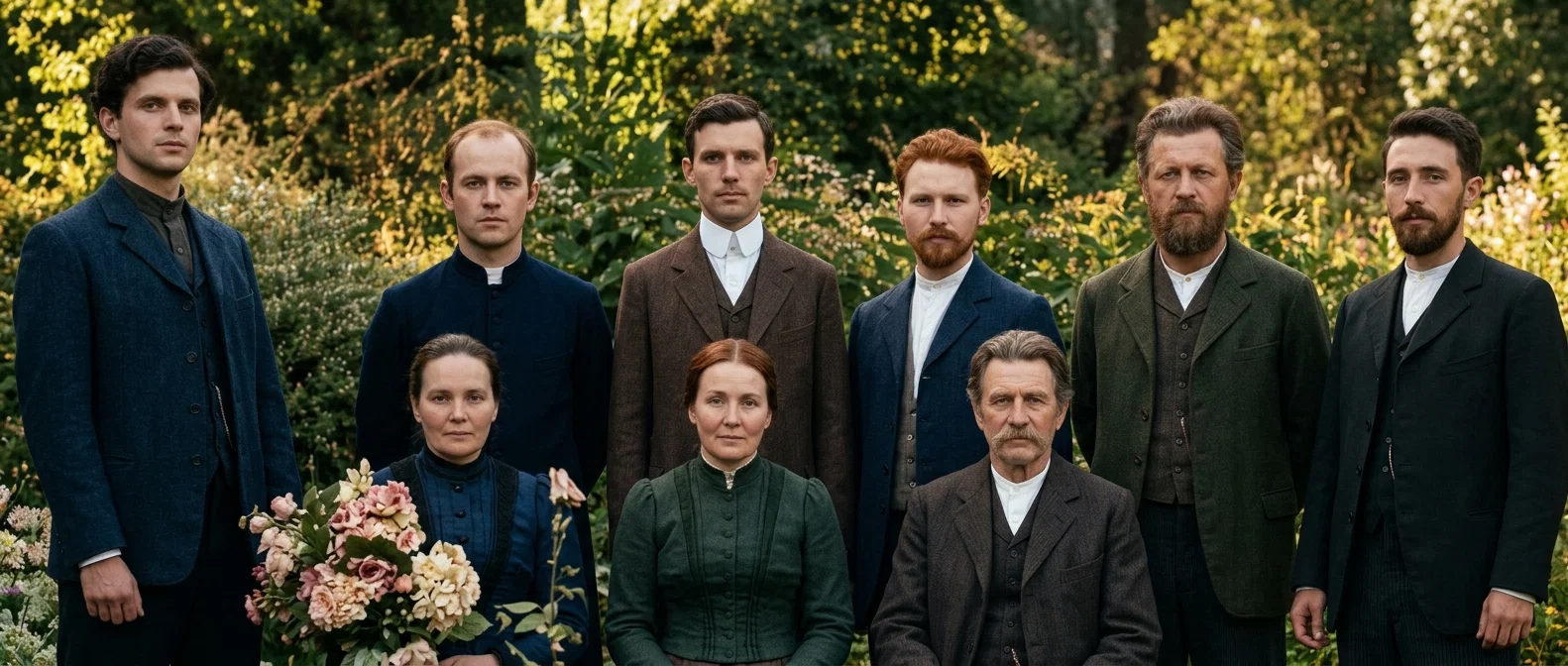
GROUP OF OUR FIRST SABBATH-KEEPERS IN PERSIA. THEY LIVE JUST OVER THE RUSSIAN BORDER
After spending a week on the river Irtysh, we left the boat at Ust-Kamenogorsk, and took the Kirghizen stage to Kokpoktinsk, one hundred fifty miles through the Attai Mountains.
These stages are very curious affairs; they are small, carry only two passengers, and have no springs nor seats. They have four wheels, with poles stretched across the axles. Fastened upon these poles is a big willow basket, in which the travelers sit. Sometimes the basket is made of wood, and has a low top. They are not very comfortable vehicles. It was an exciting ride, as these Kirghizen horses go very swiftly. Up-hill or down-hill, it seemed all the same to them; nor did they stop for ditches, stones, or small rivers. We tried to explain to the driver that we did not care to ride so fast, but he did not seem to understand.
At the stage stations, which were about twenty-five miles apart, we changed horses, wagons, and drivers with very little delay; nor did we slacken our speed when night came on. After losing our way several times, and tipping over besides, we stopped at a station for three hours, until daylight dawned.
We were twenty-four hours going from Ust-Kamenogorsk to Kokpoktinsk, one hundred fifty miles. Just as we were driving into the Tartar town of Kokpoktinsk, we saw some Europeans with their modern wagons and horses camped upon the steppe. My husband said, “That must be the brethren come to get us!” So we halted, and called to them. He was right; and they were rejoiced to see us, as they had been waiting two days. It was a pleasant change from that stage into a comfortable two-seated phaeton to ride the remaining thirty miles.
Our way lay across the steppes, with no villages, nor settlements, only now and then a Kirghizen tent and herds of cattle. The bare, lonely mountains rose high on both sides; everything was very still, far away from the noise of cities, trains, boats, and automobiles, or any of the confusing bustle of civilization.
When we arrived at the settlement in the evening, there was great rejoicing to see the friends who had come so far. Petropanloosk is composed of Germans and Russians who have emigrated here from Russia, having obtained a large tract of land from the government. But the land is stony, the soil poor, and for two years they have been suffering for lack of rain. For many, many miles there is not a single tree, and at best the land must be irrigated. Cattle thrive in these mountains and valleys. The Kirghizen shepherds are used to a very limited diet, but the settlers are suffering for the common necessities of life, to which they have been accustomed in their former homes. The children especially are suffering, and diphtheria has claimed many victims. One child died from this disease the day we came. Some had smallpox, and a great many, both old and young, had very sore eyes.
More than half of the settlement are Seventh-day Adventists. They told us, with tears, that they had sometimes feared they would never again be visited by a minister of the gospel in that far-away land, so difficult of access. Having no organized church and no ordained elder, they had not been able to celebrate the ordinances.
As they had no regular place of worship, they had erected a tent for thisspecial occasion. On account of the prevailing contagious diseases, we were very thankful to have the meetings in the open air. They were so hungry to hear the word of God that they wanted meetings day and night.
About thirty children attended the children’s meeting. They have no school, but many of them can read, and it was a pleasure to hear them sing so many beautiful hymns, and relate the Bible stories. Old and young seemed anxious to learn, and we tried to help them physically as well as spiritually, instructing them in the simple treatment of common diseases.
We thought best not to sleep in any of the houses, but curtained off a spot between two houses for our room. We carpeted the ground with fresh-cut hay, and at night we pushed the hay together in a pile, upon which we spread our blankets, and had a good bed, breathing the clear, invigorating mountain air all night. When the wolves came too near, the dogs set up such a howling that we could not sleep; otherwise it was ideal.
The Spirit of God came into the meeting, souls were converted, and those who had become weary and discouraged were refreshed. At the close of the meeting, eight Russians from the settlement were baptized. A church of forty-one members was organized, church officers were elected, and an elder and a deacon were ordained. Now we trust they will be able to carry forward the work about them, even among their Mohammedan neighbors. They also decided to establish a church-school.
If the drought continues, they may move farther toward China. Theirs is a life full of hardship, such as few of us are called upon to endure. How little one half of the world knows how the other half lives! Yet God is using such people to pioneer the truth into distant lands. It was touching to see how loyally they endeavored to do their part toward raising the $300,000 Fund.
It was a sad parting as we rode away that morning in July. The people decided to take us themselves in their comfortable wagon as far as Semipalatinsk. They knew a more direct way through the mountains, so that the distance would be only about two hundred twenty-five miles. Thirteen brethren, with their horses and wagons, accompanied us. There was no road this way through the mountains; most of the time we were riding through the valleys, the great summer pasturing ground of the Tartars and Kirghizen. Immense herds of cattle and camels were grazing there. The shepherds’ tents were scattered about all through the valleys, and both people and cattle were astonished and startled at our sudden appearance, disturbing the almost unbroken silence of their home. But the inmates of the tents were always friendly and hospitable, inviting us into their tents, and letting us look about as much as we pleased.
When night overtook us, wherever we were, we made our bed on the ground and slept unmolested, with never a cold or a bit of rheumatism. After leaving the mountains, it was often quite difficult to find water for ourselves and the horses, and if we did come to a well, the water was often salty as well as extremely dirty. There was never a tree under which we could seek shelter from the burning sun during our noon-day lunch, and our wagon had no top. But we arrived safe and well in Semipalatinsk, and found our ship, the “Attai,” waiting in the harbor.
Looking back upon our journey, which was not always easy, our hearts are filled with gratitude to God for his protecting care, and we consider being able to visit these lonely brethren and sisters one of the great privileges of our lives.
Riga, Russia.