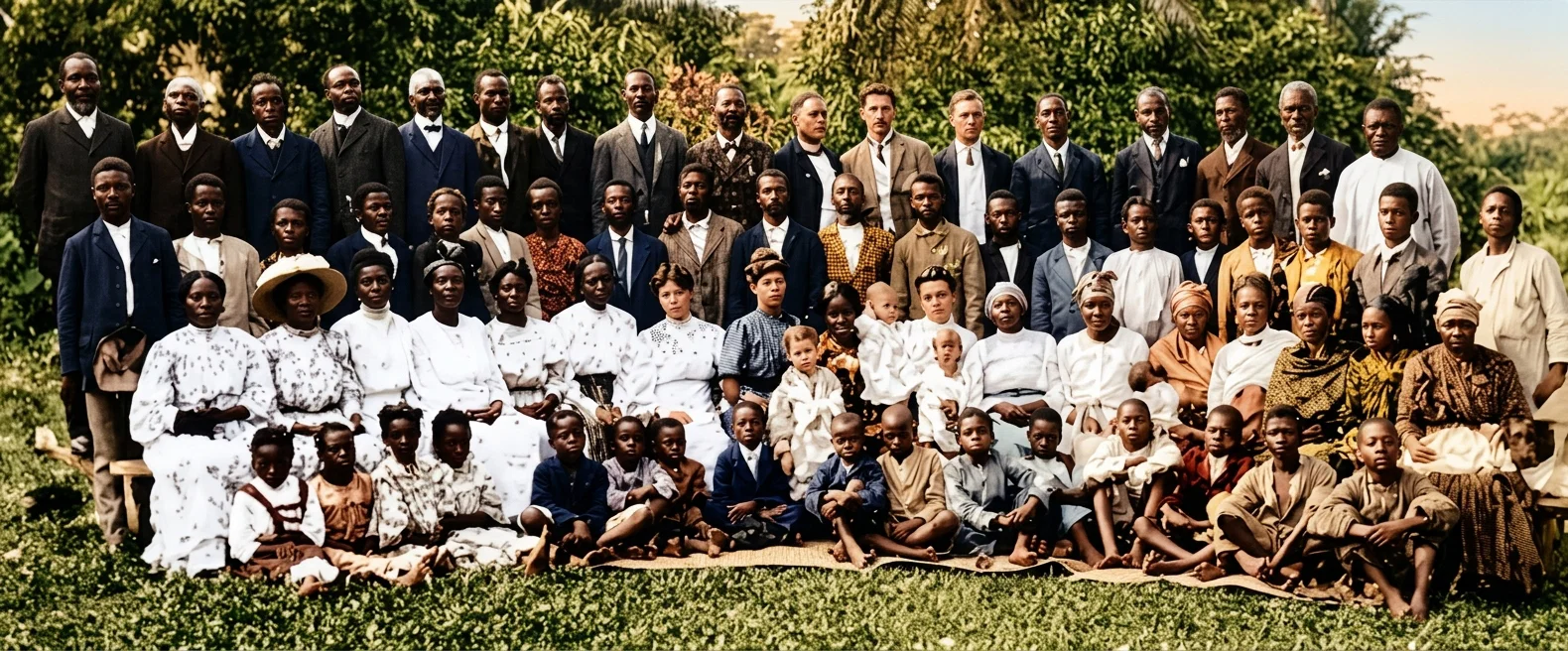
The memory of the last Sabbath of the first general meeting held by the workers of West Africa will probably never be erased from the minds of those present. The good Sabbath-school lesson prepared our hearts for the service following. The writer spoke a short time, dwelling upon what is expected of this people in the closing hours of the message,—how we must be separated from sin, separate from the customs and habits of the world,—and clothed in the clean, white garments of Christ's righteousness. Before a testimony was borne, opportunity was given for those who desired to consecrate all to God, to express this desire by rising. Almost the entire congregation immediately arose.
BELIEVERS ATTENDING WEST AFRICAN GENERAL MEETING
The general expression of the testimonies borne was that God had saved them that they might hear this last message. The review of life was not general, but specific. Many remarkable incidents were related; and as God's care was recounted, all centered on the thought of gratitude for an opportunity to hear this precious message. “That is why God spared me,” was the testimony of many.
Two incidents I must mention. One went back as far as 1898, when the speaker was a small boy (he is now only about eighteen). In that year occurred an awful massacre by the natives, when many thousands were brutally murdered. This young man told of their narrow escape through the thick jungles, with the enemy close behind, and, when they reached the river, where they would surely be overtaken, there was a boat ready for them to escape. He now saw why he had been spared. “God wanted me to have this message,” he said, “that I might carry it to others.”
Another young man related a narrow escape from death when his bicycle became unmanageable, and leaped over a wide trench several feet deep. He said, “I would be afraid not to give my heart to God, when I remember his wonderful care over me.”
The courage of our workers in West Africa is good; and hope is expressed by all. But we face millions to warn. The Macedonian cry comes from many places. Brother Hayford recently wrote me of a remarkable incident of a heathen and his wife, who, not long ago, came some distance to receive needed treatment. The effort had the desired effect; not only did the poor man receive strength in his feeble body, but he gladly received the word of life as well. He returned to his native village, sent home all his wives but one, and began to keep the Sabbath, teaching others of the true God. Now other villages around him are much interested.
A little more than one year ago, I was aboard a steamer coming up the coast, and saw five men on their way to prison for cannibalism. I took occasion each day to talk with them of a better life. They asked me for a paper telling who I was. When released from prison, they came at once to hunt me up, and to plead that our work might be opened among them.
Many similar incidents might be mentioned. Shall we press into the wide-open fields?