LEAVING Seoul, Korea, the morning of August 23, I reached Shanghai, September 27, and was glad to greet the brethren who had come to the boat to meet me. The following week we started for Mokanshan, a day's ride from Shanghai. The journey is made partly by rail, partly by rowboat, and partly by carriers. Altogether, it is a hard trip, at the best.
CHINESE UNION’ MISSION COMMITTEE
Mokanshan is a low mountain, the highest point reaching some twenty-four hundred feet above sea-level. It is covered with a thick growth of bamboo, which adds greatly to its beauty. Our location is at an elevation of about fifteen hundred feet, and has some pretty views looking down steep gulches into the valley below. A small stream dashes down the mountain, passing through the mission property. This water has been piped into the treatment-rooms, giving all the fresh, cool water we can ever use, and affording a pressure for the treatment-rooms of some forty-seven pounds to the square inch.
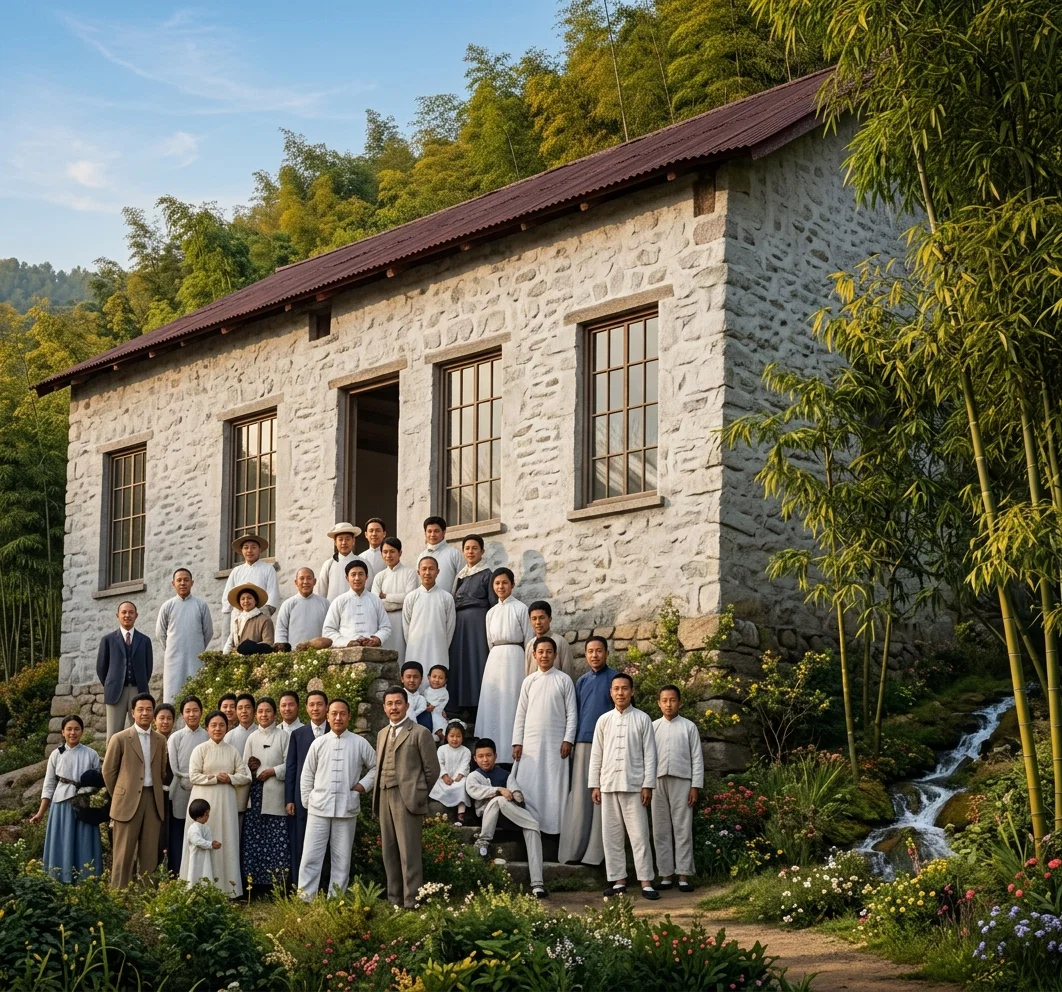
The treatment-rooms building is a plain stone structure, with walls two feet thick. It is two stories high, and about 24 x 36 feet. It has a cement floor, a corrugated iron roof, is well lighted, is piped with hot and cold water, has good sprays, and was erected for eleven hundred dollars, gold. However, some things are still needed to make the place what it should be. For about two hundred dollars, gold, it can be equipped with two full baths, and two electric batteries for giving electricity. When this is done, the rooms will be all that can be desired, and we shall be able to give treatments to all who come, at reasonable rates.
CHAPEL AND DISPENSARY AT MOKANSHAN
The total investment will not exceed thirteen hundred dollars, gold.
About one hundred families of missionaries spend from six weeks to three months on this mountain each year. Many of these are very glad for the prospect of good treatment-rooms, where they can come another year.
A small chapel has been erected, in one end of which a modest dispensary work is carried on for the Chinese. To this dispensary many come daily for medicine and treatment, which they greatly need. The chapel seats about fifty persons. The Seventh-day Baptists usually meet with us in worship on the Sabbath. The Chinese have their meetings in the forenoon, and the foreigners have theirs in the afternoon.
It was in this little chapel that we held our ten days' council for China. Most of the Chinese Union Committee were present, and the work for the whole field was carefully considered. Many recommendations were adopted, some of the most important of which follow: That seven men be asked to come to China, and take the oversight of the distribution of our literature in the seven occupied mission fields; that a study of the books of Daniel and the Revelation be printed soon; that a new press be purchased as quickly as possible, to help in printing the much-needed literature for China; that two hundred dollars be appropriated to further equip the treatment-rooms in Mokanshan; that a story of the rise and progress of our work be prepared, and printed at an early date; that the Central Chinese Mission be divided, the provinces of Honan and Hupeh being known as the North Central Chinese Mission, and Hunan and Kiangsi as the South Chinese Mission; that Elder J. J. Westrup and family be granted a year's furlough; that Elder F. A. Allum take the superintendency of the North Central Chinese Mission; that Elder R. F. Cottrell take the superintendency of the South Central Chinese Mission; that Dr. A. C. Selmon take the superintendency of the East Chinese Mission; that Dr. H. W. Miller take the superintendency of the North Chinese Mission; and that a school for Mandarin-speaking Chinese be opened this fall at Cheo Chia K'o, the same to be in the charge of Dr. Miller.
Many other important matters pertaining to the work in its various divisions were discussed and decided at this meeting. At its close we returned to Shanghai, to complete some work that had to be attended to there.
When I came to see the location of the printing plant, and the meager facilities with which they are compelled to work, I could not but say, “How long, O Lord? how long?” Dr. Selmon showed me the editorial room, which is a sample of what these workers have. They are located up-stairs in a Chinese house with low walls, and with windows on one side. The rear is boarded up with unmatched lumber, leaving cracks from an eighth to a quarter of an inch wide. This is all the protection they have against the penetrating cold of a Shanghai winter. I asked the doctor how it was possible for them to endure the heat and the cold. He replied: “It is often so cold that only by standing up and rubbing ourselves can we keep working at all. Our fingers often become11so numb we can not hold a pen. And the heat in summer is just as intense as the cold in winter.”
When I left Shanghai to take the boat, where I am now writing, I came down the narrow lane through which most of our workers in the press have to pass in going to and from their homes. In this street, not more than six feet wide, were six deformed beggars, asking alms, three of whom were lepers, almost dead with the loathsome disease. One of them was so nearly dead that his eyes were glazed, and he lay with his head in the dust, asking for help. Another poor soul had just lost two toes, and he held his swollen, bleeding foot toward the passers-by, beckoning to them to see his misery. Another had lost his hands, and could not walk, but lay there, thrusting himself toward me, begging an alms. We were compelled to pass within four feet of these poor, helpless souls, being eaten alive with this incurable malady. And the workers in our press must daily pass these poor unfortunates, exposing their very lives to the most loathsome of all human ailments. Perhaps you ask, “Why not move elsewhere?” The answer is a simple one,—to get into decent quarters costs more rent than it is possible for our men to pay, on their meager salaries. These workers have been hoping for two years that means would be forthcoming for building a plant outside the city, where the lives of the helpers can be conserved. The question is, How long shall they be compelled to wait?