G. W. REASER

6%

Review and Herald Publishing Association · Takoma Park Station, Washington, D. C. · Nov 10, 1910

FromReview and Herald, Vol. 87, No. 45.

Read the full edition

G. W. REASER

Mexico

G. W. REASER

LAST summer the Mexican Mission Committee held a meeting in the city of Queretaro. A few items of general interest may be worthy of mention by way of description of this city.
Although situated on both lines of the National Railway, which traverses the table-lands of central Mexico from the United States border to Mexico City, and having a population of approximately forty-five thousand inhabitants, yet, aside from an electric-light system, and a very crude street-car service, for which diminutive Mexican mules supply the motive power, Queretaro is doubtless contemporary in appearance and architecture with Jerusalem or Damascus in the time of Christ.
Its streets, paved with cobblestones, average from twenty to twenty-five feet in width. It is said to have forty Catholic churches, many of them being gems of art in beauty of construction and interior decoration. It has always been regarded by Protestants as one of the ultra-Catholic cities of the republic.
ITS GREAT STONE AQUEDUCT
Queretaro is famed for its charming setting in the midst of fields of alfalfa, verdant twelve months of the year, from which nine crops are cut in a single season. It is also noted for its extensive orchards, laden in season with the fruits of the temperate zone, as well as those of the subtropics. These alfalfa fields and luxuriant orchards are irrigated by water flowing from four mammoth springs, which burst forth from the earth some five miles from the city, their united volume forming a small river.
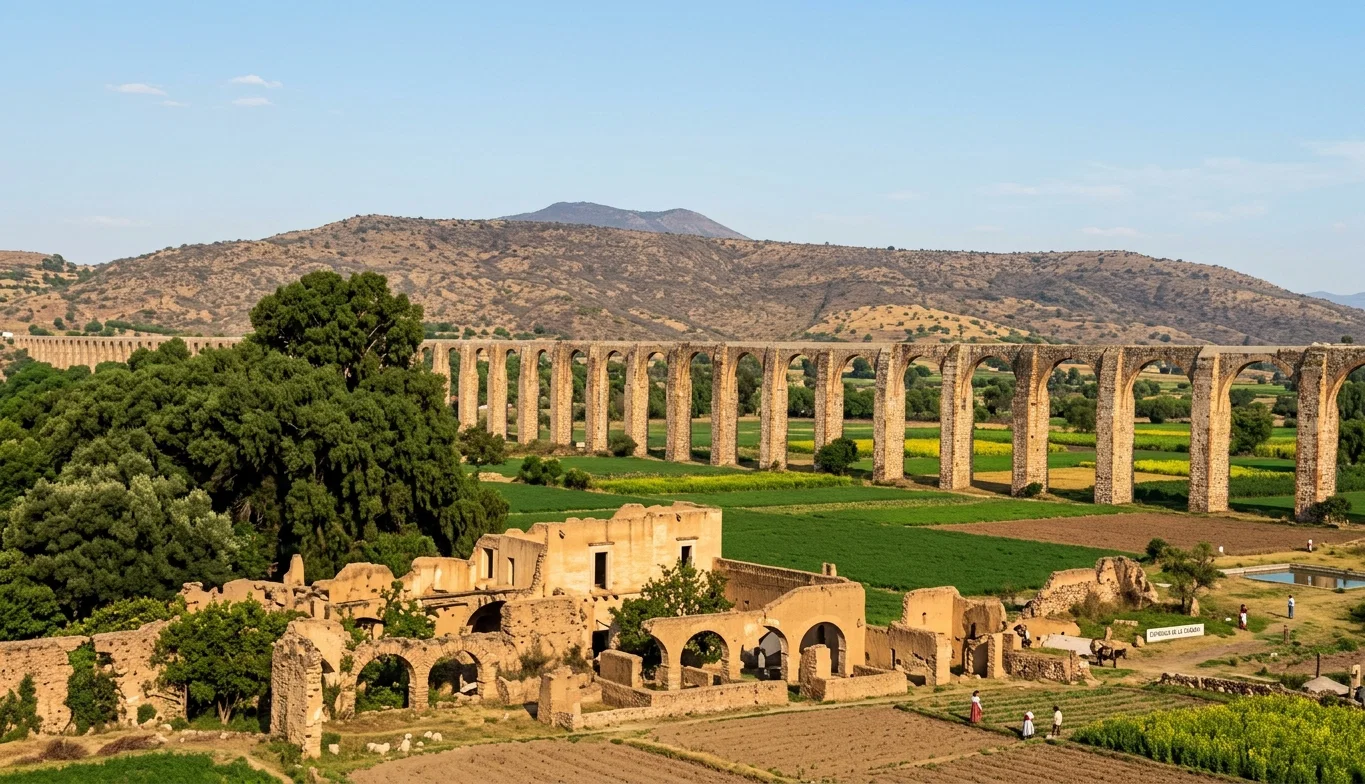
A special feature of beauty and interest in the immediate vicinity of Queretaro is its great stone aqueduct, about a mile in length, by means of which the city is supplied with water, which is distributed from the highest point of land within the city to twenty pools, or fountains, where the women gather, as in Bible times, to carry away water in earthen jars for domestic use. This aqueduct is the largest and most remarkable of its class in all North America, and is famous in Mexico, as were the “pool” and the “conduit” built by King Hezekiah in Palestine more than seven centuries before Christ, and which “brought water into the city” of ancient Jerusalem. 2 Kings 20:20.
The aqueduct system, which was theonly method formerly known of conducting a stream of water across a depression, has many examples in Mexico. The one at Queretaro, we were told, is supported by columns twelve feet square, is constructed of solid masonry, some of them reaching a height of sixty-five feet.
While Queretaro, as to climate, fertility, and beauty of environment, is, to the writer, the most charming spot of the vast table-land district of Mexico, it is likewise one of the most interesting places in the republic from the viewpoint of its thrilling history. It was here that the ill-fated emperor, Maximilian, brother of Francis Joseph, the present ruler of Austria, made his last stand against the indomitable Juarez, and, being vanquished by the latter, was imprisoned, court-martialed, and with two of his leading generals, Miramon and Mejia, taken to the hill of the bells, “cerro de las campanas,” and shot by eight Indian soldiers, June 19, 1867.
This event is one of the saddest in the history of the republic. Maximilian, considering his cause hopeless, had abdicated the throne and set out for Europe, but was overpersuaded by the Catholic Church party to return—to his sad fate. The crude coffin in which his lifeless body (now resting in Austria) was borne away from the scene of the execution is exhibited in a room in the capitol building at Queretaro devoted to the relics of what may, with propriety, be called the Maximilian tragedy. In this room the visitor may sign his name in the great visitors' register, which lies on the same table on which was signed the death-warrant of the emperor.
The coffin, or box, which held the remains of one of the proudest of earth's monarchs, still plainly shows the stains of his life-blood and the imprint of his hand, bathed in the crimson which gushed from his mortal wounds.
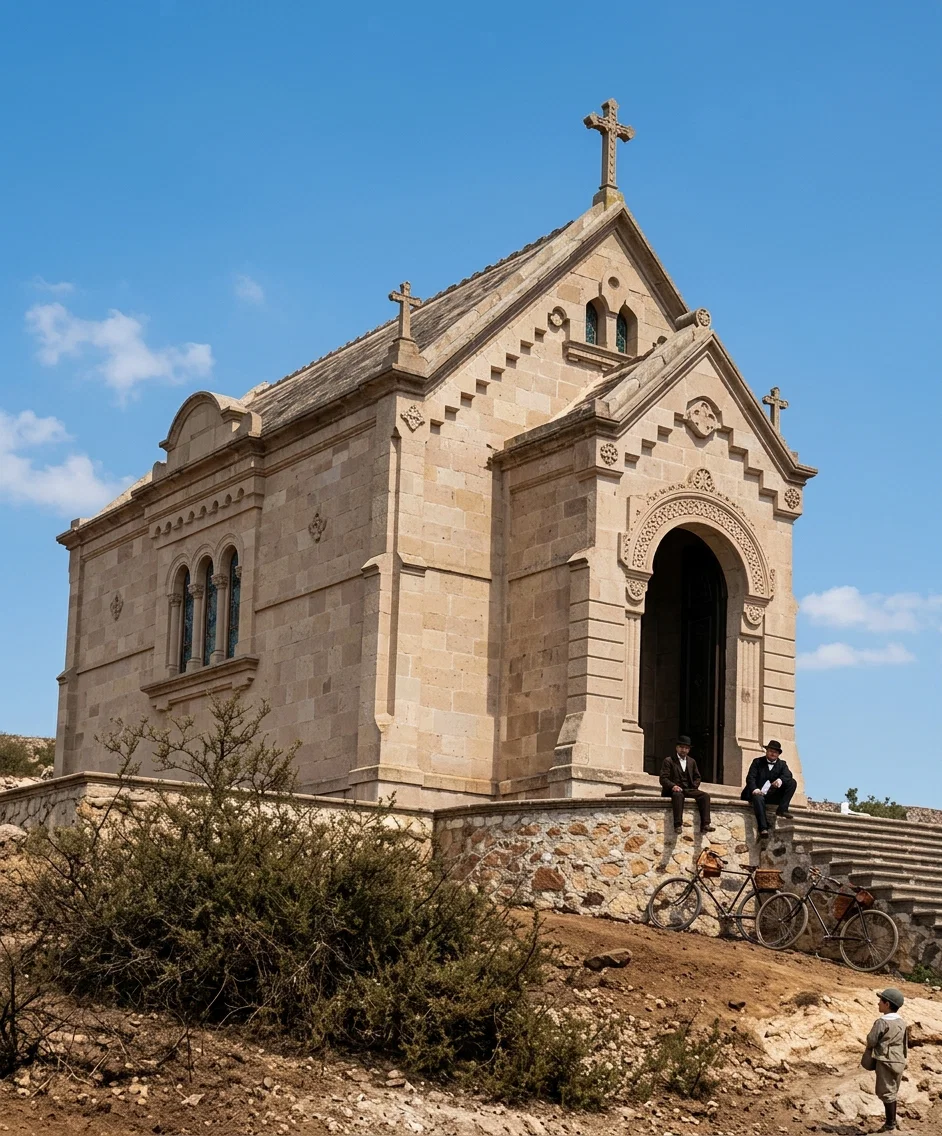
A beautiful chapel, “Expiatoria,” built with the hope that the nation might expiate the crime of slaying Maximilian, now marks the spot where the dreadful deed was done.
Tacubaya.
THE MAXIMILIAN TEMPLE