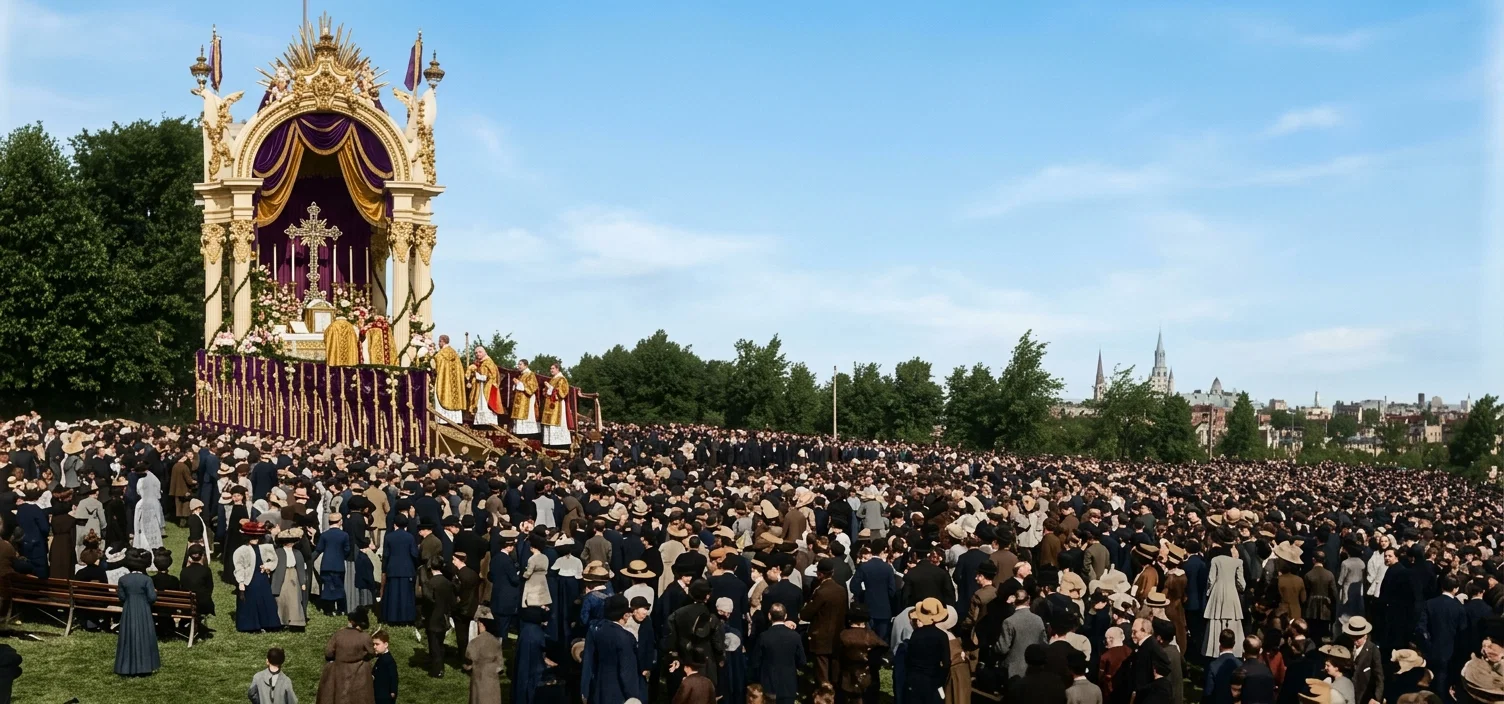
A CATHOLIC AUDIENCE ATTENDING OPEN-AIR MASS IN FLETCHER'S FIELD, MONTREAL, ON SABBATH
The Roman Catholic International Eucharistic Congress
By C. M. S.
ONE of the most imposing spectacles that was ever witnessed in North America—or perhaps in the world—was the great procession of the eucharist in Montreal, Canada, on Sunday, September 11. Nothing that money could procure to make it spectacular was omitted, and nothing that the spectacular could do to impress the world with the power and glory of the church was left undone. The idea of the leaders was that Jesus Christ, in this eucharistic celebration, was the guest of Montreal, and of course nothing was too good for his entertainment.
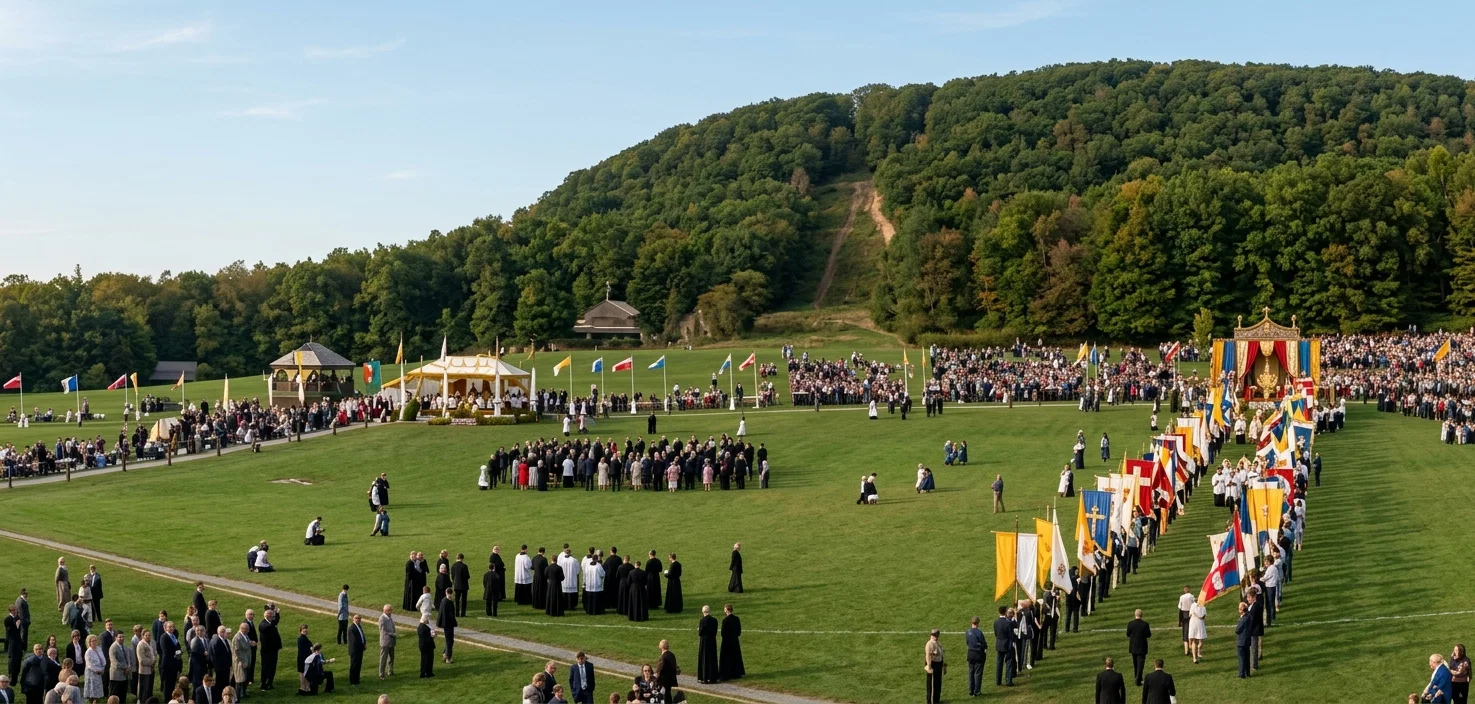
A SMALL PORTION OF THE GREAT CROWD WHICH WITNESSED THE EUCHARISTIC PROCESSION ON SUNDAY AFTERNOON. THE AVENUE OF FLAGS AT THE RIGHT TO THE REPOSITORY, THEN DOWN THE AVENUE
Preparations for this event had been going on for months; and when the day arrived for the opening of the congress, the city was in gala-day attire from steeple to basement window. The ecclesiastical and the civil were united in this in Montreal; for with the overwhelming Catholic majority in that city, Rome has her way in the administration of the municipal government. There is only one professed Protestant on the board of aldermen of the city, and it is hardly necessary, perhaps, to state that Rome had what she wanted.
13
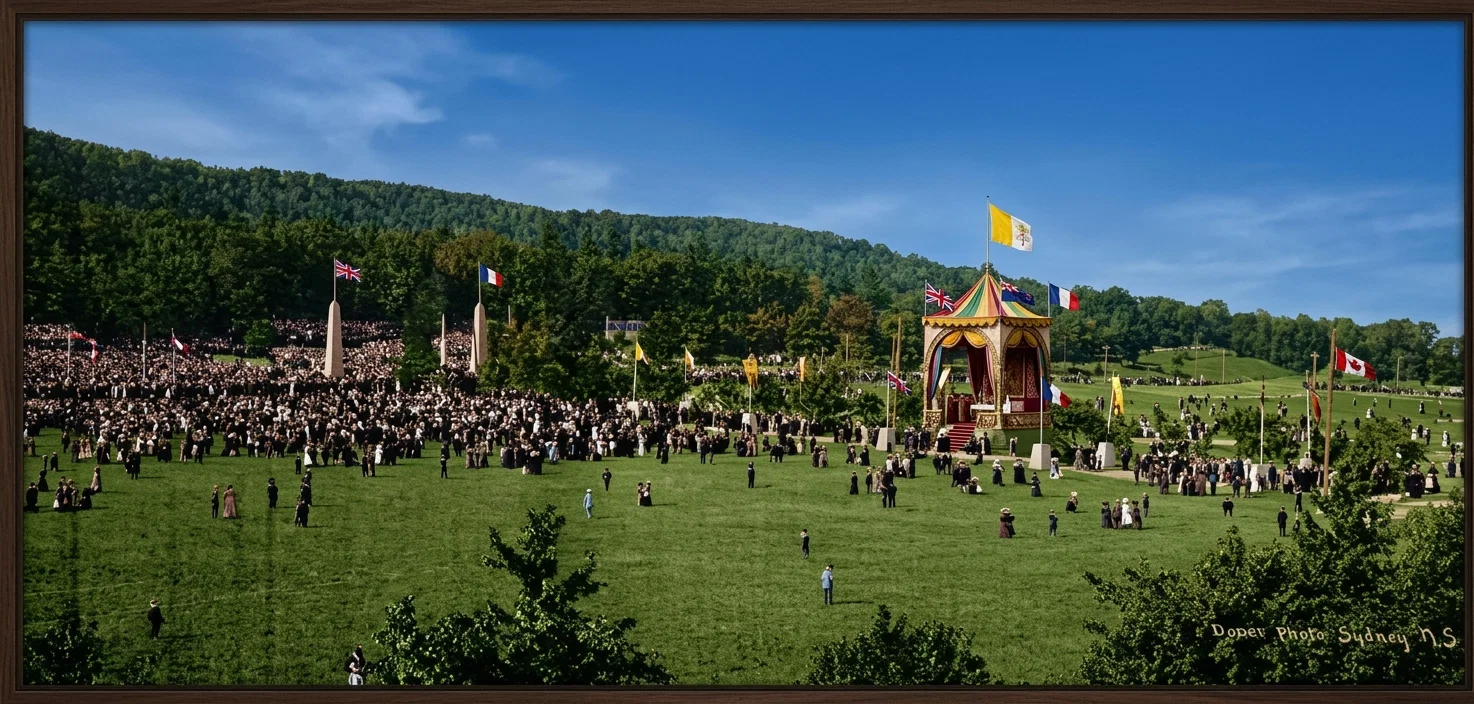
SEPTEMBER 10. MASS IS BEING CELEBRATED IN THE REPOSITORY AT THE LEFT OF THE PICTURE
The Canadian premier, the premier of Quebec, the mayor of Montreal, and the city council of Montreal were as one man in the determination to permit nothing to stand in the way of making the twenty-first International Eucharistic Congress of the Catholic Church the greatest event, if possible, in the history of that church in the western hemisphere. There is no question of their success in this matter; for in pomp and pageantry, in sacerdotal ceremony and state assistance, in length of procession and loyalty of kneeling worshipers, in repudiation of the Reformation, and in public claims to everything tangible and intangible on earth and in heaven,—the twenty-first International Eucharistic Congress of the Catholic Church stands without a peer.
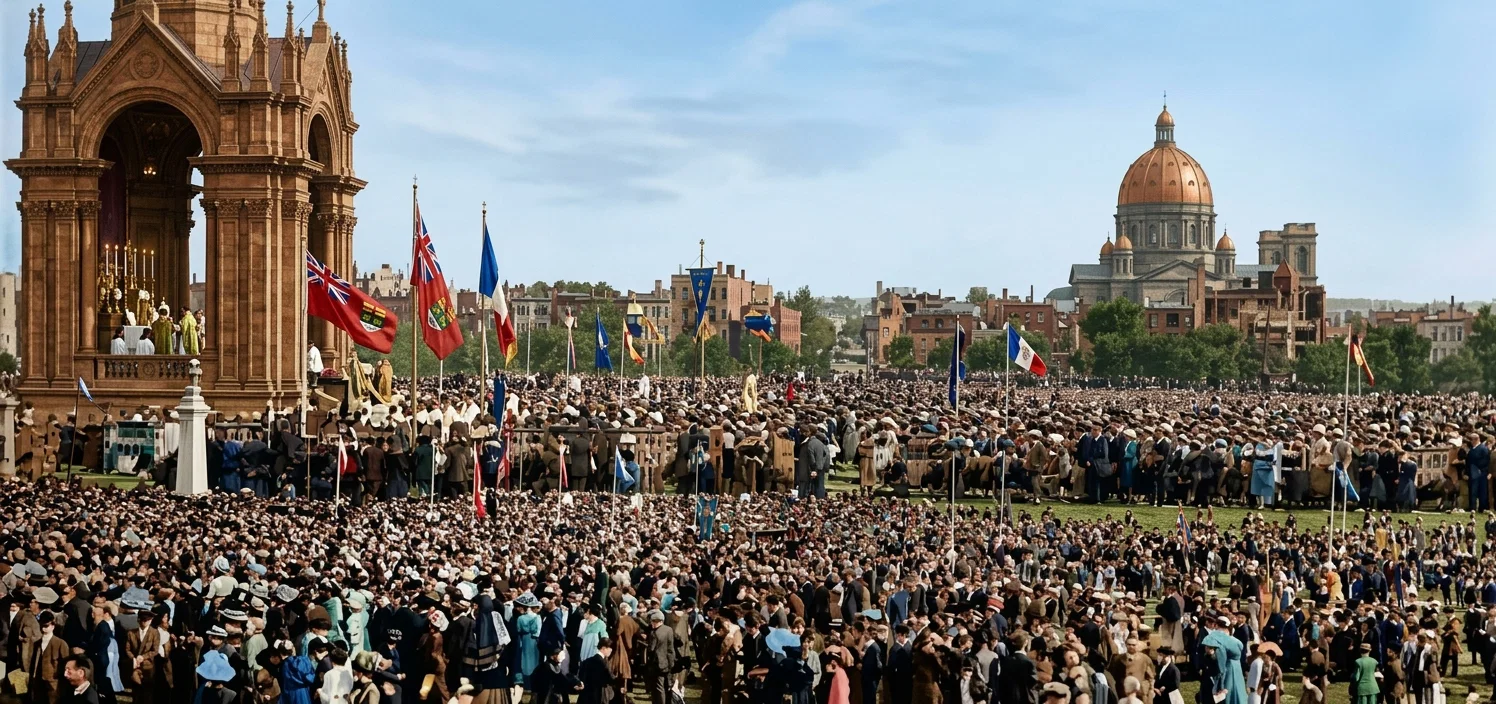
THE ARCHED STRUCTURE AT THE RIGHT OF THE CENTER IS THE REPOSITORY OF THE “HOST.” THE PROCESSION PASSED UP ON THE LEFT TO THE “HOTEL DIEU” NUNNERY, WHERE THE “HOST” WAS DEPOSITED
Canada by profession is a state without a church; but the province of Quebec on this occasion demonstrated to the world that there is a church which has its way in that state, as verily as a church ever had its way in the truest days of church and state union. From highest official to lowliest subject, all stood ready to do the bidding of the Catholic hierarchy.
When preparations for the congress were actively begun in Montreal, it was proposed to devote fifty thousand dollars of the public money to the purposes of the congress. There was a strong protest against this by the Protestant portion of the population, and the project was finally abandoned, outwardly. There is a strong belief, however, on the part of many, that in some way the project was accomplished, and that the money of the general public was used in contributing to the success of the Eucharistic Congress.
In open council this much was done: money to the amount of ten thousand dollars was voted at one council meeting from the funds of the city, raised by general taxation, for the entertainment of the eucharistic delegates. At another meeting, two thousand dollars more was voted for the same purpose. This being used for the entertainment of the city's guests, there was not so much protest against the appropriation as against the14use of the fifty thousand dollars for arches, decorations, etc.
To provide the finances of the congress, the city was districted, and collectors were placed over each district, who were to see to it that a certain specific sum of money should be raised in each district. The public contribution list was headed by a professed Protestant with a contribution of five thousand dollars. There were no questions asked as to “tainted money.” Every one who would give was given the opportunity to do so. Estimates by the public press of Montreal place the cost of the congress at between one and two million dollars, and this evidently does not include the cost of repairing and paving the streets along which the procession was to march. This street work along the route of the procession was one of the marked examples of the city's willingness to tax itself to add to the splendor and success of the congress; for streets which bear little of the burden of the city's traffic were paved for the marchers of the eucharistic procession, whereas other streets, on which the procession did not pass, but which were sadly in need of repairs, that the city's daily traffic might be accommodated, were left untouched.
Mgr. Archbishop Paul Bruchesi, under whose directions all the arrangements for the congress were made, in speaking of the assistance received from Protestant sources, said:—
The encouraging messages and liberal donations from friends and well-wishers, near and far, from the American hierarchy in particular, and even from non-Catholics, have impressed us more than words can convey. The press, both English and French, has been most friendly, and will continue so, I trust, to the end.
He was particularly well pleased, he stated, with the expressions of sympathy and encouragement which he had received at the hands of the non-Catholic population of the city, and was glad to say that the leading Protestants of the city had been most generous in the assistance which they had given.
It is certain that the type of Protestantism which contributed to the success of this glorification of a Roman Catholic dogma was not the type which was dominant in the days of the Reformation. The eucharist is declared by Roman Catholics to be the heart and soul of their religion. It stands for the transmutation of a piece of bread into the very body of Jesus Christ, when the priest has said over it the words, “Hoc est corpus meum” (“This is my body”); and then for the worship of that piece of bread when exposed or elevated for the adoration of the faithful. Every Protestant who contributed of his means for the success of the Eucharistic Congress, helped to fasten that idolatrous worship and belief upon the people.
It was not merely the city of Montreal, nor the province of Quebec alone, that paid such handsome homage to the Catholic “Host” and the ecclesiastical dignitaries who were to bear it. The federal government of Canada was also represented, and through its officials paid homage to the pontifical delegate, and to the papal dogma he had come to glorify.
There was a magnificent demonstration at the city of Quebec when the papal legate, Vincenzo Cardinal Vannutelli, reached that place on his way to Montreal, also at Three Rivers, one of the oldest Catholic stations on the St. Lawrence. It was not left for the cardinal legate of the pope to come to Montreal as ordinary individuals come; he must come with all the pomp and ceremony and acclaim that could be offered one of earth's greatest rulers. To carry out this purpose, the Canadian government steamer, “Lady Grey,” was despatched to Quebec to meet the papal legate, and bring him up the river to Montreal, a distance of about one hundred fifty miles; and during the latter part of the trip this boat was accompanied by many other vessels. Nothing but the furious storm raging at the time prevented a fleet of sixty-one yachts from joining the cardinal's river procession.
A special wharf, seventy-five by one hundred feet, had been constructed for the cardinal to land upon, and a gorgeous throne was built at the wharf, upon which he was to sit while hearing the mayor's address of welcome, and from which he was to read his reply. Prayers had been offered that it might be a propitious day when “His Eminence” should arrive. The mayor in his official robes was at the wharf at the appointed time, the throne and the wharf were ready; but instead of the fair weather prayed for, the worst storm of the season was raging. The open-air reception planned for, and the use of the specially constructed wharf and the gorgeous and expensive throne, were abandoned. The government steamer, with the papal legate on board, and the papal flag flying, docked at the regular wharf on the afternoon of September 3, amid the screaming of steam whistles and the flapping of rain-soaked bunting. Every vessel in the harbor was flying its full quota of flags, and on shore the same display was manifest.
Because of the evident impossibility of carrying out the open-air program, the papal legate was ushered into the mayor's carriage, and quickly whisked away to the city hall, where the ceremonies of the reception took place. The “one thousand gentlemen,” consisting of cabinet ministers, consuls, senators, members of Parliament, ecclesiastical dignitaries, and prominent citizens, who waited at the wharf in the wet to add dignity and honor to the welcome of the pope's representative, hurried to the city hall through mud and rain.
At the city hall, on an improvised throne, the papal legate was seated, with the mayor on his right, Archbishop Paul Bruchesi on his left, and the highest dignitaries of the church, the monsignori, grouped around.
The mayor's address of welcome, prepared beforehand, and anticipating a day of sunshine for the reception, opened thus:—
YOUR EXCELLENCY: In the lives of men there are certain days when the sun arises with more wondrous glory, shines with more vivifying ardor, and touches all things beneath its rays with beauty and benediction. Such is this day, when to our shores you come invested with sacred rights, representing our Holy Father Pius X, to open the first great Eucharistic Congress in America. With joy we hail you! Welcome! Ten thousand times welcome! And while I who am signally honored, speak these words, they are wafted from lip to lip throughout our beloved Canadian land, through all the vast expanse of this great continent, where a Catholic heart beats, or a Catholic knee bends before the Adorable Sacrament of our altars.
He referred to Montreal as the Rome of the New World, illumined by the light of the infallible church, and closed his address by applying to the papal legate the words which the Bible applies to our Lord: “Hosanna in the highest!” “Blessed is he that cometh in the name of the Lord!”
The formal opening of the congress did not take place until the evening of the sixth. It is impossible to deal with this, or with the incidents and utterances following it, in this article. Suffice it here to say that no more royal welcome could have been given the king of the realm than was accorded the papal legate by both ecclesiastics and civil officials. Wherever he appeared in public, he was seated upon a throne, with cardinals and archbishops in gorgeous robes on either hand, and bishops by the score grouped around. No matter in what company he appeared, no second place was ever his; and as representing the church, he might reasonably have been led to think, in the words of Scripture, as he viewed the display and the veneration, “I sit a queen, and am no widow, and shall see no sorrow.” But the one who is familiar with the history of this organization, its character, and its tendencies, and knows the meaning of the infallible prophecy concerning the Papacy, must tremble for her when the times comes for Heaven to lay its hand on her high pretensions.
The notable utterances and events of the congress will be considered in another article.