Central Polynesia

5%

Review and Herald Publishing Association · Tacoma Park Station, Washington, D. C. · Jun 16, 1910

FromReview and Herald, Vol. 87, No. 24.

Read the full edition

Central Polynesia

This mission field includes the Fijian, Tongan, and Samoan groups.

Samoan Mission

Our work in Samoa has been an uphill struggle, but Elder J. E. Fulton, of the union conference, writes, “We are hopeful that we are now getting the work there on a better basis than ever before.” A change was made at the end of the year, J. E. Steed, the director, returning to Australia, on account of failing health, and Brother Howse coming from Australia to take his place. Of the work there Brother Steed writes:—
For a mission home and school our brethren have secured sixty-three acres of land, rising from the sea to several hundred feet elevation at the upper side. This beautiful piece of land has a permanent stream of water, from which it takes its name, Vaiola (vai, water; ola, life); it is also well supplied with cocoanuts, vanilla, bananas, and other things. While many other pieces of land were offered for our work, we had signal evidence that the Lord was reserving this for us.
Among the many blessings that have been our portion, we feel thankful indeed that he placed a bright young half Samoan-Niue woman in our way, with the result that she has been a great help to us in getting out our literature. She is at present at the Avondale school, Australia, the Queensland young people’s societies keeping her there. A young man who has taken his stand with us has also helped in translating; so that we have a number of tracts in the Samoan language, and several in the Niue, the language of the island of Niue, several hundred miles from Samoa.

Fiji Mission

The Fiji Islands are our headquarters for Central Polynesia, and workers trained there are going out to other groups. Elder C. H. Parker writes:—
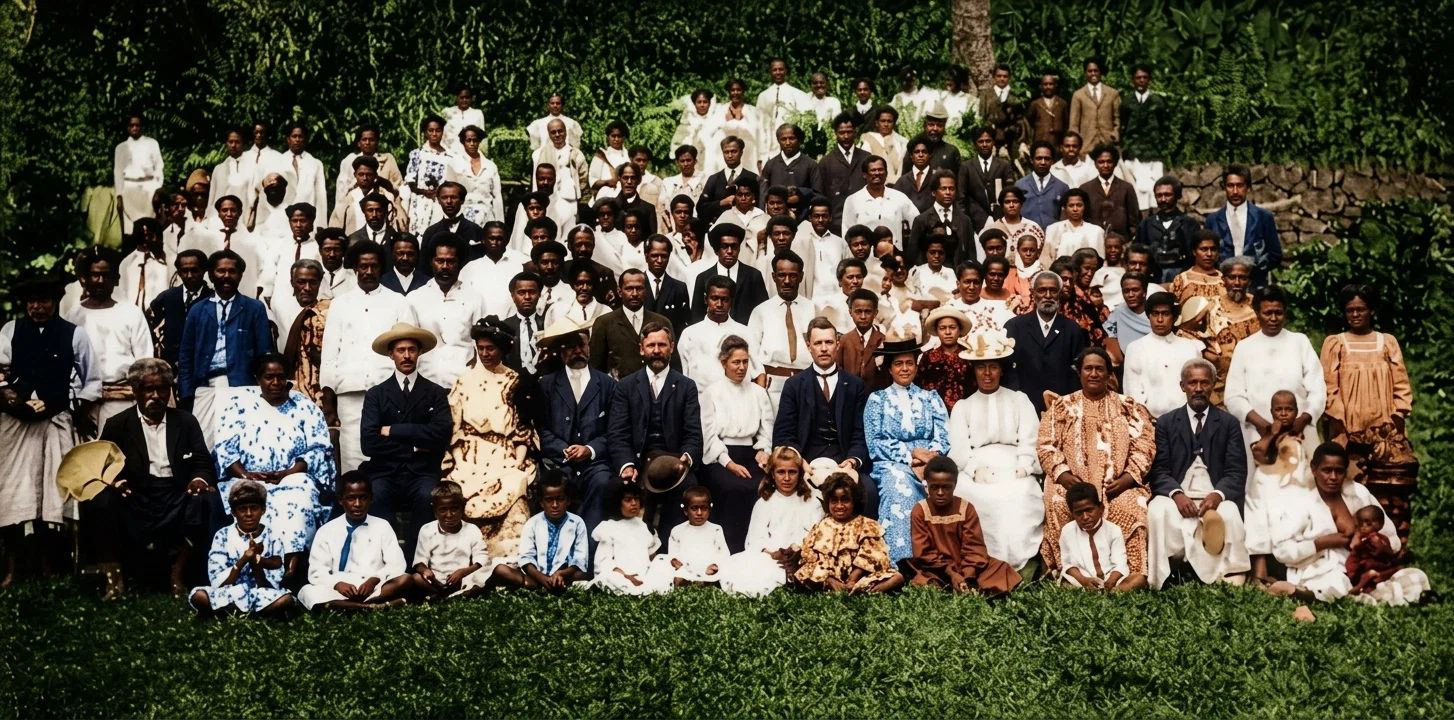
Over fifty have taken their stand with us during the past year. One whole village lately came to us en masse. At our June council about two hundred of our people were in attendance. Our Buresala school, on the island of Ovalau, came in for much thought. Out of their mites the people present gave $150 toward the erection of a new boys’ dormitory. During the year a girls’ home was added to the school, now occupied by nine young women and their European teacher, Miss Williams. We have two ordained ministers, one white, the other Fijian; a licensed minister; fifteen Bible workers, native; and five schoolteachers, two of whom are natives.
We have a printing plant at the school, which prints our monthly paper, Te Maramarama (The Light), and tracts. At the present time a small “Bible Readings” and a partial translation of “Early Writings” are being printed. This press will be utilized also for Tonga and Samoa.
Lately I found one man who had been keeping the Sabbath for two years. He had never come in contact with us as a people. While I was talking with him, another man came in, and said that there were four others, besides himself, who wanted to unite with us. These were entire strangers, but they were acquainted with what their Bibles said. As I left this house, we met the chief of the town on the full run. He was coming to hear me pray. I might relate many such incidents, but these are enough to show that Fiji is ready for the consideration of the advent message.

Tonga Islands

Tonga has had an interesting year of work. A training-school has been built up during the year, and a goodly number of young people gathered in. Some new ones have accepted the blessed truth, and others are interested.

Norfolk Island

Of work in this island, settled by people from Pitcairn long ago, Brother H. Mitchell says:—
We see many encouraging indications of progress in our work in this field. We have a fine mission home, with twenty-eight acres of land, and horses, cattle, and sheep, which we hope in time will defray the expenses of the mission. We are training some young men, whom we hope to see workers in the islands. Three of our young people are in the Avondale school, Australia. Thereis little money handled in a place like Norfolk Island, yet our Sabbath-school of forty-one members gave over forty dollars to missions during the year. Tithes and offerings were over $100, and much labor on the church and mission was given by the brethren.

A PROPHECY FULFILLING

Thus, with the East Indies and the South Pacific under its care, the Australasian Union Conference has a vast mission field. As Elder Fulton says:—
In this area are many thousands of fertile and beautiful islands, containing about forty million souls, and while it is true we have done something, yet we have really only touched this great field. But God has said that the isles “wait for his law.” The message of the commandments of God and the faith of Jesus must go to all. Isa. 24:13-15 tells of the gleaning time, when cries of triumph will sound forth from the sea, and the conclusion is, “Wherefore glorify ye the Lord in the east (R. V.), even the name of the Lord, the God of Israel, in the isles of the sea.”
GENERAL MEETING IN FIJI, 1909
In the six organized conferences of Australia and New Zealand we have several thousand loyal Sabbath-keepers who are the backing to this work in the islands. Reports from the conferences show that substantial gains have been made in the camp-meetings, tent efforts, through the circulation of our literature, and by various other means. In the early part of the year we had Elder J. N. Loughborough with us, and his testimony was a great encouragement to our people. The Avondale School for Christian Workers (Cooranbong, N. S. W.) has had a year of spiritual blessing, as well as its most successful year financially. Good work has been done at the smaller schools in New Zealand and West Australia. Workers trained at Avondale and the Sydney Sanitarium are found in all parts of our field. There never was a time in our field when the opportunities for labor were so great. O for more of the spirit and power of the Model Missionary!