Incidents of Medical Mission Work Among the Abyssinians
By L. R. Conradi
L. R. CONRADI
DURING my recent stay in Eritrea, I visited the Swedish mission station at Bellesa, seven miles from Asmara. Here I made the acquaintance of Dr. Karl Winquist, the first medical missionary sent out by the Swedish Mission Society. As he has been laboring in this colony over twenty-five years, his long and varied experience will be of interest.
Sensing the great advantage of being able to work for both the spiritual and bodily welfare of mankind, the doctor, at his own request, was sent by the Evang. Fosterlands Stiftelsen, which has its headquarters at Stockholm, to Edinburgh, where he finished the medical course. In the summer of 1883 he was sent to Massawa, East Africa, and connected with the Swedish mission station at Monkullo, some fifteen miles inland. The Swedes conducted a home for both girls and boys there, in which various nationalities were represented — the Amhara, Tigré, Tigrene, Galla, Shamkalla, also the Kunama.
Previously to his arrival, the Mohammedans, who prevail in the coast district, had avoided the mission, but when they learned that a doctor had come from Europe, they began to flock to the station from all quarters. The two rooms available he used for an office and a meeting-room, while the veranda served as a ward for the sick. A few young natives, who had acquired the Swedish, were educated as nurses, while the doctor gave his principal attention to the study of the Tigré. In the summer of 1884 he spent several months at Cheren, where he had his hands full of work. The Abyssinian chief, Alula, who then resided at Asmara, had made quite a raid into this district, and many had been wounded and were in need of a physician. The Catholic mission at Cheren, having no doctor, also asked him to look after their sick.
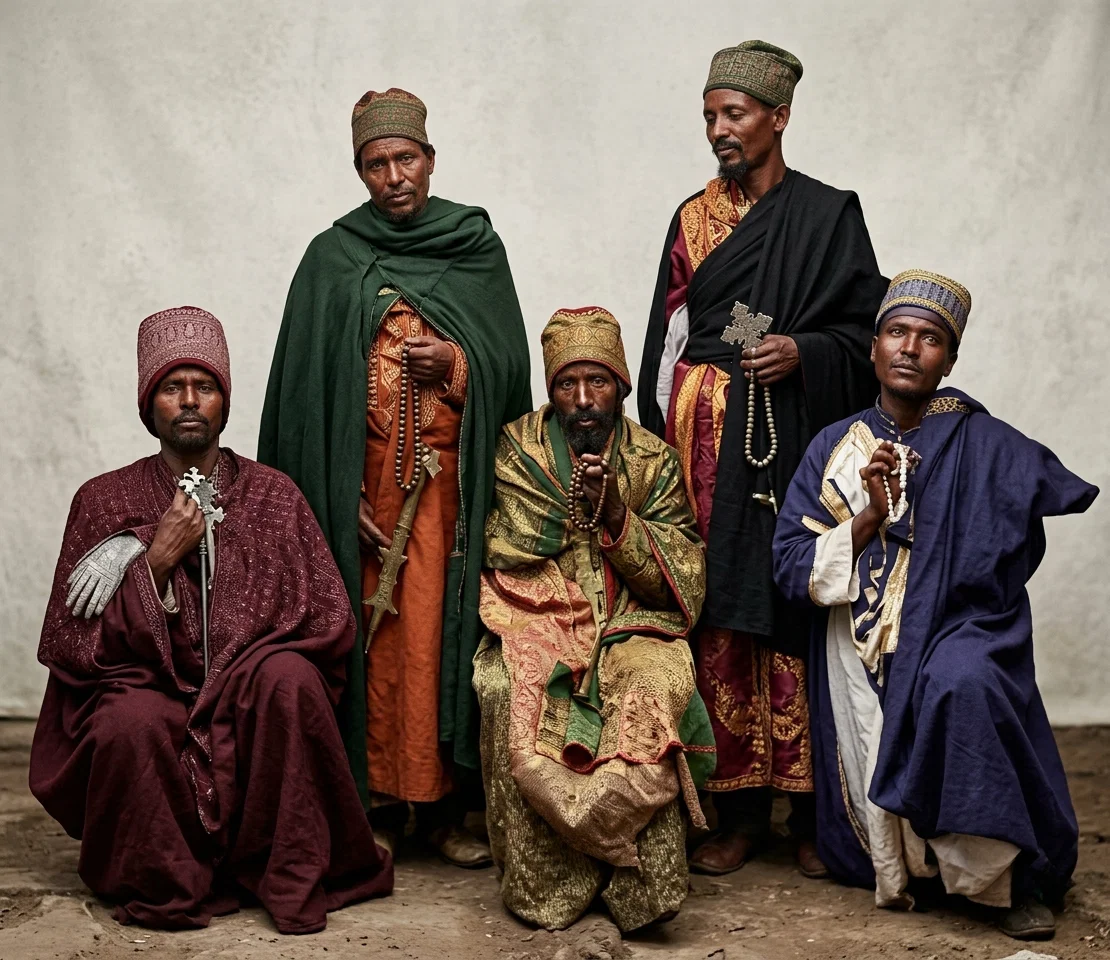
ABYSSINIAN PRIESTS
In the summer of 1885 Ras Alula sent messengers inviting him to Asmara, as he had many wounded ones in his army. Two Italian army physicians went up with him at the same time. Having some difficult cases to look after, the doctor would at times fall on his knees to ask help of the Great Physician. Ras Alula, hearing of this, chose him as his personal physician, but the doctor was obliged to taste the medicine first before he gave it to the ras. Alula became so well pleased that he wanted to retain Dr. Winquist, but was informed that he could consent only upon the condition that his fellow missionaries would be permitted to be with him. But as this permission must be obtained from the king, the doctor returned after two and one-half busy months.
In 1890 a great famine broke out in Abyssinia. Hundreds of people came down to the coast to obtain help. The cholera broke out, and there was no shelter for the sick. Through the assistance of willing friends at home, they were able to distribute a thousand loaves of bread a day, but that was as a drop in the sea. They put up some grass huts for the sick, some of whom lost their senses. Months passed ere some were fully restored. But the help rendered left grateful memories in the hearts of many, who called Monkullo, “The house of the world's Redeemer,” and some of these afterward united with the Swedish Church.
In 1885 the Italians took Massawa over from the Egyptian government. When King John, in 1889, became weakened by inner strifes, the Italians took Asmara and the whole province of Hamasen. Consequently a number of missionaries left the sickly lowlands and opened up stations in the highlands. But the doctor continued his medical mission work at Monkullo in two large grass huts during the cooler months, and in the hot season they went to the highlands and there continued their work.
In 1896, when the war was raging between the Abyssinians and Italians, nearly everybody around Massawa came down with fever. The doctor and his coworkers suffered severely from it, and in order to fully recover, he spent a year in Sweden after thirteen years of hard work. On his return, he began work at Bellesa. Here he soon found it necessary to take hold of the Tigrene language. Among his patients there was a Tigrene teacher, and thus he made good progress with his language study. During their temporary stay in the highlands, they had taken considerable pains to acquaint themselves with the people, with their manner of living and their ways of thinking. They found many of the young people anxious to learn to read. To meet this desire they first published a Tigrene primer at Monkullo. After further study, between the years 1899 and 1901, they printed in Asmara the four Gospels, a small catechism, and9Bible history. As the Tigrene had thus far not been committed to writing, the doctor had to overcome many difficulties. The result of ten years' hard work is that they have just finished the New Testament in the Tigrene, and I found him hard at work with his helpers translating the Old Testament also.
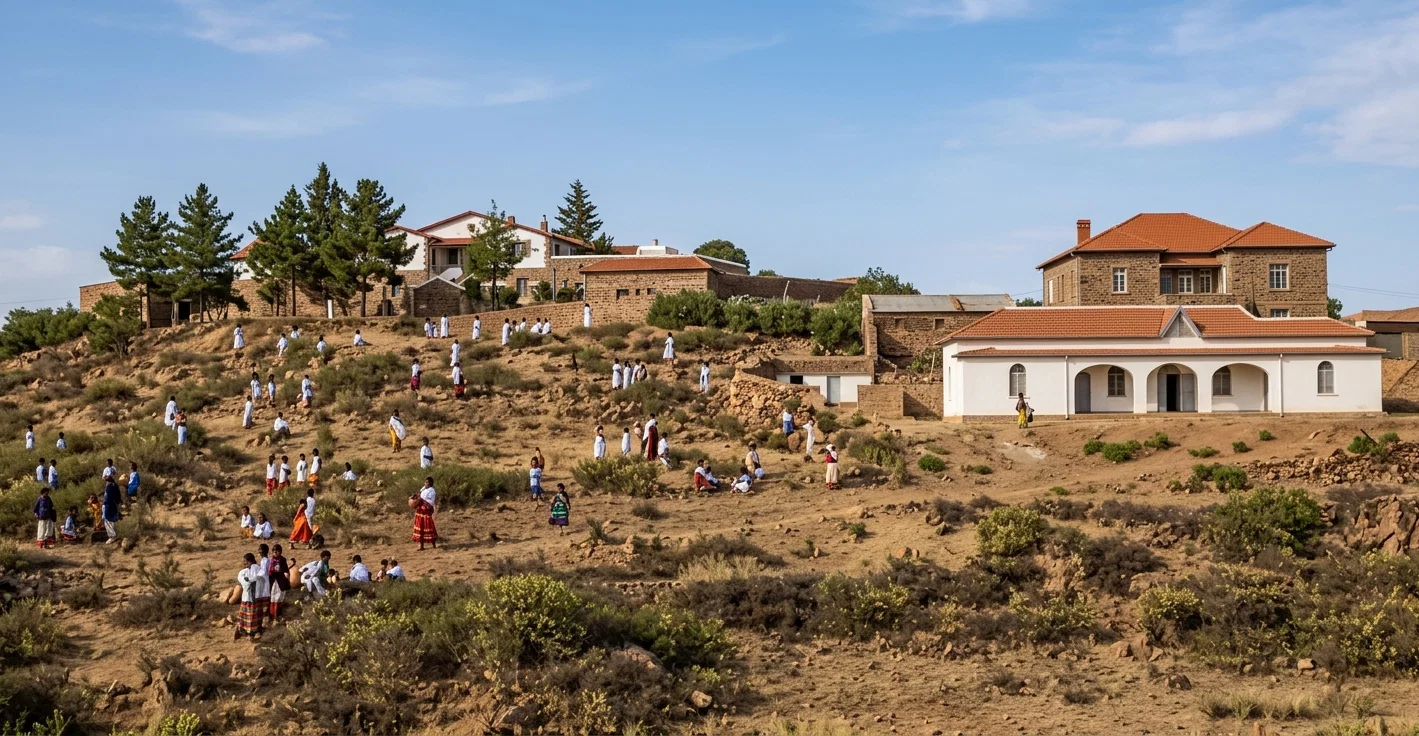
During this time they found it necessary to erect some permanent quarters for the sick who came to Bellesa. As their means were limited, a large one-story building was erected, and divided into different parts. From the picture it can be seen that the building is plain. One large room serves as meeting hall, and at times also as ward for the less ailing class of patients; then there is a ward for women, and one for men, an operating-room, a laboratory, a kitchen, and a provision-room. The hospital has room for twenty patients, and the cost of the buildings was only seven hundred dollars. The beds were made Abyssinian fashion, of stone and cement, and some mixture which gives them a glassy surface easy to be kept clean of insects. Since 1903 the doctor has had a Swedish nurse — a woman — to assist him in his work.
SWEDISH MISSION AT ASMARA
One of the native evangelists reads some part of the Bible each morning and evening, and offers prayer for the sick. They keep the Word of God in the different tongues, so that the patients can study for themselves. Many thus become acquainted with the precious truths of the gospel at the very time when their hearts are most willing to receive it.
An important question was whether the treatments should be entirely free. But as instruments, medicines, bandages, etc., are all expensive, and they had but a limited sum, they soon found it necessary to make a small charge. Many came applying for help, and quite a number of these only wanted to know whether they had any disease, but as soon as they made a nominal charge of ten centimes (or two cents), these last kept away, and only really sick people came. About twenty per cent of all the diseases were eye diseases, and next the cases of malaria from the lowlands. As the people are poorly clad, many suffer from colds. The mission workers have from 3,000 to 5,000 out-patients during the year, while in the hospital itself, they have about 130 annually. With the out-patients, the treatments given vary from between 10,000 to 20,000 a year. The present income is between $600 and $1,000 a year, which covers at least most of the expenses for medicine, etc.
As we went through this small, primitive hospital and saw the grateful faces of the patients, then went to the doctor's study-room and to the room where his translator was busy with the translation of the Bible, and then listened to the doctor's experiences as he has gone on muleback to visit the native houses, we could but realize that here was real medical missionary work — blending the healing of the body with the preaching of the word of life, yes, even providing the latter by translating it into the native tongue. During the twenty-five years, the doctor has been on furlough only once to Sweden. When I asked him why he returned only at the time when his own health was run down, he replied, “I could not leave the many sick.”
Above the hospital, is the doctor's simple home. His wife is a great help to him in translating, being the daughter of a Jewish missionary, and having been reared in Syria. Above his home the mission has a home for sixty girls, and a few simple schoolrooms. As the matron had been in England, she told us freely on what principle the school was conducted. The girls generally stay from two to three years, and while receiving instruction in their mother tongue and handiwork, are at the same time taught the Word of God. Many thus become Protestants. As the girls marry at a very early age, the mission workers have not succeeded as yet in securing good nurses, and there is not much prospect of their being able to use them as teachers. Thus the best the school can do is to educate good wives for the Protestant young men who are educated as teachers, evangelists, printers, etc., at the mission school at Asmara.
Mission work among the Abyssinians presents many difficulties, but here, as elsewhere, if the precious seed is sown with tears, it will bear fruit in time; and here, as elsewhere, true medical missionary work proves a mighty factor in bringing the gospel to the dark natives.
Dr. Winquist called on me in Asmara, November 25, when we had a long talk together about the “present truth,” and I gave him the Special REVIEW and some other periodicals. On December 4 he rode again to town, and the next day, we learned that he had suddenly passed away. So now he rests at Bellesa, until the great Chief Physician gives life indeed. Dr. Vasenius attended the funeral to represent the Seventh-day Adventist Mission.