The Seventh-day Adventist Mission of Eritrea and Abyssinia
4%

Review and Herald Publishing Association · Takoma Park Station, Washington, D. C. · Mar 24, 1910

FromReview and Herald, Vol. 87, No. 12.

Read the full edition

The Seventh-day Adventist Mission of Eritrea and Abyssinia
L. R. CONRADI
KING MENELIK OF ABYSSINIA
(See article on Abyssinia on page 8)
KING MENELIK OF ABYSSINIA (See article on Abyssinia on page 8)
Missions, as well as countries and individuals, have their peculiar histories; so this new mission has its history from the beginning of investigations until its final establishment at the end of 1909. Some twenty years ago the writer's attention was first attracted to Abyssinia while editing Elder J. N. Andrews's “Sabbath History” for the German people. As I learned that the Abyssinians in their high mountain recesses prevailed for ten centuries against the overwhelming powers of Islam; that when they appealed in the seventeenth century to the Portuguese for help, the Jesuits took advantage of their distress, and granted assistance on the pledge that the king would insist that his people submit to Rome and renounce their peculiar tenets—among them a special regard for the seventh-day Sabbath as a day of public worship in memory of the creation; and that the Abyssinians shook off the iron yoke, an ardent desire arose in my heart some day to come into direct contact with them. From the meager knowledge possessed by the world in regard to that people, I also learned that the Abyssinians ever since this cruel attempt of the Jesuits were suspicious of all missions, and had lately closed their doors against all.
QUEEN TAITU, WIFE OF MENELIK, KING OF ABYSSINIA
Years afterward, while traveling on a Russian steamer bound for Joppa, six dusky pilgrims, joining us at Beirut, increased my interest in this mission field. Their crosses suspended on blue strings around their necks, their praying before every meal, their reading in prayer-books, attracted my attention, and soon I found out that my neighbors were Abyssinian pilgrims. Reaching Jerusalem, I soon found their church, near our health institute, and was informed that they had services every Sabbath. In conversation with some of their priests through an Arab interpreter, I was assured that they had special services on the seventh day in accordance with the fourth commandment, while Sunday services were also held because it was customary among the other Christians. Returning to Germany, I told the simple story, and our members quickly responded, and about five hundred dollars was collected as the first Abyssinian mission fund.
Six years ago I met in Dar-es-Salaam, an aged German missionary who for years had been laboring on the Egyptian side, and had married a Galla woman, but finally had had to give up the attempt of entering Abyssinia from the west.
Next I learned that Swedish Lutherans had carried on mission work from the Red Sea for nearly thirty years, and, at my first opportunity, I visited their headquarters at Stockholm, and their school at Johannelund, where I gained much information both from books and also from missionaries who had been there. Here I also formed the acquaintance of Professor Taleen, who, at the request of the German emperor, had been sent by King Menelik to teach the Amharic language in the oriental seminary at Berlin. He assured me that, especially in some of the interior provinces, the Sabbath was held in greater esteem as a day of worship than Sunday. One of the Swedish missionaries informed me that Bishop Tucker, of Uganda, had expressed the conviction to him that the best way of access, especially to the Galla people in the south, would be from Lake Rudolph. But inquiry made by the British commissioner destroyed the hope of entering from that section; for the English government had no agent as yet in the territory close to Lake Rudolph, and they were averse to having any missionaries settle there.
Next I made the acquaintance of Missionary Flathe, who had labored about fifteen years among the Abyssinian Jews, or fellahs, with success, but was taken captive by King Theodor, who sent him as a special envoy to Queen Victoria. But as soon as Emperor Menelik [see his picture on first page of this paper] gained full control, all missionaries had to leave. Thus every avenue seemed closed, except one—the Italian colony of Eritrea.
When our German, British, and French Sabbath-keepers began to occupy their respective colonies in Africa, it was but natural that the Scandinavians should also have a special portion, and as the Swedish Lutherans labored in Eritrea, providence pointed to it, and to Abyssinia with its ten millions of people, as their special field. In the early part of 1907, Brethren P. N. Lindegren and J. Persson were appointed, and after some preparatory study sent to Eritrea. They rented dwellings at Asmara, and at once began the study of both Italian, the government language, and Tigré, the language spoken by the natives. In the fall of 1908 Brother Lindegren attended our general meeting at Beirut, expectingto take Sisters Larson and Rhode back with him on his return. But a few days before we left, he was taken sick with typhoid fever, and the two sisters had to proceed alone. The Italian officials demanded so many documents for the marriage that Brother Persson could not marry until August, 1909, and Brother Lindegren until the end of December, 1909.
The brethren looked over the whole colony to secure suitable locations for our missions, and there seemed to be no obstacle in the way of securing them. In view of this, Elder E. Grundset, of New York, was selected as director of this new field at the last General Conference, and Dr. F. W. Vasenius and Brother V. E. Toppenberg were appointed to assist there. In order that Elder Grundset might become somewhat acquainted before I should arrive, he left for Asmara in October, while Dr. Vasenius and wife, and Brother Toppenberg came with me. Immediately after my arrival on November 18, we looked at some places near Asmara, and called on the secretary, as the governor was absent, and also on Professor Baldrati, the land commissioner.
Four days after my arrival we secured an audience with the governor. He informed us that the colony had but a small population, that there were already several missions, and that the political situation across the Abyssinian border was so uncertain that they had to use every precaution not to stir up any trouble among the Abyssinians in their own colony. Consequently he could only grant us some land within the town limit of Asmara,—about a three-mile circle.
We therefore selected a suitable piece of about sixty acres, near a village, but on the twenty-seventh the reply came that we could secure only fifteen acres as a free grant; that the villagers were objecting to our securing the farm in question. As the fifteen-acre homestead grants were limited to one piece, near the fortress, with no surety of water, we next turned our attention to some homesteads already occupied by Italians. Several were willing to sell their rights, but again the matter had to be submitted to the governor. Finally, on December 2, we received the reply that we were at liberty to buy any favorable concession in the prescribed town-limit. After prayerful consideration, we finally concluded that we would buy the homestead of a Mr. Pollesco, containing seventy-five acres, on which there was a fair crop of wheat, and which also had water. We agreed on nearly eight hundred dollars for this concession. As he had been back on it the required time, and had fulfilled all other requirements of the homestead law, we entered into his rights, and can obtain the concession as full property at any time we desire. The only open question is whether we shall have it deeded free, or whether we must pay an additional two hundred forty dollars to the government. Meanwhile we pay a nominal rent of twelve dollars to the government.
On December 6 I called once more on the governor, to convey our thanks, and to ask several favors, also on the secretary, and on Professor Baldrati, the latter having been very kind to us, as has also the chancellor, Signor Consortori, who made out the deed to the “Seventh-day Adventist Mission of Eritrea and Abyssinia,” which was duly signed on the same day. The farm joins the first sixty acres for which we applied, and lies within one and one-half miles of the center of the town. Asmara, being the capital, will soon be a railway center; it is the natural gateway to northern Abyssinia, and has an excellent climate; so we have every reason to be grateful to God that such a fine location has been secured.
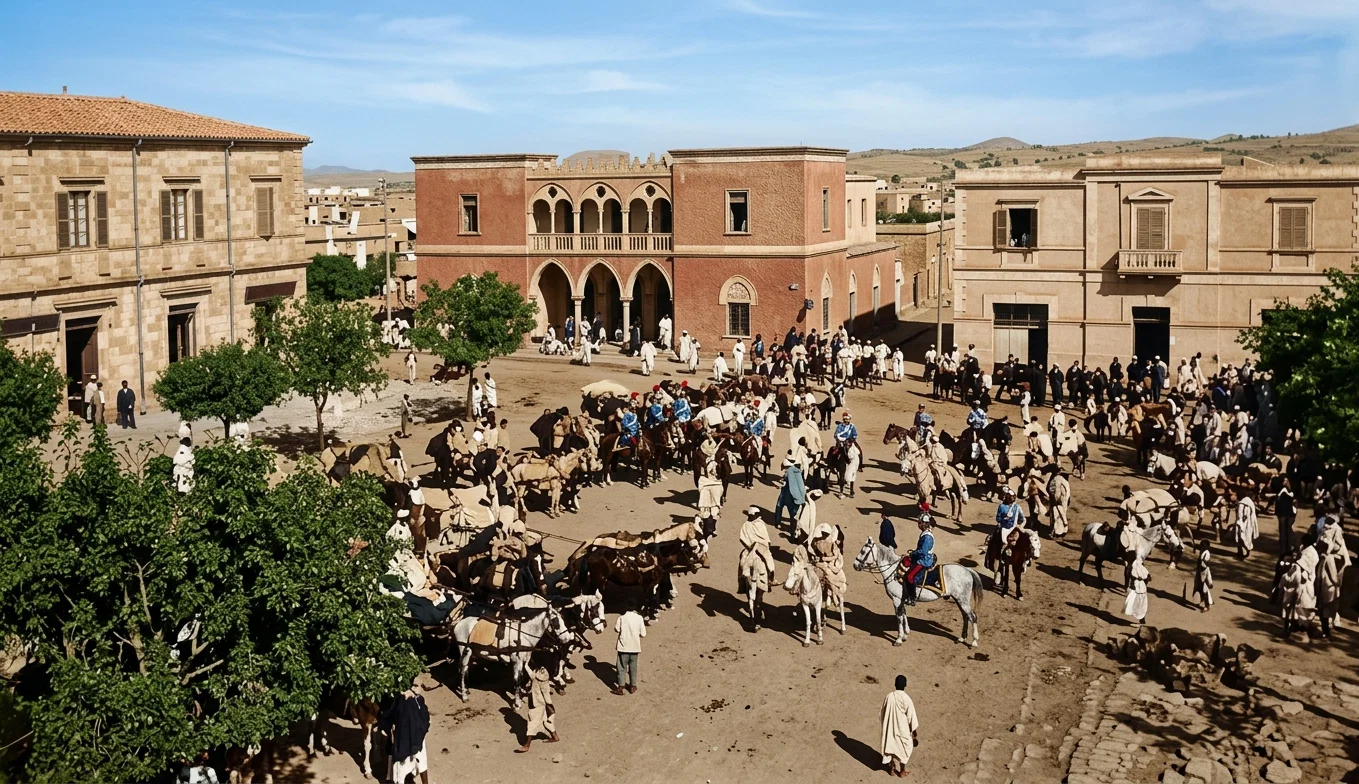
ASMARA
Building in center is the post-office. Near this our missionaries now live. Italian mounted soldiers standing in the square
ASMARA Building in center is the post-office. Near this our missionaries now live. Italian mounted soldiers standing in the square
Both the Roman Catholic and Lutheran missions endeavored to keep us out, but we went many times to the different officials, beseeching them like the importunate widow, and the Lord did not disappoint us. Meanwhile we studied the question of building, and obtained the prices for materials, etc., also drew up plans for a school and for a dwelling-house for two families.
There is sufficient stone on the very spot where the buildings are to be placed. The buildings, well, seed, oxen, carts, etc., will cost us about two thousand dollars, and we shall have to send some four thousand dollars within the first four months of 1910. As the Abyssinian Mission is to have three thousand dollars from the $300,000 Fund, we hope that all our people will rally to raise this amount soon.
In four months the buildings are to be completed, and we expect that the products raised, together with the nominal rent charged our missionaries, will give sufficient means to keep from ten to fifteen young men at school. The cost for each is figured at some thirty dollars a year. One of the hard problems will be to secure good reliable young men, who will unite with us and become workers.
On Sabbath, December 4, the church at Asmara was organized, nine offering their names, and a tenth one expecting to be baptized at the earliest opportunity; and though it is a church of missionaries, yet a foundation for the spiritual building is laid. The Lord drew near to us as we celebrated the ordinances, and all testified of his goodness in opening the way before us.
Quite a number of problems still need to be worked out. If possible, our medical missionaries ought to enter Abyssinia proper during 1910. This means some important and careful correspondence. Probably one of our workers may go in the spring to Uganda, as the way seems now to open, and begin work from that corner. But meanwhile, all our missionaries have here the very best chance of studying the three leading languages of Abyssinia. Brother Persson has already such a fair knowledge of both the Italian and Tigré that he could fluently interpret for me. Brother Lindegren is working hard to gain a knowledge of the Tigré; Elder Grundset and family are beginning to study the Tigré, while Dr. Vasenius and wife are to study the Amharic, and Brother Toppenberg the Galla.
Asmara being heathful, and good lodgings obtainable at fair prices, our missionaries have here a golden chance to learn the languages, as well as the ways of the people, at the same time helping in constructing the buildings, and becoming in every way better prepared for their work. Asmara itself is a favorable location for our school, as here we have religious liberty, weekly mail facilities, and Europe and Abyssinia are easy of access to us. After all was settled, I remained with them two days and a half. During this time I rode about seventy miles on muleback, visiting the Swedish superintendent, who had just returned from Syria, at Zazega, and going some twenty-five miles south to Debaroa, toward the Abyssinian border, where our brethren thought of establishing another station if the way should open. About forty miles more would have brought me to the present border of Abyssinia.
But twenty years ago Asmara was an important Abyssinian town, and there are thousands of Abyssinians living in and about it. The Abyssinian Mission is fairly opened, a foothold has been obtained, and soon another school will be erected at an elevation of eight thousand feet, to shine as a beacon light in this portion of Africa. It is now for our people to rally to our support, helping with their means and their prayers, that the work may be quickly extended.
Asmara.