The India Mission Field

8%

Review and Herald Publishing Association · Takoma Park Station, Washington, D. C. · Mar 10, 1910

FromReview and Herald, Vol. 87, No. 10.

Read the full edition

The India Mission Field

J. L. SHAW
The Master said, “Behold, I say unto you, lift up your eyes, and look on the fields; for they are white already to harvest.” “The field is the world,” and India is a great unwarned and waiting part of that field. Though not comprehending more than one thirty-fifth of the world’s area, in population it is a continent in itself. The figures are 297,970,499—but these are bare figures. And how wholly wanting are they to give any adequate idea of this one fifth of the human family, which, hemmed in to itself, forms a world all its own.
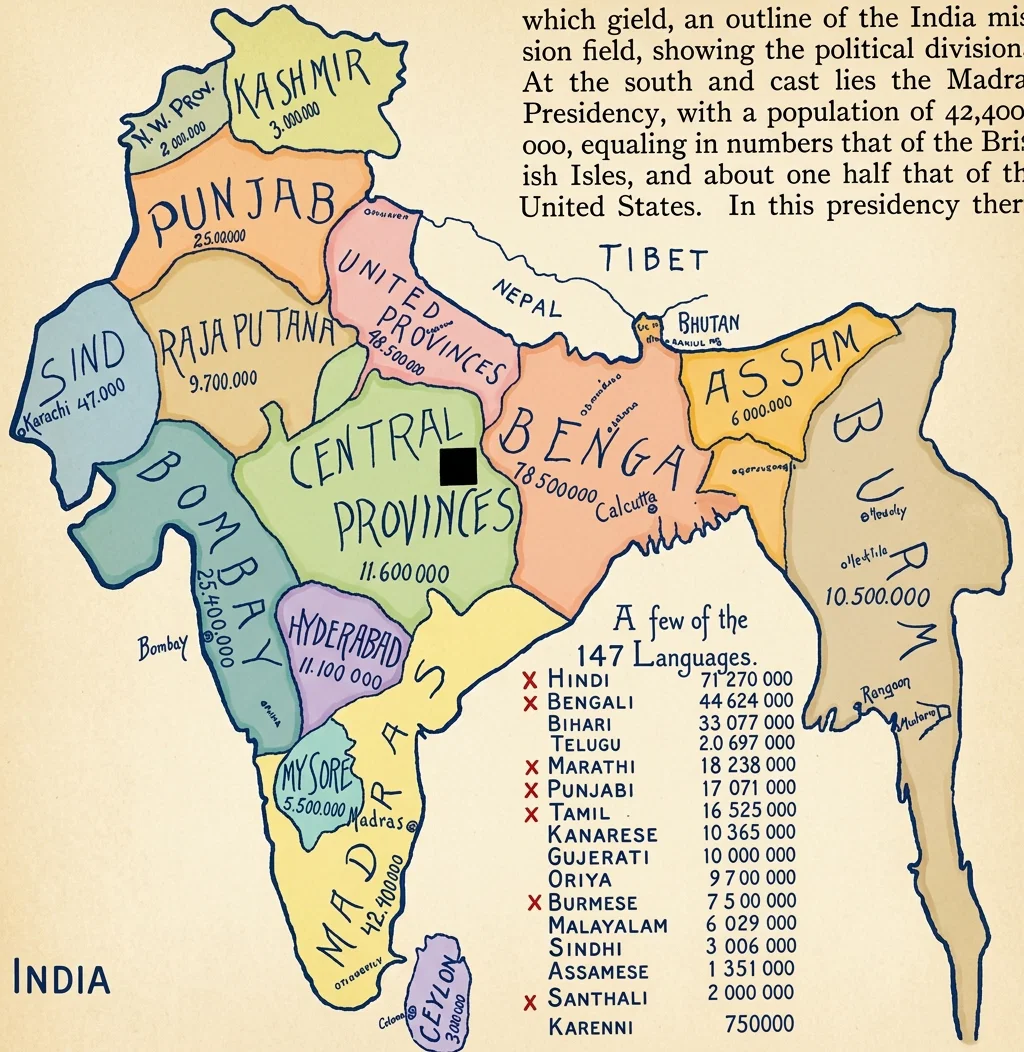
PROVINCES, POPULATION, AND PRINCIPAL LANGUAGES OF INDIA. THE BLACK SQUARE SHOWS THE PROPORTION OF CHRISTIANS TO THE HEATHEN
Let us look at the accompanying map, which gives an outline of the India mission field, showing the political divisions. At the south and east lies the Madras Presidency, with a population of 42,400,000, equaling in numbers that of the British Isles, and about one half that of the United States. In this presidency there are two families and one single worker located, in the southernmost extremity among the Tamil Sabbath-keepers. Madras, its capital, the third city of India, has no laborer. We met one Sabbath-keeping family a year ago when there. They besought us for a minister to come, and desired to know whether, if money were found to pay transportation, one would come and help them. This city, with nearly half a million people, is a great field in itself. Few, if any, cities are there so great in numbers without an appointed representative of present truth.
To the north, yet mostly within the Madras Presidency, are the more than twenty millions of Telugus. We have gone through their country several times, and have seen the people, and talked with them. Other missionary societies are operating in this territory, making many converts, multiplying missions,schools, and hospitals, yet we have no one among the Telugus who can speak their language, and we have never so much as voted any one to them. Think of it, dear friends! twenty millions—one fourth the population of the United States, three times the population of Australia, and more than double that of the South African Union Conference, and yet no entrance. At the present stage of the work there are few languages spoken by so many millions without at least one or two centers of light.
Going farther north and east, we find Bengal, with 78,500,000—more than four fifths as many as the population of the United States. The Bengali people alone number 44,620,000. Among them are located three families and a single worker. But what are three families without a mission property, a school, or a hospital? True, some literature has been prepared, and a few Sabbath-keepers have been gathered out. A Bengali church has been organized in Calcutta.
Farther west and north are the United Provinces, with 48,500,000. Within their boundaries lie the Mountain Mission Rest Home, which is the largest property we own in India, costing eight thousand dollars. These provinces are the very center of the great Hindustani world. A few Sabbath-keepers have been gathered, and a year ago the first church was organized. Here we have two families and three single missionaries.
The Punjab, Northwest Provinces, and Kashmir, lying still farther north and west, with more than 30,000,000 inhabitants, have no representative of the present truth. Punjab alone has a population of 25,000,000. To the south are the provinces of Rajputana, and Central India, and Central Provinces, neither of which has a Seventh-day Adventist within its borders.
To the west is the Bombay Presidency, with two families. East and south are the native states of Hyderabad and Mysore, into which we have not entered. To the east, across the Bay of Bengal, is Burma, with three families and three single representatives of the message. Other small provinces, like Baroda and Berar, in the west, and Assam in the northeast, lie unentered. Considerable has been done in different parts of India in English, mostly on the Calcutta side. There is a church at Calcutta, Lucknow, and Mussoorie. Yet the English-speaking people of this country are few, only a drop in the bucket of Indian humanity.
We have made a small beginning in seven of the languages—seven out of one hundred forty-seven marks the hand of progress here. And so these nations tell us of vast unentered territories. They speak to us in an unknown tongue. We do not hear or know their need, yet they are waiting, in their ignorance, waiting for the Light of the world, and the glorious message of our coming King. Who now is willing, who is able, who is ready to pioneer the way among the unentered dialects of India?
Takoma Park, D. C.