To the Highlands of Abyssinia

8%

Review and Herald Publishing Association · Takoma Park Station, Washington, D. C. · Mar 3, 1910

FromReview and Herald, Vol. 87, No. 9.

Read the full edition

To the Highlands of Abyssinia

L. R. CONRADI
From the middle of the Red Sea to the equator, or over one thousand miles north and south and six hundred miles from west to east, extends the great coast line behind which Abyssinia towers to an elevation of about eight thousand feet, the vast Switzerland of Africa. Italy has acquired the largest share of this coast. Its northern colony, Eritrea, extends five hundred miles along the Red Sea; then come French and British Somaliland, occupying a strip of about three hundred miles in extent; then Italian Somaliland, bordering the Indian Ocean for another six hundred miles. As early as 1850 Italian statesmen had their eye on this long coast line. After England punished King Theodor of Abyssinia in 1869, the plan took tangible shape. As England was exceedingly sensitive on the subject of the Red Sea, Italy obtained its first footing only by diplomatic strategy.
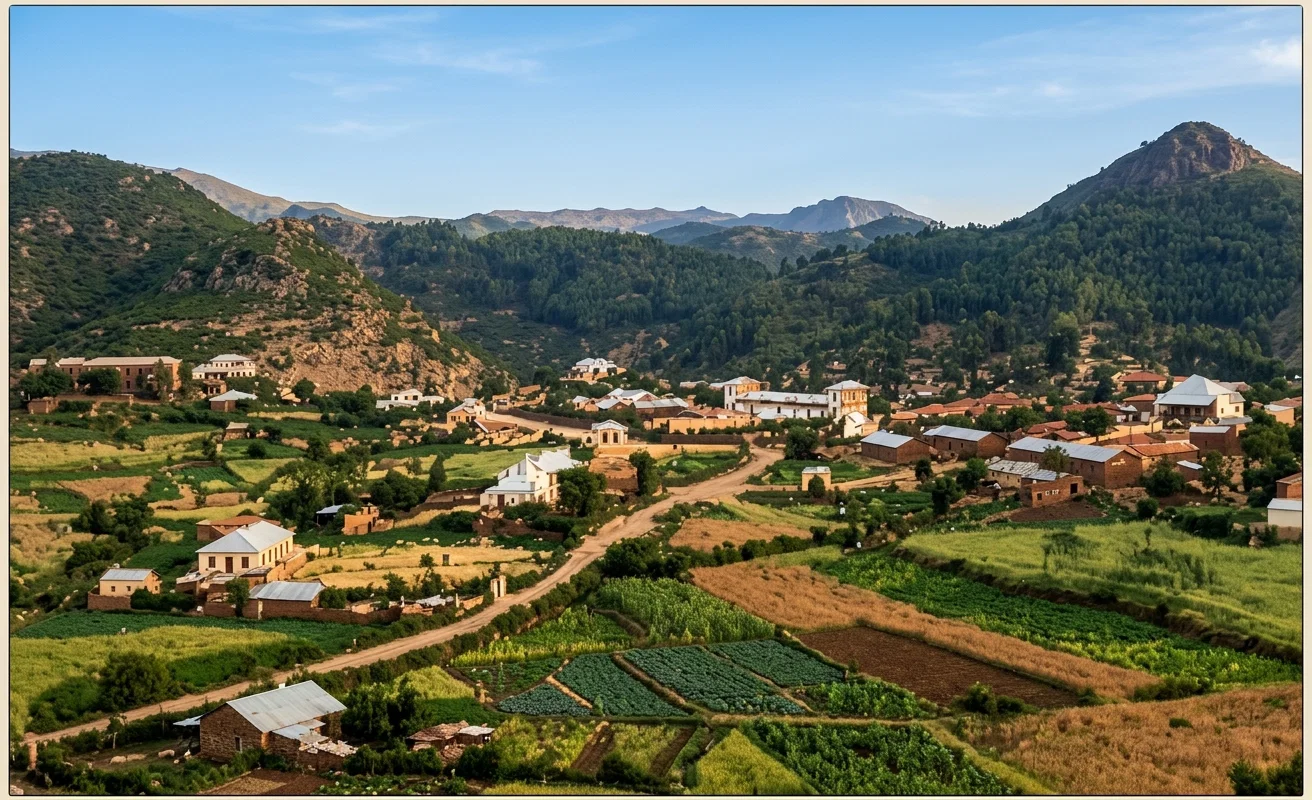
GHINDA, THE TERMINUS OF THE RAILWAY. ABOVE, ON THE MOUNTAINS, LIES ASMARA
On March 11, 1870, the Florio Rubattino Steamship Co., of Genoa, obtained from Sultan Rechambey, who claimed independence for both Turkey and Egypt, the bay of Assab and the island of Darmaba, as a commercial settlement. Though England and Egypt protested, yet in January, 1881, a commissioner was appointed. As his secretary and some seventy-five soldiers were killed on an exploration tour in the interior in June, Italy had now sufficient pretext to declare it an Italian colony.
Massawa, one hundred eighty miles north, had not been mentioned. As early as 1557 the Turks had taken this important seaport from the Arabs; in 1886 they, pressed by England, ceded it to Egypt. As late as 1884, the Abyssinian king, Theodor, demanded that Egypt should either cede it to Abyssinia, or else promise not to give it to any other European power. But when England was hard pressed by the Mahdi, she was anxious to obtain Italy's co-operation, and on Feb. 6, 1885, Admiral Caina issued this proclamation: “The Italian government, in friendship with England, Turkey, and Egypt, has commanded me to occupy the town.” In the following November the Italian commander simply asked the Egyptian governor to evacuate the forts, who quietly yielded. Abyssinia protested, but in spite of the protests, Italy erected strong forts on the mainland. The Italians lost over four hundred men in an engagement in January, 1887; then the government sent two thousand soldiers there under an experienced general, and sought the friendship of the Mohammedan Arabs along the coast. When King Theodor descended to the coast with some fifteen thousand men, the general wisely avoided a battle, and the king was obliged to return, losing his life, March 9, 1889, as a result of attacking the Mahdists. King Menelik succeeded him, and entered into a friendly agreement with Italy, September 21. This agreement was written in the Amharic; and then, in a French version, was brought by Italy to the notice of the European powers. But while the Amharic stated that the chief king of the Ethiopian kings might in future make use of the Italian diplomats in conducting its affairs with the European powers, the French version declared that he must, thus virtually declaring Abyssinia an Italian protectorate. Meanwhile Italy secured some strategic point farther inland, and by a royal decree of Dec. 20, 1889, all the long coast line was declared an Italian possession, and called “Colony Eritrea.” The Italian governor, without consulting Menelik, entered also into a friendly agreement with the governor of the adjoining Abyssinian province of Tigré. Menelik vainly protested; his letters were left without reply, and consequently, in a letter of February, 1893, he accused Italy of perfidy, and declared the agreement null and void. As the governor of Tigré had also broken friendship, General Baratieri, with over seventeen thousand Italian soldiers, advanced into the interior, the Abyssinians constantly retreating, until the general was far from his strong base of operation.
Meanwhile an army of one hundred twenty thousand Abyssinians, under Menelik himself, gathered about Adua, and as Baratieri, urged by wires from Rome, on Feb. 29, 1895, advanced into the mountains at the dawn of day, marching in three different columns, the Abyssinians swooped suddenly down upon them, inflicting the most terrible defeat any European army ever suffered in Africa. Several generals, four hundred officers, and over ten thousand soldiers lost their lives, and an immense quantity of ammunition and all the guns fell into the hands of Menelik. But still more terrible was the punishment inflicted by Menelik on the few thousand natives who fought in the Italian ranks; he simply had their left hand and right foot cut off. I met several of these survivors, showing their crippled limbs and asking for alms. Menelik has ever since been the undisputed ruler over eight and one-half millions of Abyssinians. But it is a fact, that if the general had avoided an engagement for a few days longer, Menelik, lacking any systematic organization for provision, would have been forced to disband his army.
Italy sent Governor Martin to arrange for peace, who since has turned his attention to developing the colony. Nowhere in East Africa did I find such a fine system of roads as in Eritrea, and many of them lead over most difficult mountain passes. Massawa itself is an island, connected with the mainland by two moles,—a shorter one leading to the island, whence the railway starts, the other, a long one, being a path for the railway to reach the mainland. Thus far, the railway, a narrow gauge, has been completed up to Ghinda, three thousand feet above the Red Sea, a distance of fifty miles. There is but little vegetation, only in the watercourses, and they contain but little water most of the year. About fifteen miles inland, we passed Monkullo, where the Swedish Lutheran missionaries began their operations, the wooden house shipped from Sweden still standing near the Arab villages, on which they made but little impression. Farther on, Italian forts in the midst of the mountain desert were passed, and some monuments and gravestold of the early struggles to gain a foothold. A few hours' ride on the cars took us over a territory for whose possession the soldiers fought for years; and for an equal length of time the missionary struggled in the hot feverish plains below to gain an entrance among the Abyssinians as they came to the seashore with their merchandise. Quite a number of noble missionaries have lost their lives in this peaceful combat in behalf of the cross.
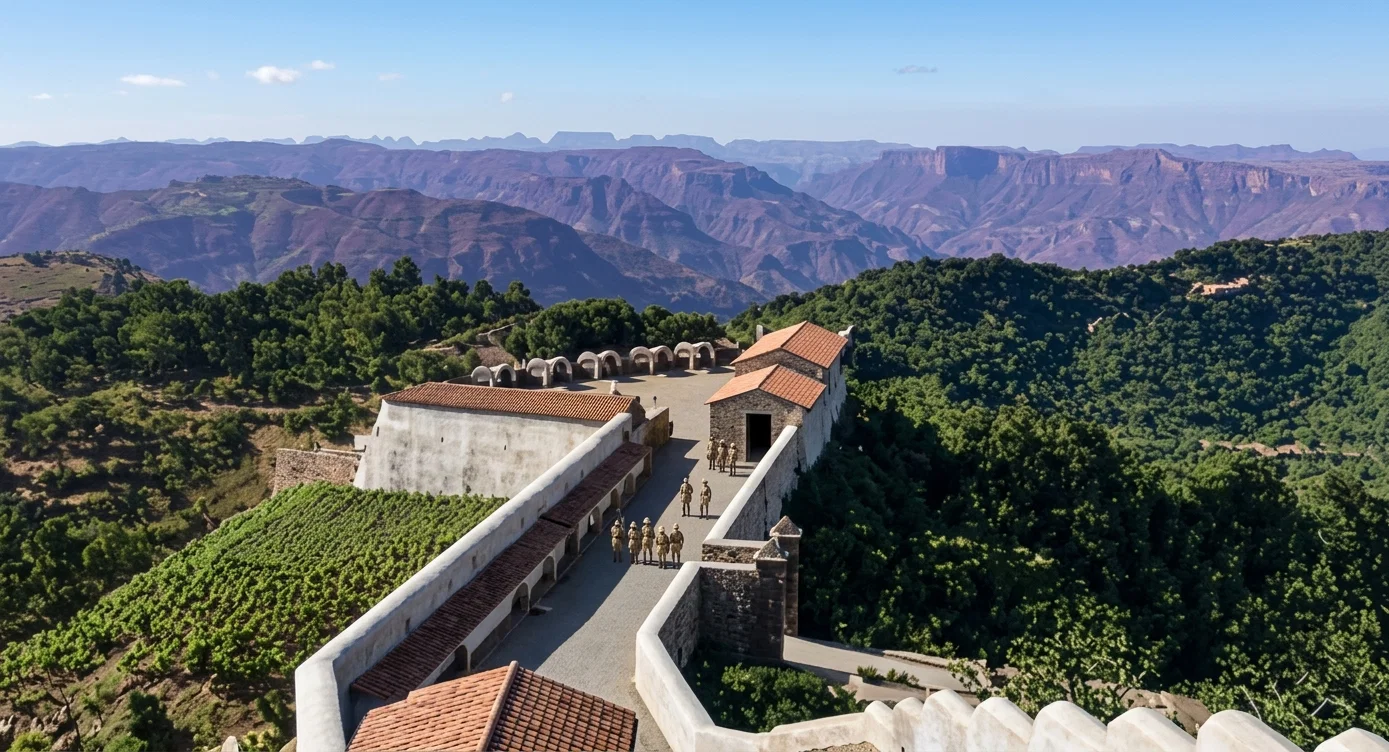
AN ITALIAN MOUNTAIN FORT
At the railway station a special mail-coach, drawn by mules, was awaiting us, to carry five of us the remaining thirty miles between here and Asmara. It was not so much the distance that made this journey remarkable as the fact that in this thirty miles we would ascend five thousand feet higher, up to the Abyssinian plateau. Leaving at noon, and changing mules every six miles, driving from three to five mules according to the steepness, we made this journey in six hours,—and a wonderful ride it was indeed! At one station, we could see right above us our next station, almost hidden in the clouds, and the road winding its way forward and backward to the summit. Then scarcely two hours later, we looked down, yes, looked seventy miles in the distance, and there, as a tiny white spot at the edge of the blue sea, saw the white houses of Massawa! The road was often only wide enough for one team, and as the mail-coach advanced, the driver would blow his bugle, and long rows of camels, or of heavy-loaded teams would halt and press against the edges of the rocks until we passed. Two years more and the bugle of the mail-coach will have given way to the shrill whistle of the engine, the rails being already laid nearly half of the distance. The tracks of the railway, in longer and easier bends through tunnels and viaducts, will climb up in hours, where camels and men before toiled days over dangerous mountain paths!
Africa is indeed opening up, and even the steep mountains of Abyssinia, which proved a mighty bulwark against the inroads of Islam for ten centuries, are conquered by modern technic; and as the railway advances, Abyssinia itself must open its doors, not only to the trader and tourist, but also to the missionary.
As the evening drew nigh, and we found ourselves in the midst of the clouds, our heavy overcoats proved none too warm. A ride of a few miles over the plateau, and the electric lights of Asmara greeted us—a modern town, and yet quite a share of it consists of the round huts, or tobals, of the Abyssinians. As our coach halted close to the post-office in the center of the town, Brethren A. Grundset and J. Persson bade us welcome to their hospitable homes—the end of our long journey had been reached, we were actually above and in the midst of the clouds of Africa, among our own brethren and sisters, and yet among the Abyssinians.
Hamburg, Germany.