Reading on Religious Liberty for Sabbath, Feb. 5, 1910
By K. C. R.
THE past few years have not been characterized to any great extent by bitter outbursts of persecution for violation of the Sunday laws; nevertheless that affords no reason why we should lessen our activities in enlightening the people on the principles of religious liberty. Indeed, we should be more active when there are seasons in which we are left free to worship God according to the dictates of our own consciences.
This lull from the intolerance of those who long to see the earth rid of God's commandment-keeping people has been in the providence of God, in order that his people might do uninterruptedly the work he has committed to them.
Each should seriously ask himself the question, “Have I improved the golden opportunities which have been granted me, in doing what I could to give the warning message against the beast, his image, and the reception of his mark?”
While outwardly there has been no very prominent demonstration of religious intolerance, we should not allow ourselves to feel that we have been needlessly alarmed. If we do, we deceive ourselves, as multitudes in the world are deceived. If this indifference was confined to those who are unacquainted with the third angel's message, the situation would not be so serious. Are not many Seventh-day Adventists saying by their inactivity in this department of the Lord's work that it is not necessary to make so much of a stir over this matter?
A brief outline of the activities of the forces that are seeking to bring about the very things the sure word of prophecy has warned us would come, may be of interest to us at this time. If these events scheduled on the great prophetic program do not take place, they will be the first prophetic utterances to fail of meeting with a remarkable and unerring fulfillment. The facts are that these acts in the great prophetic drama are no less important than any that have gone before.
We are all aware that the warning is first against the beast. Little has been said concerning the mighty strides that the Roman Catholic Church has been making during recent years. The January number of Current Literature quotes from a book on Roman Catholicism, which gives the total number of Roman Catholics in the world as three hundred million, and fifteen million six hundred thousand of these are in this country; in other words, one in every six of the inhabitants of the United States is a Roman Catholic. With so rapid a growth of this church during recent years, it is not difficult to estimate what influence and power she will be able to exert in another decade.
It will be remembered that recently the Catholic Church has launched a thoroughly organized proselyting propaganda in this country. She is sending forth educated and talented priests to conduct meetings in large cities for non-Catholics.
It must be confessed that she is exerting a great influence politically; besides, the public press is largely under her censorship and control.
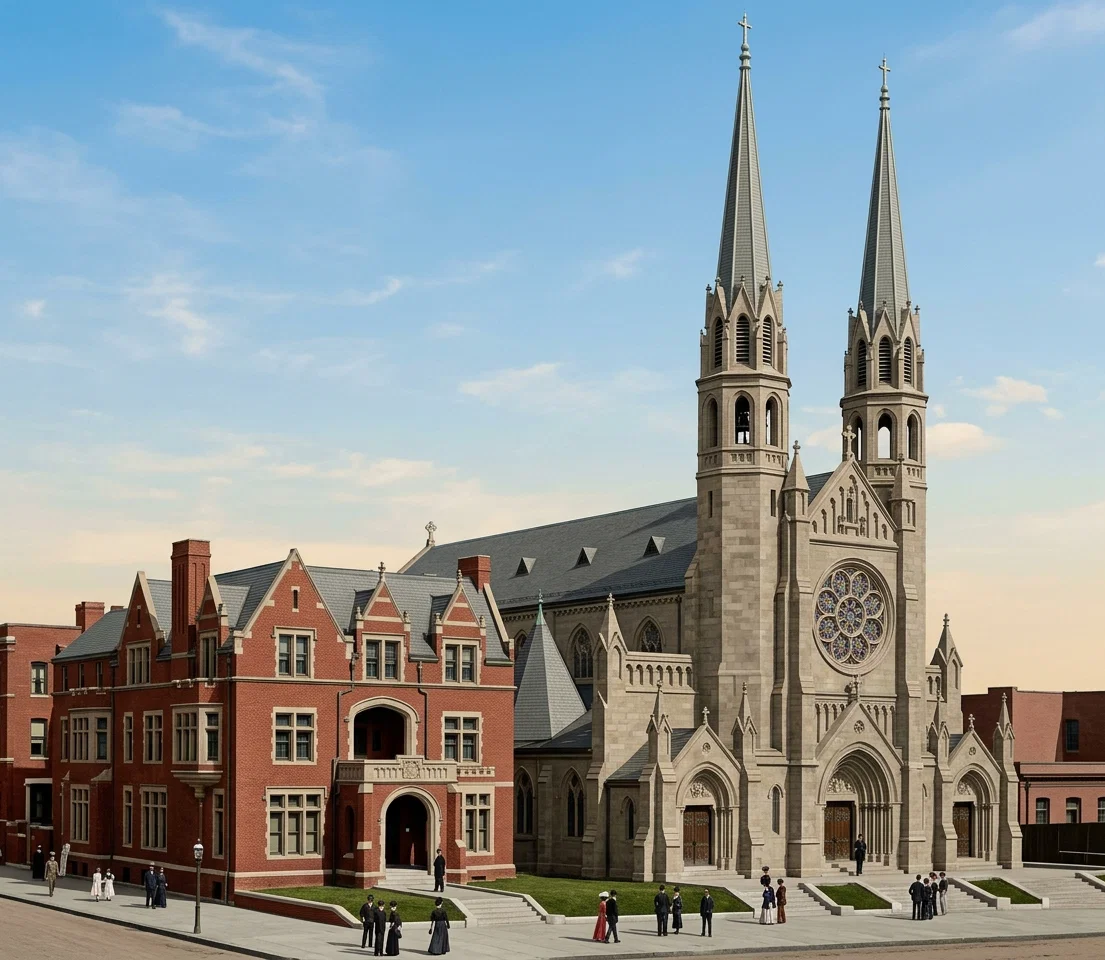
Recently in Washington a great and significant function was held in St. Patrick's Catholic Church, at which President Taft, his cabinet officers, justices of the Supreme Court, members of Congress, and representatives of other nations were in attendance. The Washington Post speaks of the occasion as follows:—
“The Pan-American Thanksgiving day celebration at St. Patrick's Church in this city yesterday was an event unparalleled in the annals of religious16functions in this country, and the first occasion in the world's history when all the independent nations of the Western hemisphere united for the celebration of a thanksgiving festival.
“The ceremony formed an epoch also in the history of the Catholic Church in America, because it was the first solemn mass of thanksgiving ever attended by the President of the United States on the day set apart by him and his predecessors as ‘one of general thanksgiving.’”
Yet in the face of these facts, multitudes of professed Protestants do not see the danger confronting them, but instead believe that Rome is becoming Protestantized. It is not difficult to understand why it is that so many in recent years have not learned the character of this organization, for the Catholic Church has been successful in having eliminated from many school-books and histories any reference to her past terrible history. How truly the Lord symbolizes her cunning and craftiness when he speaks of the “little horn” as possessing “eyes like the eyes of man”!
The various efforts of the professed Protestant churches to effect a union of church and state in this country are all pleasing to the Roman Catholics, for when the proper time comes, all these things will be used by them in confirmation of the church’s long-established policy in that direction.
The past year a strong effort was made in Congress by the advocates of religious legislation to secure a Sunday law for the District of Columbia. They were greatly disappointed and displeased with their failure in securing the legislation for which they had so long and earnestly striven.
During the special session of Congress, held last spring after the election of President Taft, the Johnston Sunday bill for the District of Columbia was again introduced by Senator Johnston, of Alabama, and the committee to which it was referred has recently reported it favorably to the Senate. A joint-resolution was introduced also at this time in the House, calling for an amendment to the United States Constitution which would put the expression, “in the name of God,” in that document.
Since the convening of Congress this winter, another Sunday bill has been introduced into the House, which is known as H. R. 13876.
In addition to the efforts of these enemies of the Sabbath here in Congress, there is a strong effort being exerted in nearly every State in the Union to secure more stringent Sunday legislation.
In 1888 and 1889, when the Blair Sunday-rest bill was being urged before Congress, this was the message to us:—
“The crisis is now upon us. . . . That which we have, for the last thirty or forty years, proclaimed would come, is now here; and the trumpet of every watchman upon the walls of Zion should raise the alarm.”
“O, do not sleep now, and in your inactivity feel that you are doing the will of God! The experience of God's commandment-keeping people now should correspond with the events that are crowding upon us.
“It should be the business of all the righteous in the land, as they see the signs of the approach of peril, to arouse to action, and not sit in calm expectation of ruin, comforting themselves with the belief that this work must go on, because prophecy has foretold it, and that the Lord will shelter his people in the day of trial. Effectual, fervent prayers should be ascending to heaven that this calamity may be deferred; for we are not ready to meet it.”
“Arouse and come to the front. Be stanch to defend your religious liberty.”
—Mrs. E. G. White, in Review of Jan. 1, 1889.
If the situation twenty-one years ago demanded such an earnest, stirring appeal from the servant of the Lord, how much more is it needed after so many years have elapsed, and we are so much nearer the final crisis!
ST. PATRICK'S CHURCH, WASHINGTON, D. C.
All are aware that, with such a gigantic proposition as that of enlightening about ninety million people in this country concerning the principles of religious liberty, it will require most earnest, liberal, and self-sacrificing efforts upon the part of every loyal Seventh-day Adventist to accomplish the task before us.
It will be remembered that, according to the action of the last General Conference, the religious liberty offering this year is to be divided equally among the General, union, and local conferences. This should be an additional incentive to make our offerings larger than ever before.
May your offering be accompanied with your most earnest prayer that the greatest good possible may be accomplished with it.