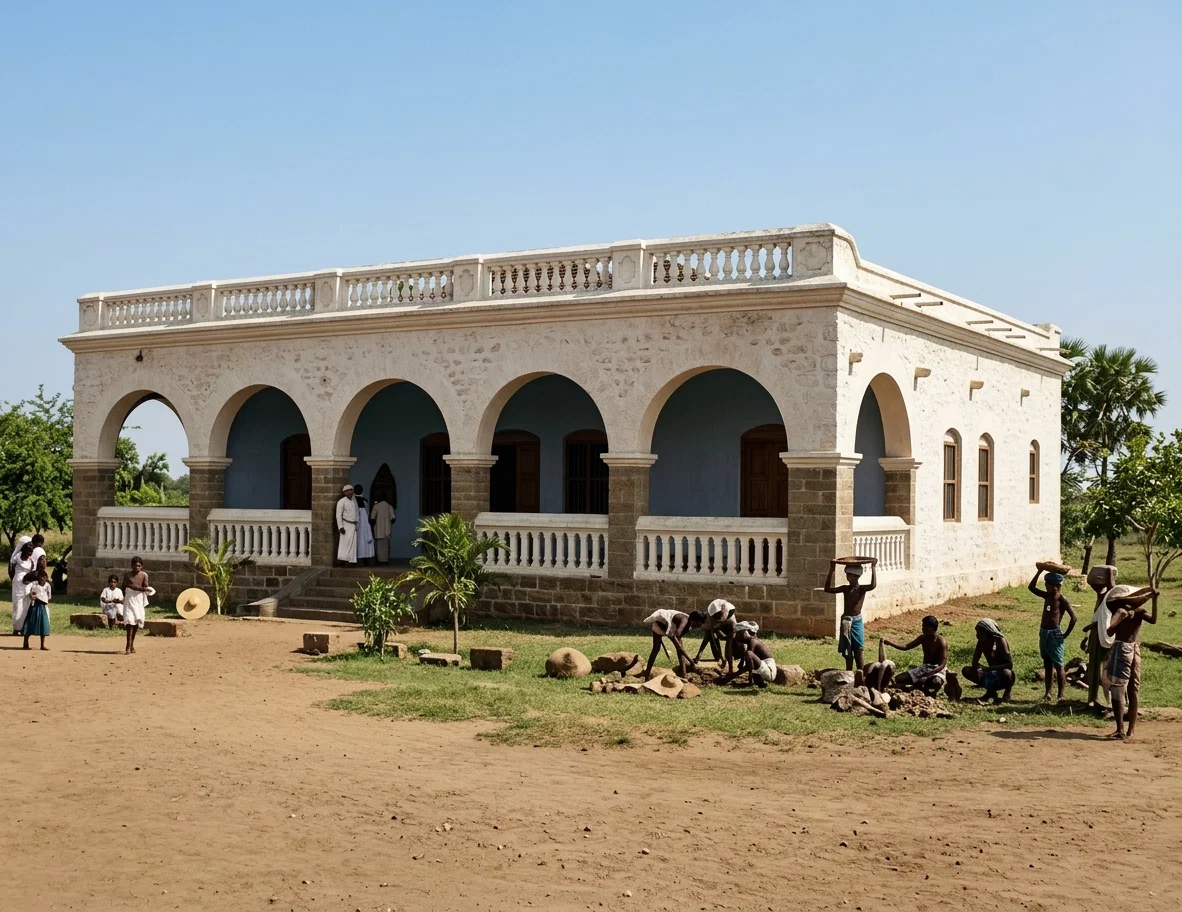
Since my last report to the Review, we have completed the building of a mission bungalow, a picture of which is given herewith. This is the first structure erected by mission funds for our work in India; consequently we had but a scant stock of experience from which to draw. We are especially thankful to God for his protecting and guiding hand which has been over us as the work has progressed. We now have a building in which we may live with some comfort in all seasons of the year, away from the noise and disease of the native village, and free from damp.
We definitely decided to begin work on this building the nineteenth of February. Ten days later the work was begun, and the building was practically completed by August 1. This work took us through the most trying season of the year, and it was with considerable anxiety that we began. This time last year I was laid low with a sunstroke, and I was ill prepared, physically, to encounter the exposure to the sun and heat. But we knew God was able to protect us, and that he was acquainted with all the conditions under which we must labor, so we committed all our plans to him, and went earnestly to work. Almost from the first, it was necessary for me to take the personal oversight of the work. This kept me going and coming in the hot sun much of every day. I was as well protected as my work would permit by wearing a large sun-hat, and dark glasses, and carrying a double covered umbrella, the under cover of which was of a deep-red color. This last item I consider very important, and worthy of mention for the benefit of those living in the tropics who are affected by the sun. Red and orange are the only colors which will effectually neutralize the dangerous rays of the sun. The principle is well illustrated in the photographer’s use of a red or orange light in the dark room to protect his sensitive plates, and at the same time give sufficient light. The government of India has so far recognized this principle as applied to clothing for the protection of her soldiers in the tropics that a patented cloth with one side showing red or orange is being made up into uniforms. Many of the leading merchants are now selling a tropical underwear in deep-red and orange colors for the general public.
FRONT VIEW OF BUNGALOW, TINNEVELLI DISTRICT, SOUTH INDIA
Building a house in India is a much harder task than the same work at home. Frequently we find our Western ideas obsolete, and we must conform to conditions and circumstances. Many times we question the logic and methods of our Oriental brothers, and fail to discern their standpoint of reasoning. I had declared over and over again, after looking at the way most houses in India were built, that if ever I built a house, I would demonstrate a few advance ideas in building. Well, I have had my chance. I worked in a few of my pet ideas in this building, but strange to say, when it was finished, it looked remarkably like every other building of its kind in India. The very things I could not see then, I now find a good and sensible reason for. Such is the value of experience, and a closer acquaintance with the native mind and customs.
Our hearts have been greatly cheered and encouraged by the recent news that we are to have the addition of a man and his wife to our small force. For a long time we have hoped to start some kind of school work among the Tamil people, but no one could be secured to look after it. A good school is greatly needed, and would add quite materially to the permanent results of our work.
It seems, as fast as we fill one opening, there comes a call from another. A few days before leaving Tinnevelli for Mussoorie—where I am taking a short rest—I was visited by a native evangelist into whose hands had fallen some of our Tamil tracts. He has been working on a self-supporting basis for a number of years, having established an orphanage and school and three native Christian congregations. As soon as he read our tracts, he became convinced of their truthfulness, and set about to better inform himself and teach his people. He has a good knowledge of English, and I have supplied him with other tracts on present truth, which are not in Tamil. This man lives in a prosperous farming community about thirty miles north of where we are located in the Tinnevelli District. He has written me several letters begging that we send some missionaries to his place to further instruct them in the truth, and to carry on the work in the surrounding country. When I return to south India, I expect to visit this locality and investigate his work. He seems to be a sincere seeker after truth. He was educated in the Baptist faith.
If this situation proves to be a door opened of the Lord, where are the workers to place in it and develop the work? Our daily prayer is that God will open up some way whereby these millions may hear the truth.