The First Canvassers Institute in Spain
11%

Review and Herald Publishing Association · Takoma Park Station, Washington, D. C. · Nov 25, 1909

FromReview and Herald, Vol. 86, No. 47.

Read the full edition

The First Canvassers Institute in Spain

I ARRIVED here the evening of September 19, expecting to sail for South America the twenty-fourth, but the boats were all full, so I could get no passage until October 2. As soon as we learned that, Brother W. G. Bond wrote to his workers, telling them we would have a week's institute. We began last Sunday, September 26, and close to-morrow. The workers go out with the paper every morning, and in the afternoon we have our classes. Their average sales of the papers have been just about the same here in a half day as for a whole day before they came.
We have made a special study of the book “Coming King.” Including the Bond brothers, there are ten in the class taking the instruction. We are also studying how to present “His Glorious Appearing” with the paper. I have emphasized the matter of their trying to reach the better classes with the book, telling them how our workers have succeeded among this class in Mexico. They are all enthusiastic, and those who take up the book work, I believe, will make a success.
During the first nine months of this year the canvassers here in Spain have worked 5,662 hours, sold 30,289 papers, 1,288 tracts, 167 books; total value 3,452.05 pesetas. (The value of a peseta is 18 cents.) They have had an average of five canvassers.
There were lively times here in Barcelona during the revolution in the last days of July. It started because the government called out the reserves to go to the front in Melilla. Some of these reserves were men with families, and the people objected to their going. Some were widowers with children. When called, they presented themselves, together with their children. The officers asked them what those children were doing there. They replied that they had no place to leave them, as their mothers were dead, and so had to bring them along. The officers took the children from them and sent them to the poor asylums, and marched the fathers to the front. When they came to embark the troops, a general strike and stoppage of business was declared. Everything in Spain stopped. In the afternoon, as the troops were marched down toward the boats, crowds of men, women, and children crowded in between the soldiers and the wharf, so that the soldiers could not be embarked. The officials then ordered these soldiers to fire on the crowd. They fired into the air instead of into the crowd. Then the officials called the civil guards, and they fired on the crowd, killing a good many.
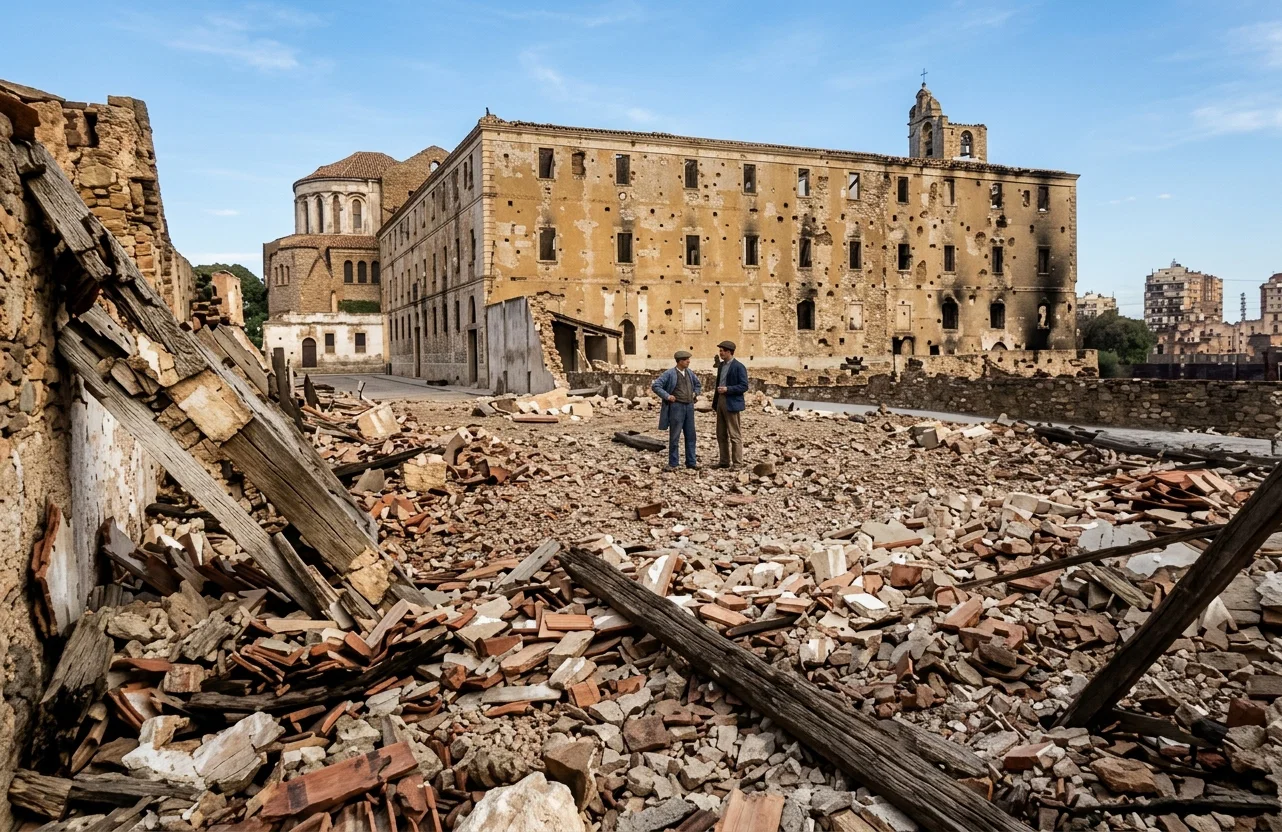
RUINS OF A CATHOLIC MISSION AND COLLEGE, AT BARCELONA
Then the battle was on. During the next few nights, forty-eight Catholic churches and convents were burned. The populace tore up the stones out of the streets and carried them to the houses, whence they hurled them down on the soldiers' heads. They also built barricades with these stones in different parts of the city. The mobs who burned the convents made all the inmates leave before firing them. The priests and some others were so enraged at the soldiers because they would not fire on the crowd that they in turn fired on the soldiers.
I am sending a few views, which show something of the destruction, although they do not show the worst, as these cards have all had to pass the censor.
Since order has been restored, court martials and shooting of revolutionists have been almost daily occurrences. “Después de los successos” (after the events) is one of the headings in nearly every daily paper now. Since I have been here, we hear of bombs nearly every day, but the Lord has cared for his children, and none of our brethren have suffered. N. Z. TOWN.