German East Africa

6%

Review and Herald Publishing Association · Takoma Park Station, Washington, D. C. · Oct 14, 1909

FromReview and Herald, Vol. 86, No. 41.

Read the full edition

German East Africa

A. C. ENNS
We left Kisumu the last of May, Brother Raessler and I, to find an opening for a new field of labor. We arrived at Shirati the next day, but found that all the country next to Shirati is infested with the sleeping-sickness plague. Several sanitary officials have themselves been infected, and two British physicians have died this year of it. The German authorities have been working ever since it appeared, but as yet have been unsuccessful in their efforts to stop the plague. A certain district has been placed under quarantine by the government. The fly (glosina palpalis) which carries the disease is found in a certain marsh tree which grows in the water only.
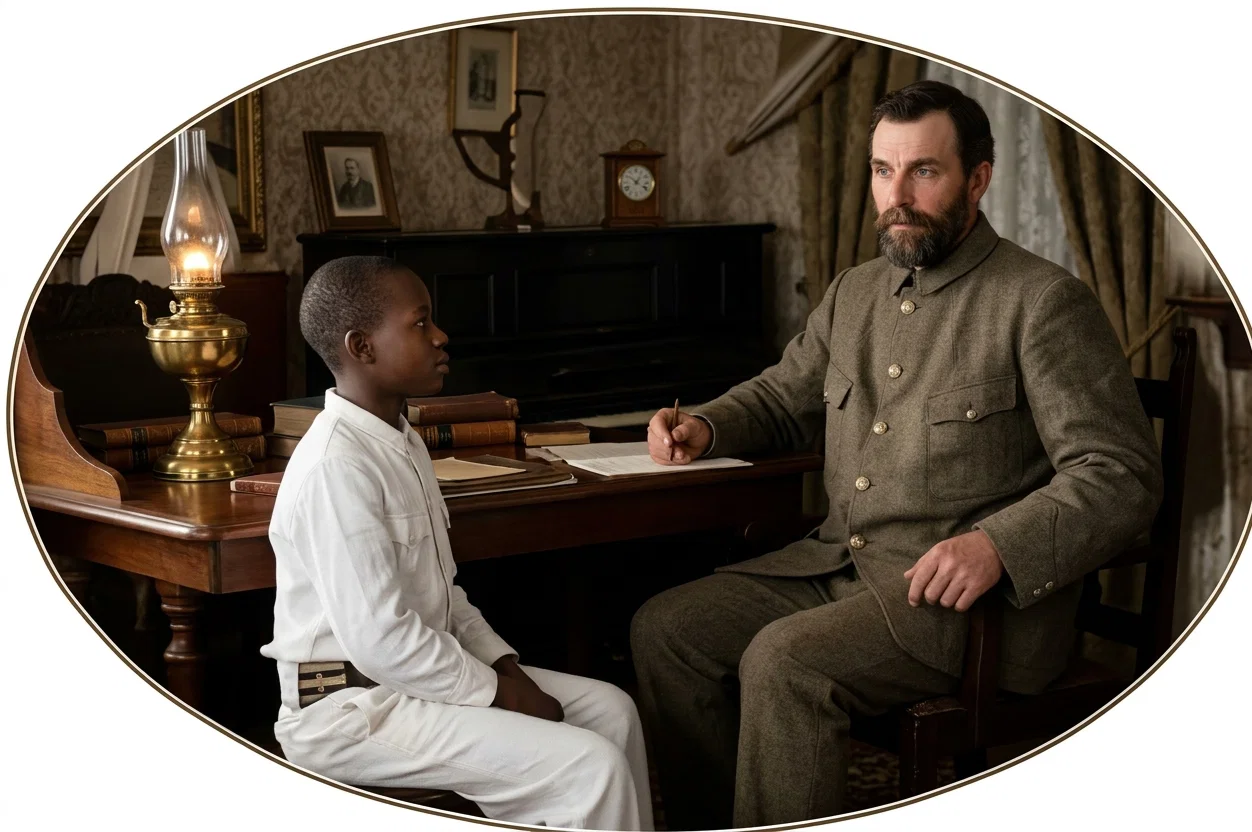
BROTHER ENNS AND HIS MUGANDA LANGUAGE TEACHER
But as we were anxious to get a station as near to the lake as possible, to make transportation cheaper, we decided to take the country south of the Mara River, which is healthful, except for malaria. By shutting out the mosquito at night, so avoiding infection, this disease can be almost entirely avoided.
The next day, June 2, we took a small sailboat and went to Nyanangi, south of the Mara River. The small boat costs only five dollars, or single loads of one hundred fifty pounds, twenty cents. We made an eight-day march, looking over the country. We found two excellent sites, one in Majita, near Bukerewe Island, on the mainland, and one in Buzanaki. On the latter site we decided to build. As Majita will naturally be the center, or head station, later, I decided first to help Brother Raessler to get started.
We have finished building a primitive schoolhouse, forty-five by forty-five feet; in one end of which I have my room, and in the other the school. Brother and Sister Raessler live in a straw hut. We now have half the sun-dried brick ready. The roof we expect to cover with corrugated iron.
Since arriving at “Bursegwe,” which name we have adopted for our mission station, we have had some interesting experiences. First the chief’s sons came with a drill as soldiers that is known only in the German army. They presented front, and in a chorus said, “Tamekuja Bwana Mwalim” (We’ve come, Mr. Missionary). “Well, what is it you want, my sons?” I said. “We want to learn to read, during which time we want to live with you.” “Well, but you can not appear before me again naked [all were entirely nude], nor so dirty.” After a moment of quiet, as they evidently were struck with my firmness, they began to get uneasy. Finally they took breath and asked: “But what shall we do? We have no clothes. Shall we wear skins of goats?” “No, indeed! don’t appear in goat-skins. Buy clothes, and keep yourselves clean.” “But we are too small to hoe and plant our own fields, so we can sell peanuts and buy clothes. And mother’s field is not enough to eat and sell also.” “All right, I am building a school, for which I shall have need of
thatch and sticks. You may work for me until my school is finished, which will be enough to pay for your clothes” (consisting of a white jacket, and a piece of American cloth to tie about the loins). “But how many days will we have to work?” “Twelve days, if you work all day fast.” “Ndie Bwana Mwalim” (Yes, Mr. Missionary), was the answer in a chorus, and with considerable satisfaction off went the whole squad, keeping step as well as they could, which was not faultless.
The next day not only the chief’s sons, but also about thirty others came, asking whether they might now start work. They carried thatch, while the grown people built the grass hut and the school. From day to day the number increased. The girls also began to come, and we soon had quite an army of little folks at work. In two weeks we finished our grass hut, my schoolhouse, and one hut for my personal boys (the one who does the cooking, the wood and water carrier, and the one who looks after my room and does the washing and ironing and dish washing), and also a kitchen for Brother and Sister Raessler.
When all was finished, I had to leave for Shirati, to make arrangements concerning the land for the mission station, and to buy provisions, and also to get all the tools for the expedition out of the customs, consisting of about one hundred fifty loads of eighty pounds each, in boxes. Brother Raessler went to meet Sister Raessler, who was planningto arrive in Shirati by June 26. I had told the children that I would bring the clothes with me when I returned.
In the evening I could hear their conversation, which invariably was about my return and the clothes I would bring with me. ‘The Bwana Mwalim will bring each of us clothes. I wonder if they will be large or white. What will we wash them with?’ ‘O,’ said one, ‘they must be washed with soap and water.’ ‘Yes, but where will you get it from?’ ‘And then we shall learn to read and write, and to make doors and windows,’ said another, ‘and do blacksmithing,’ ‘and to sew our own clothes, and to read the Word of God, and to pray. O, there are so many things, and such peculiar-shaped instruments, how nice they all are made! O, the Warunga [Europeans], how they can make everything, and all this they want to teach us! Shall we be able to learn all this?’
It is inspiring to listen to the harmless, childish talk. Indeed, if we will not turn and become as little children, we can in no wise enter the kingdom of heaven. How beautiful are the feet of those preaching peace and salvation! and how beautiful is the work of preaching peace, knowing that the present constantly increasing spirit of strife will soon be over, and eternal peace reign supreme.
When we returned to the station, it was dark; so after the boxes had been placed under cover, all had to go to bed, after we had evening worship. The next morning all were to appear, the grown people for work and the children for school. At eight o’clock school began with fifty children present, fifteen girls and thirty-five boys, ranging all the way from eight to eighteen years of age. The number constantly increased, until now I have about eighty, all from the one district, Bursegwe. There are about eight districts with independent chiefs, most of which are larger than Bursegwe, which can easily be worked from this station, under one or two European workers, by starting out-schools in all these districts. Then there are eleven tribes, each having a different dialect, which would have to have mission stations of their own.
Our mission, Bursegwe, consists of the territory east of Lake Victoria and south of the Mara River, with twelve tribes, having a population of about one hundred twenty-five thousand. I expect that either Majita, or one of the missions in Ururi, will eventually have to be the center. Each will be a center for part of the stations in the inland back of them. We can figure on two stations in Ururi, next to the lake shore, taking their water-supply directly from the lake, and one in Majita, also next to the lake. These will always be accessible by sailboats. Perhaps we shall be able later to procure one of our own. A medium-sized one costs about four or five hundred dollars, but I think by chance one could be secured for a little over half that amount. One would pay for itself in one season, carrying peanuts to Shirati. A boat takes about one hundred loads at seventeen cents each. The trip can be made in a day and a night. During the season these boats go continually. Then we would save all our own transportation expenses from Shirati to the mission, such as carrying cotton, which we expect to raise in order to cover at least part of the running expenses of the mission. Cotton does very well here, and the government is giving us sufficient land to cultivate, so that we are in the most favorable circumstances to be able to start several stations with less means than we otherwise could.
I have finished preparing a tract in Muganda on the Sabbath, and another on the second coming of Christ, which will be sent to Hamburg to be printed. These will come out, I hope, the last of the year.
Bursegwe, Post Shirati.