Canvassers’ Institute in Mexico

10%

Review and Herald Publishing Association · Takoma Park Station, Washington, D. C. · Sep 9, 1909

FromReview and Herald, Vol. 86, No. 36.

Read the full edition

Canvassers’ Institute in Mexico

AUGUST 1 I left Washington, D. C., en route for Mexico City to assist in a canvassers’ institute appointed to begin on the fifth. On the way I stopped off in Kansas City to counsel with Brother H. H. Hall, of the Pacific Press, concerning the Spanish publishing work. We had a profitable day together, and in the evening were joined by Elder E. R. Palmer, who also gave us valuable help in planning for the future of our Spanish book work.
Leaving Kansas City on Tuesday night, I arrived in Mexico City Sabbath morning, August 6. Elder G. W. Reaser, Brother J. A. Green, and Mrs. G. W. Caviness were at the station waiting for me, and took me directly to the Sabbath services in the city. The meeting was held in an upper room, which was filled with attentive listeners. Brother J. F. Blunt has been working in the city since his arrival in Mexico, and although he is not yet able to speak the Spanish language freely, the Lord has blessed his efforts. The attendance at the meetings has steadily increased, and several have accepted the truth since they began work there.
I appreciated very much the privilege I had of meeting with the brethren who have been pioneering the book work in that difficult field. When they began work last year, all they knew of the Spanish language was the printed canvass for “Coming King,” which they had committed to memory almost parrotlike. Probably no company of canvassers ever stuck more closely to their “story” than did these brethren. But from the very start they did well, and have successfully solved several hard problems which presented themselves in connection with the canvassing work in Spanish Catholic fields. The average value of books delivered by each canvasser during the year has been ninety-one cents, gold, an hour. This compares very favorably with the general average made by our canvassers in the United States.
The attendance at the institute was not large, but we had a profitable time together. Those who had been working with “Coming King” developed and learned during the institute a new canvass for the book, better adapted to the conditions in Mexico. We were also able to prepare a canvass for over half of “Home and Health” in Spanish, from advance sheets which the Pacific Press sent us.
During the time of the institute Elder Reaser called a meeting of the mission committee to consider plans for the advancement of the work in that field. The outlook there never was better than at present. There are twenty-four awaiting baptism in different parts of the republic. Wherever the Spanish paper El Mensajero de la Verdad has been circulated, new Sabbath-keepers are springing up, and calls are coming in for further labor.
The canvassers returned to their field with renewed courage. A report just at hand from Brother J. L. Brown states that in three and one-half-hours’ work, he and Brother Robinson took twenty-five orders for “El Rey Que Viene” (Coming King).
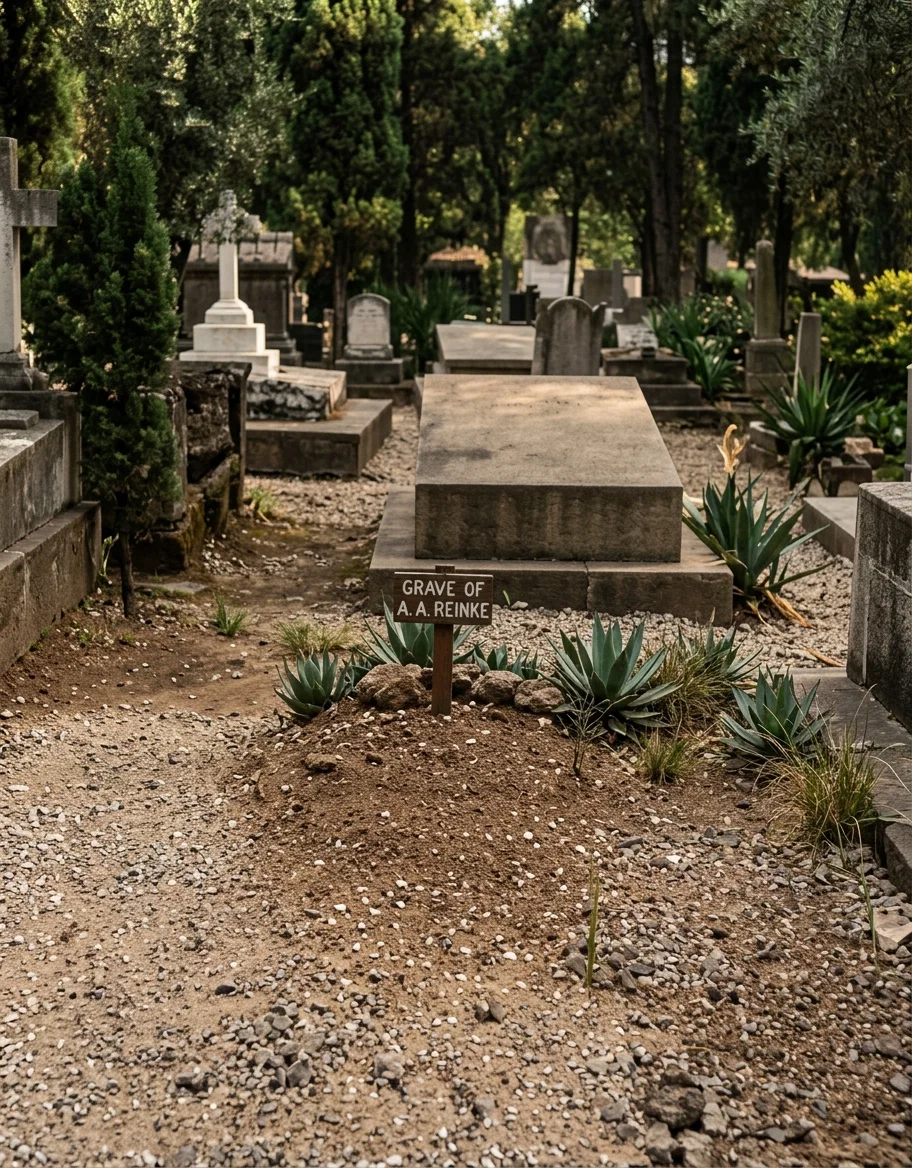
After the institute closed, I spent one day visiting some of the interesting historical places in and around Mexico. The last place we visited, which was perhaps the most interesting to me, was the one represented in the accompanying cut. It is a view of the place where Brother A. A. Reinke is buried. All that marks the spot is a small piece of tin, with the following inscription:—
GRAVE OF A. A. REINKE
The workers there are planning to erect a tombstone over his grave. Many of the readers of the REVIEW will remember the sad circumstances of his death from typhoid fever. It was a severe blow to the other workers; but instead of bringing discouragement to them, it led them to renew their consecration to the work in needy Mexico. One young man, who, before Brother Reinke’s death, had decided to return to the United States, determined he would remain at his post, and there he is still helping to fill the gap. N. Z. T.