China

6%

Review and Herald Publishing Association · Takoma Park Station, Washington, D. C. · Sep 9, 1909

FromReview and Herald, Vol. 86, No. 36.

Read the full edition

China

CHINA’S future and its commercial interests are rapidly commanding unusual international attention. With numerous concessions already granted to foreign powers, and with treaties favoring commerce with foreign nations, China, with her immense population and lack of modern facilities, presents to the leading nations of the world opportunities for trade expansion, the like of which is not known elsewhere.
With a population approximating four hundred thirty-five million; with almost every natural resource, such as coal, iron, lead, copper, and the precious metals; with a soil so fertile and so carefully husbanded that it has raised successive crops of wheat or rice or other cereals for perhaps two thousand years; with a civilization antique and negative to all that the last three centuries have brought to the Western nations of the world; with remarkable exaltation of the family, where filial duties are discharged with almost religious devotion, and where the home and the family burial-grounds are never lost sight of during the ages; where poverty and enforced economy have developed a people so discreet in finance that no people or nation in the world can compare with them in eking out a subsistence at a minimum of cost; where not a few of the people, notwithstanding all their poverty and lack of opportunities in life, have such a respect for learning that it is probably not excelled by any people in the world,—with all these and far more, China presents opportunities for exploitation in the fields of manufacturing, commerce, and material progress perhaps superior to any nation on earth.
Through international treaties, oftentimes enforced by compulsion, missionary endeavor is tolerated in every province in China. Since the first pioneer missionary, almost single-handed and unaided, undertook to do missionary work for the Chinese people, more and more have the barriers against Christianity been removed, until to-day both the life and the property of the missionary are generally protected.
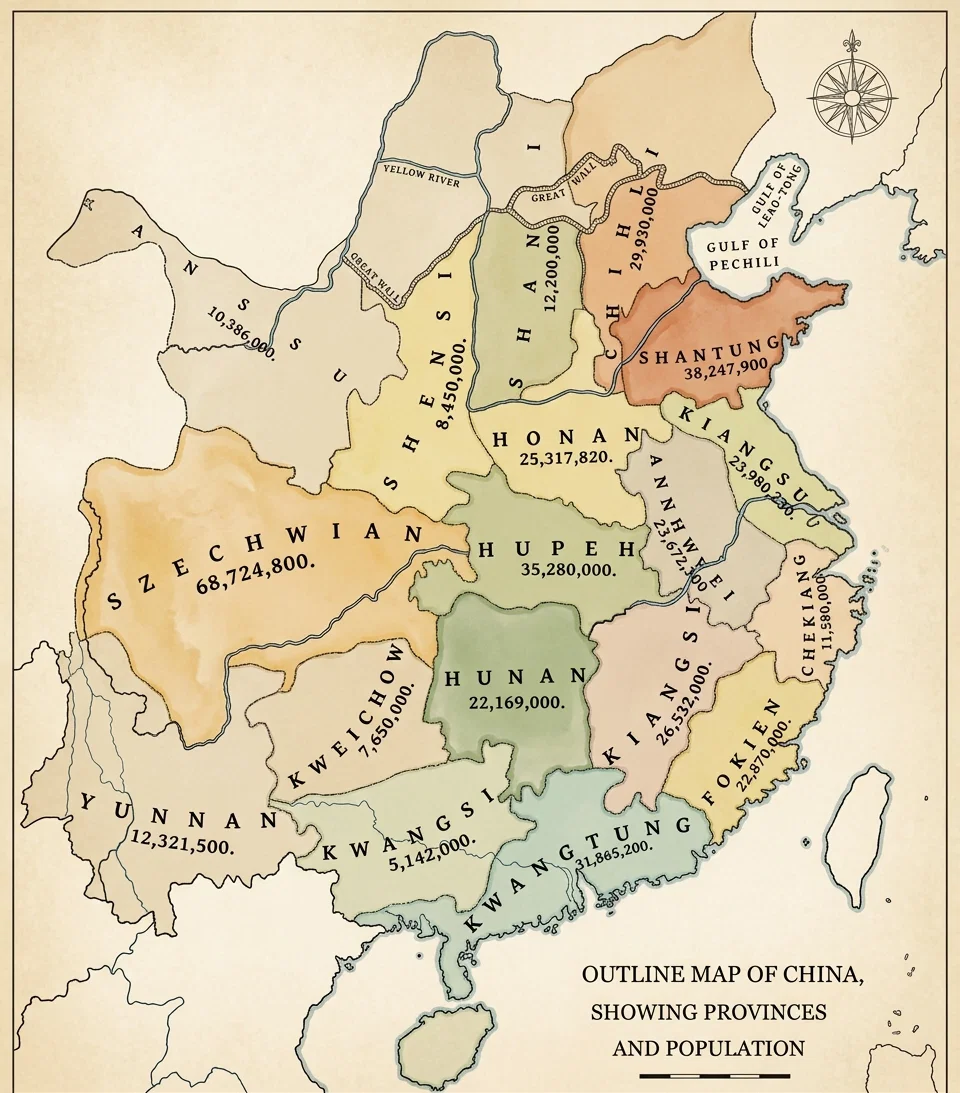
Politically the Chinese empire is divided into eighteen provinces and four dependencies. The dependencies are Manchuria, Mongolia, Chinese Turkestan and Tibet. In what is known as China proper there are said to be one million five hundred thirty-two thousand square miles of territory, with a population of more than four hundred ten million. The four dependencies increase the territorial area to 4,277,542 square miles, while its population is increased to over four hundred thirty-five million. From every standpoint by which a nation can be measured, in population, in territorial extent, in natural resources, in the ability of the people who inhabit the country, in the long continuance of its government, China is one of the greatest nations that has ever existed.
OUTLINE MAP OF CHINA,
SHOWING PROVINCES
AND POPULATION
OUTLINE MAP OF CHINA, SHOWING PROVINCES AND POPULATION
With the exception of what was done by Brother A. La Rue in the distribution of literature, no work had ever been done in China by Seventh-day Adventists until the year 1902, when Brother J. N. Anderson and wife and Miss Ida Thompson were sent by the Mission Board to take up work in that country. From this small beginning, new workers have been sent to the field from time to time, until to-day we have eighteen foreign families and single workers who have spent more or less time in China, though at present five of these are on a furlough in the home land.
At the late General Conference, steps were taken to greatly accelerate the prosecution of our work in China. Up to the present, the workers have had very limited facilities. The most meager printing plant conceivable has been set up, and is now being utilized to its fullest capacity in printing the third angel’s message in the native languages of China. This printing plant, however, is entirely inadequate for the needs of the work, and is such as would not be used in the home land for a single week. Think of printing the third angel’s message for four hundred thirty-five million people with a little pony press that is turned by hand, located in a private Chinese house, where, when the machinery is operated, the whole building trembles and shakes so that it is almost impossible to do good work.
A girls’ school at Canton has been started, and the last year it has had an attendance of about one hundred. Some of the students are boarded and kept in the home. This seems to be the most satisfactory way of helping these people to receive the true idea of home life, and to carry out the principles of the Christian religion.
Only five of the eighteen provinces have workers located in them, and these are wrestling against great odds, with so many interests on their hands that it is almost impossible for them to give the work the needed attention. At the late session of the General Conference, the delegates from China came with a most earnest petition to the General Conference that forty-two additional families should be sent to that kingdom during the coming two years. This was with the understanding that two workers should be placed in each province, so that we could have at least as many as two families of foreigners in each one of the eighteen provinces in China proper. It was also requested that the GeneralConference place men in Manchuria, Chinese Turkestan, Mongolia, and Tibet. This seemed like a very large undertaking, but the delegates no sooner heard the needs of this great field than they promptly voted to grant the request of the Chinese workers, and authorized the General Conference Committee, as soon as suitable workers could be found who would take up this work, to place them in the field.
It may seem to some as if this was supplying China with altogether too many workers, but when the additional forty-two families have all been located in China, and should our present number of workers continue, still there would be a population in China of seven million people for each worker. Think of one worker to warn a community, largely rural, of more than seven million. Let us contrast this condition with what we find here in the United States. According to the census of 1900, the last one taken by the United States government, seven million people would take every soul in the States and territories of California, Washington, Oregon, Arizona, Utah, Colorado, Idaho, Wyoming, New Mexico, Oklahoma, Nebraska, Nevada, Montana, New Hampshire, Maine, Delaware, and Alaska. What would we think of asking one man to preach the third angel’s message to all of these States, to give the inhabitants the warning of the third angel’s message, and to get a people ready for the soon coming of Christ? This could be as readily done, as far as numbers are concerned, as can our present force of workers, with the forty-two additional families to be sent to China, give the Chinese people the third angel’s message. It would seem like a Herculean task for one man to undertake to warn all the people in the above States, and yet this is what will have to be done in China through the help and blessing of God.
Suppose that we take these people in the States named above and exclude from them all knowledge of the true God, all knowledge of the Christian religion of any nature whatsoever. Let us place them among heathen temples and shrines that have been built for ages, perhaps where their ancestors have worshiped for many generations. Let the people be steeped in the deepest superstitions concerning religion; let the great mass of them be without education, by far the larger per cent unable to read or to know their names when they see them in print; with scarcely a single convert or sympathizer in the whole country; and you can imagine what it means when we place the responsibility of giving the third angel’s message to the Chinese people upon the little band of workers in China.
We certainly do not have too many workers in the United States of America, and yet there are single provinces in China, with an enormous population, that have never seen or heard of a Seventh-day Adventist. The province to the far west known as Szechuen has an estimated population of sixty-seven millions, and yet never has a single worker entered that province. The province of Shan-tung is the most densely populated country in the world, having more than six hundred eighty people to the square mile for the entire province, and a population equal to half of that of the United States of America, and yet not a single worker has ever been placed in that province. In one of our divisions of China, known as the Central Mission Field, including the provinces of Honan, Hupeh, Hunan, and Kwang-si, there is a population of over one hundred nineteen million souls.
When we think of the dearth of workers in this great country of China, is it not time to distribute some of our forces in foreign fields? Will we weaken our work at home if we send to these distant lands some of our strongest and best men, that the work can be placed upon a proper footing? Is it not high time that a valiant army of consecrated, God-fearing young men and women was going to the Orient to give their lives to the advancement of the third angel’s message? We appeal to our people everywhere when they close their eyes at night, seriously to call to mind that there are over four hundred millions of poor Chinamen in the very depths of heathen darkness and superstitious idolatry,—individuals for whom Christ died, who have no knowledge of God or of a Christian Bible, or of the means of salvation. They live and die, hopeless and helpless, as far as they are concerned, and are dependent upon those who have the truth and the light, to send them the news of salvation through Jesus Christ.
One would think that the Christian’s heart, when he ponders such a proposition, must burn with zeal and enthusiasm to impart to these benighted souls the light which God has given to us concerning salvation. Every week we should give an offering to the Lord for these poor darkened souls. The small sum of ten cents a week could do much toward helping to sustain missionaries in foreign fields, and there are those who could even give hundreds, or thousands, of dollars and still have everything they need to make life comfortable, and to supply every necessity.
The General Conference has most earnestly looked for men and women to send to China, but up to the present time we find ourselves almost powerless to send even so many as half a dozen recruits to that great kingdom. We raise the question, “Who will go?” The Harvest Ingathering during the month of November will be a rare opportunity for us to interest our neighbors and friends in the gigantic work that we are undertaking, and to enlist their sympathy and financial help. Certainly something must be done to accelerate the giving of the message in these great darkened heathen lands. Let us all continually pray that God will raise up workers to go to that field under the anointing of the Holy Spirit, and that he will supply the means by which they may be supported.
I. H. EVANS.