The Hearing on the Johnston Sunday Bill
2%

Review and Herald Publishing Association · Takoma Park Station, Washington, D. C. · Feb 25, 1909

FromReview and Herald, Vol. 86, No. 8.

Read the full edition

The Hearing on the Johnston Sunday Bill

ANNOUNCEMENT has already been made that a hearing on the Johnston Sunday bill had been granted, and that it was appointed for Monday, February 15. This hearing was held in the room of the House Committee on the District of Columbia in the new office building of the House of Representatives. Every seat in the main committee room was occupied, while many stood, filling the doorways and the adjoining space.
The time was granted to the opponents of the bill, but through their courtesy, several speakers who favored the measure were accorded the privilege of speaking.
The bill, which has already passed the Senate, is a substitute for the one originally introduced by Mr. Johnston, and reads as follows:—
“A BILL. “For the proper observance of Sunday as a day of rest in the District of Columbia.
“Be it enacted by the Senate and House of Representatives of the United States of America, in Congress assembled, That it shall be unlawful for any person or corporation in the District of Columbia, on the first day of the week, commonly called Sunday, to labor at any trade or calling, or to employ or cause to be employed his apprentice or servant in any labor or business, except in household work or other work of necessity or charity, and except also newspaper publishers and their employees, and except also public-service corporations and their employees, in the necessary supplying of service to the people of the District.
“Section 2: That it shall be unlawful for any persons in said District on said day to engage in any circus, show, or theatrical performance: Provided, That the provisions of this act shall not be construed so as to prohibit sacred concerts, nor the regular business of hotels and restaurants on said day; nor to the delivery of articles of food, including meats, at any time before ten o’clock in the morning of said day from June 1 to October 1; nor to the sale of milk, fruit, confectionery, ice, soda and mineral waters, newspapers, periodicals, cigars, drugs, medicines, and surgical appliances; nor to the business of livery stables, or other public, or the use of private, conveyances; nor to the handling and operation of the United States mail.
“Sec. 3: That any person or corporation who shall violate the provisions of this act shall, on conviction thereof, be punished by a fine of not more than ten dollars, or by imprisonment in the jail of the District of Columbia for not more than ten days, or by both such fine and imprisonment, in the discretion of the court: Provided, That persons who are members of a religious society, who observe as a sabbath any other day in the week than Sunday, shall not be liable to the penalties prescribed in this act if they observe as a sabbath one day in each seven, as herein provided.
“Sec. 4: That all prosecutions for violations of this act shall be in the police courts of the District of Columbia and in the name of the District.”
The first argument against the proposed legislation was made by the editor of the REVIEW, who occupied fifteen minutes in bringing to the attention of the committee a number of reasons why the bill should not be favorably reported.
The following is a brief outline of these reasons, which were developed in the argument:—
1. There are a large number of associations and alliances pledged to secure the passage of State and national Sunday laws throughout this country.
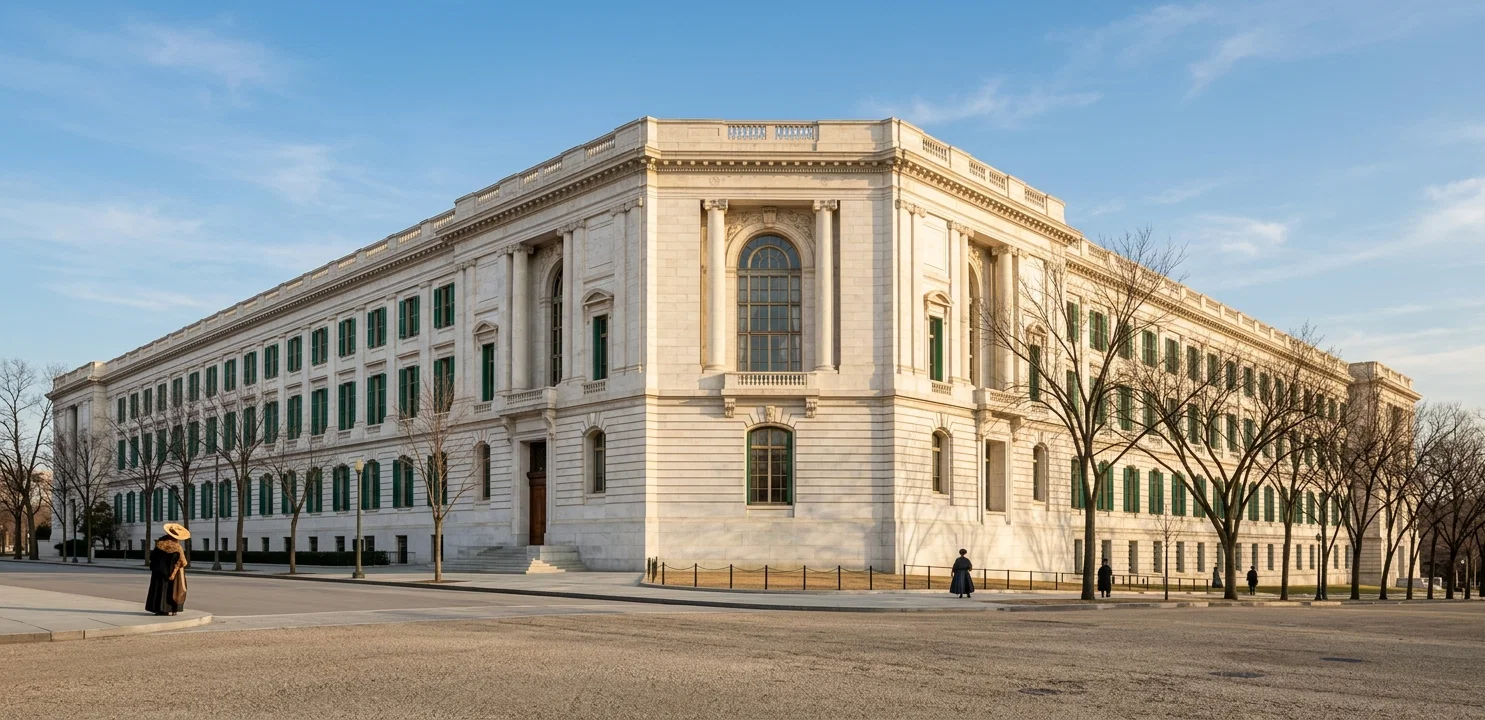
THE HOUSE OF REPRESENTATIVES’ OFFICE BUILDING
The hearing on the Johnston Sunday bill was held in an office in this building
THE HOUSE OF REPRESENTATIVES’ OFFICE BUILDING The hearing on the Johnston Sunday bill was held in an office in this building
2. These organizations have declared their purpose to secure a Sunday law for the District of Columbia.
3. In one of their official documents credit is claimed for the preparation of such a bill as the one now before the committee, and for bringing to bear “the influence of the federation wherever possible in favor of the passage of the bill.”
4. The advocates of the enforced observance of the first day of the week desire to secure the action of Congress making a distinction between the first day of the week and other days, being assured that the influence of such legislation will be helpful in securing and enforcing State legislation upon the same subject.
5. Those who are demanding Sunday laws for the ostensible purpose of securing one day of rest in seven for the working-men are not satisfied with a law which provides this very thing, unless that day of rest be specified as Sunday. This is shown by the present agitation for a Sunday law in California.
6. The representatives of over thirty Protestant denominations constituting the Federal Council of the Churches of Christ in America have declared in favor of Sunday laws, and have refused to adopt a resolution disclaiming their intention to do anything which would interfere with the convictions of those who conscientiously observe another day.
7. The exemption clause in the bill before the committee is most convincing proof of the religious character of the bill.
8. Prominent Sunday-law advocates have made most unseemly statements concerning their control of Congress, and their purpose to bring to an end the career of every politician who will not grant their demands.
9. The famous Sunday Mail Report adopted in the United States Senate in 1829 sounds a timely warning against permitting the influence of extensive religious combinations to control the action of Congress.
10. If the laboring men desire to rest upon one day of the week, they should assert their right to do so: no employer can compel them to labor against their will.
Referring to the exemption clause which was attached to the bill when reported by the Senate committee, the editor said: “An examination of this exemption clause will throw much light upon the real character of this proposed legislation. The clause reads thus:—
“‘Provided, That persons who are members of a religious society, who observe as a sabbath any other day in the week than Sunday, shall not be liable to the penalties prescribed in this act if they observe as a Sabbath one day in each seven, as herein provided.’
“The conditions herein prescribed should be carefully noted. In order to be exempted from the penalties of this act:—
“1. One must be a member of a religious society which observes as a sabbath some other day than Sunday.
“2. He must observe as a sabbath one day in each seven, ‘as herein provided.’
“Interpreting the bill in the light of this exemption clause, it is perfectly clear that it is religious in its character, and that its intention is to require the observance of Sunday as the sabbath. The words ‘as herein provided’ are of no force whatever unless they mean that this act provides for the observance of one day in each seven as a sabbath. This conclusion is so clear that it requires no argument to establish it.
“Furthermore, although it is claimed in behalf of this bill that its purpose is to secure for employees that measure of rest which their physical nature demandsyet from the penalties of this act certain persons are exempted, not because they have had the benefit of the required physical rest on some other day, but because ‘they observe as a sabbath one day in each seven, as herein provided.’ That is to say, the purpose of this act is to require the general observance of the first day of the week, commonly called Sunday, as the sabbath, but the observance of some other day of the week as the sabbath will be accepted as a sufficient compliance with the general spirit of the bill. It is plain upon the face of it that such legislation as this is religious, and from the evidence already submitted it is certain that if the religious bodies now seeking the passage of Sunday laws could have their own way in the matter, even the observance of another day of the week than Sunday as the sabbath would not be allowed as a compliance with the legislation asked for in behalf of the so-called Christian sabbath.”
At the conclusion of this argument, W. A. Colcord, secretary of the Religious Liberty Bureau, presented a clear and forcible protest against the bill, of which the following is a brief outline:—
Referring to the statement in the famous Sunday Mail Report that ‘if Congress shall, by the authority of law, sanction the measure recommended [prohibiting the transportation and handling of mails on Sunday], it would constitute a legislative decision of a religious controversy, in which even Christians themselves are at issue,’ he declared:—
‘I bring the direct charge, therefore, that this proposed legislation is religious; that its principal promoters and supporters are religionists; that if passed, it will be the beginning of a religious establishment in the United States, and that in the end, as with all other religious establishments, it will result in religious oppression and persecution.’
Convincing proofs were set forth in support of this charge:—
1. ‘The Sabbath itself is a religious institution.’
2. ‘The chief promoters and supporters of this legislation are religious people.’
3. ‘The movement in the District has been placed in the hands of the ‘Interdenominational Committee upon Sunday Observance in the Capital.’’
4. ‘The bill permits only ‘sacred concerts’ to be given on Sunday.’
5. ‘It exempts upon religious grounds.’
6. ‘Dr. W. F. Crafts said: ‘A weekly day of rest has never been permanently secured in any land except on the basis of religious obligation. Take the religion out, and you take the rest out.’’
As to the province of civil government, the speaker said:—
‘From the civil standpoint, the only standpoint from which civil government has a right to deal with any question, a man has as much right not to be religious and not to observe a day of rest as he has to be religious and to observe a day of rest.’
As to the need of any legislation in behalf of religion, the speaker quoted Benjamin Franklin:—
‘When religion is good, it will take care of itself; when it is not able to take care of itself, and God does not see fit to take care of it, and it has to appeal to a civil power for support, it is evidence to my mind that its cause is a bad one.’”
In answer to some of the arguments urged in behalf of Sunday legislation, the following statements were made:—
‘It is asserted that the right of each to rest demands a law of rest for all. This may be good rhetoric, but it is poor logic. Two million Jews and a hundred thousand Christian observers of the seventh day in this country, without a law compelling others to observe it, disprove the statement.
“‘It is claimed that Sunday laws are essential to religion and the stability of government. In reply, we need but cite the fact that Sunday laws did not save the Roman empire, nor make a nation of saints. Rome fell, and the Dark Ages followed.
“‘It is urged that the majority should rule. Not in religious matters, we reply.’
Other considerations were urged against the measure, some of which are:—
‘All Sunday legislation is a violation of that general constitutional principle so frequently expressed in American law, that ‘no preference shall be given by us to any religious sect, society, or mode of worship.’
“‘No man has the right to compel another man by law to do in religious matters as he does, simply because he believes he is right, or because he may be in the majority.’
As to the wide-reaching influence which would be exerted by the passage of this bill, the speaker, in conclusion, said:—
‘If, in response to the wide-spread demand, Congress yields and enacts a compulsory Sunday law, it will in this act reverse the course it has for so long consistently and persistently pursued, and repudiate one of the fundamental and most cherished principles of the national government. It will be the first fatal step in the downward course of uniting church and state, and will open the floodgates to a tide of evil, the results of which many little realize.’
A report of the other arguments presented against the bill, and of the speeches intended to be in favor of the bill, which, however, were turned against it, will be given in next week’s paper.
W. W. P.