C. E. RENTFRO

6%

Review and Herald Publishing Association · Takoma Park Station, Washington, D. C. · May 28, 1908

FromReview and Herald, Vol. 85, No. 22.

Read the full edition

C. E. RENTFRO

Portugal

C. E. RENTFRO

For some time we have decided that summer is nigh; for we have seen the fig-tree and other trees putting forth their leaves. Before we left our home State, Iowa, and before we saw a fig-tree, we were told that this tree was one of the last to put forth leaves. But as we look from our study window, we have watched the progress of the fig and other trees, and now we say that it is among the first. It seems that the almond and English walnut trees blossom and put forth leaves, to be soon followed by the fig-tree, then by apple-trees.
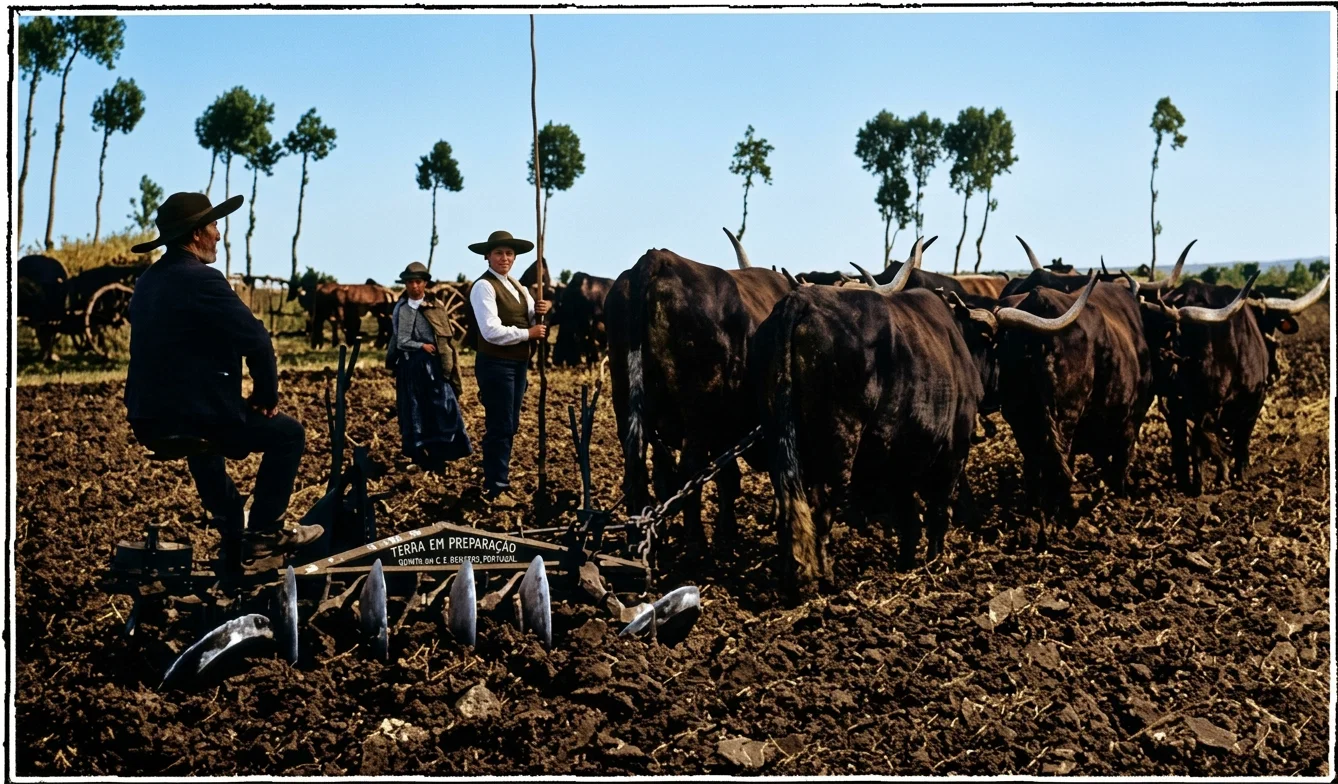
PREPARING THE SOIL IN PORTUGAL
So we, at least in this climate and latitude, will be obliged to interpret our Saviour’s prophecy according to Luke’s testimony: “Behold the fig-tree and all the trees,” to know that summer is nigh. Yes, all the signs tell us that the coming of Jesus is nigh. This, however, is not a summer to blight the winter and spring growths by its cruel hot winds, but it is the summer that merely ripens the growing grain, and brings the reapers to gather into the heavenly garner. May we all be among the chosen grains of wheat!
If an Iowan should be placed in this climate, to see the wheat, oats, or rye springing up and growing beautifully, and the flowers, both in the field and garden all watered by what would seem to him to be March rain or April showers, he would be somewhat bewildered. This is all to be seen here in January, which would be midwinter in Iowa. So the only proof of coming summer is to see the fig-tree and other trees, putting forth their leaves. On emerging from the cruel darkness at the beginning of the Reformation, one might have thought, “Behold the summer is nigh at hand.” But no; the true signs were yet to be seen. Already have they appeared, and Jesus will soon come, and will not tarry.
In this country the ancient and modern methods of farming seem to be engaged in a last struggle. In our trips by rail to Porto we have seen the traction engine pulling a number of plows, but looking out of our windows or taking a short walk we may see two yoke of oxen hitched to an ancient plow, which appears to be a tree trunk for the beam, and a root for the lay, being pointed with iron. This strange machine tears up the ground after the manner of a hog in its pasture, leaving large clods to be broken up by men, women, and children with heavy hoes.
The grain is sown, and when it is well headed out, women and children work from sunrise to sunset, earning ten or twelve cents a day, by going through the grain to pull out the weeds. I used to pull weeds when a boy, but only to throw them down again; but here every green plant is precious. Some wild thistles are for burros; but other tame, cultivated ones are eaten by the people. Other weeds are for the cattle or pigs.
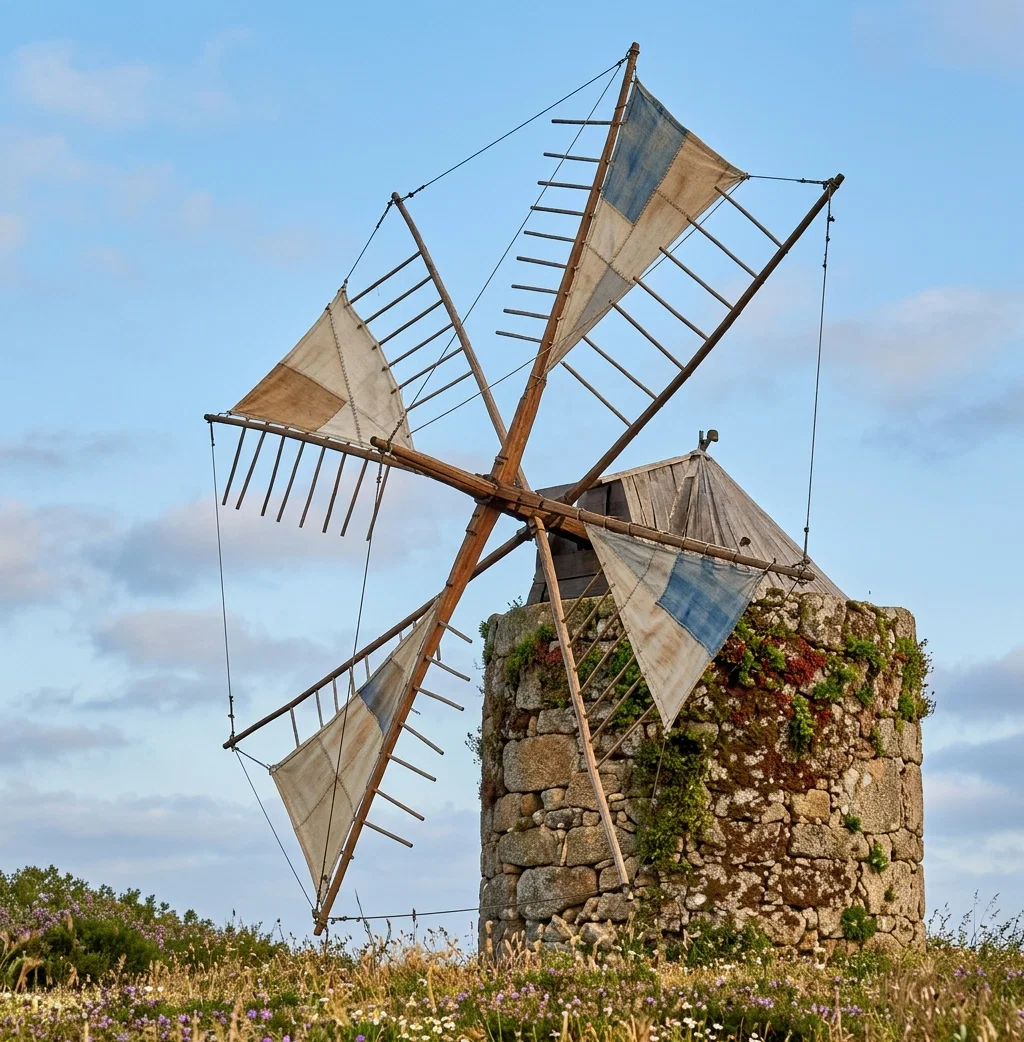
THE WIND GRISTMILL
THE WIND GRISTMILL
Some small patches of oats or wheat are to make green feed for the cows, and this is cut down by men with the small curved sickle grasped in one hand, to reap a bunch of grain in the other.
Soon a cartload is ready, and loading up, the worker is off to other duties. If the grain ripens, it is gathered into sheaves and hauled to the threshing-floor, where as in King David’s day, the grain is trampled out by oxen, while men with forks toss the straw up in the air, thus blowing away the chaff.
The wheat, when ready for the market, is loaded either on a donkey’s back or by other means of conveyance, carried either direct to a mill, and exchanged for flour or traded in the city for other necessary articles. We have three kinds of gristmills,—air, water, and steam for power. The wind-mill is a round stone and cement building, to be found on a hilltop, where its huge arms bearing great sails go squeaking away, grinding out the flour. We often grind between our teeth little pebbles or particles off the large mill-stones.
The writer was visiting at the home of a friend one Sunday, where some men were stretching a barbed-wire fence. One man was tugging away at the spool, turning and rolling it over and over. I picked up a Portuguese hoe, and thrust the handle through the hole of the spool, saying, “Take hold here, man.” Hedid so, and in a moment the work was missed done. His only remark was, “Ah, you are a foreigner,” conveying the idea that Portuguese can not think of such things.
As we look out of our window on the handiwork of our Creator, we return him thanks for the oxygen provided for us in the green verdure on all sides. We thank him for his bountiful hand of love, in providing such a great variety of food in fruits, grains, and nuts, to satisfy our need.
“To him that overcometh will I give us to eat of the tree of life.”
Lisbon, Portugal.