The Javanese

8%

Review and Herald Publishing Association · Takoma Park Station, Washington, D. C. · Aug 22, 1907

FromReview and Herald, Vol. 84, No. 34.

Read the full edition

The Javanese

G. E. TEASDALE
BORN in a country where nature works with lavish and almost uninterrupted benevolence, of simple habits, mild temperament, and few ambitions, the native of Java could not be expected to develop those sturdier qualities which are found in the inhabitants of less favored lands, where foresight must be exercised, and provision made for half a year of unproductiveness, or flood, or drought, or famine, or old age.
Nature is partial. If she be compelled to scourge this favored land of hers, she does it mildly. Of recent years some floods, and droughts, and seismic disturbances have occurred, and diseases of vegetation are becoming common. But so far the visitations have been mild, and the impression made upon the mind of the native has been lost in subsequent years of ordinary recurrence. If the Javanese is improvident, nature is largely responsible. She generally indulges him. And when she does occasionally chastise him, it is easier for him to suffer inconvenience or want sometimes, than to be always exercising thrift and forethought.
The government and capitalists have endeavored in many ways to arouse in the heart of the native desires and ambitions sufficiently strong to induce him to engage in regular employment. After centuries of experimenting, they have been partially successful. But still the inclination to work is only foreign. When his immediate wants are supplied, he generally can not be depended upon until his wants again reach a certain degree of acuteness. I read of a man who doubled the wages of his coolies, as an inducement to greater exertions. To his surprise they refused to work more than three days a week. Their reasoning is obvious. The farmer mortgages his crops, the mechanic his tools, the carter his oxen,—for what man of sense will work so long as he can borrow money?—and when the money is spent, he turns his serious attention to work again. “The borrower is servant to thelender.”
The pawnbroker from henceforth partially owns the man, and exacts his toll. The country reaps the benefit of his labor, and the man himself is benefited by being compelled to work seriously, that he may have money to pay taxes and interest, and buy rice. Also he has but little time or energy left for the development of those rebellious instincts, or religious fanaticisms, so near to the surface of all Mohammedan races.
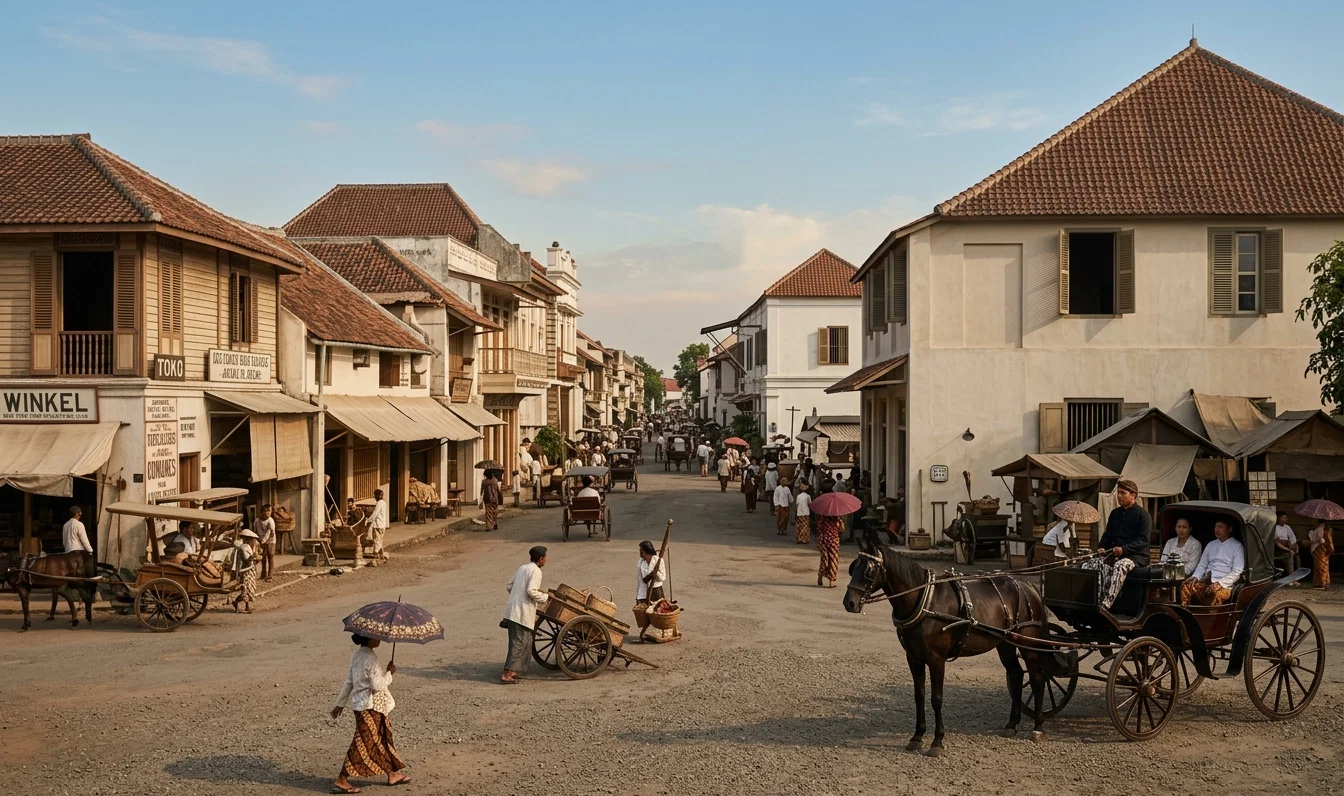
CHIEF BUSINESS STREET, SOURABAYA, JAVA
The Javanese, however, are not thoroughly Mohammedan. Ingrained in their nature are many superstitions pertaining to their old Hindu beliefs. The country and customs bear numerous evidences also of ancient Buddhism, which is said to have been brought here early in the first century of the Christian era. Marvelous ruins of wonderful temples have been found in many places, indicating skill and forces now unknown. Not until the fourteenth century were the inhabitants converted to Mohammedanism. Then it was not a matter of heart or will, but of military force.
There are three distinct national languages spoken on the island. Malay is foreign, and is used only on the coast and by the Chinese. At places the languages overlap each other, making it necessary to learn two languages in order to speak to one people. They are said to be difficult to learn. The composition of the sentences is strange to Europeans, and the forms of address are very perplexing. The languages are thought to be a mixture of old Sanscrit and the languages of the pre-historic inhabitants of the island.
All idea of caste, such as exists in India, is lost. Also the sexes are social equals. Plurality of wives is practised, but is not common. More wives bring more responsibility, and more work. That is undesirable to a native. The marriage tie is very loose, though, and it is quite common for natives to practise plurality of wives or husbands consecutively, if not simultaneously. Children are not objected to. Indeed, it is more congenial for the native to increase in numbers than in wealth. Children are inexpensive, and will provide for him when he is old. A little rice is not missed, and clothing is an item not worth mentioning. Nature supplies all that is required for several years, and keeps it in repair. Soon the children become very useful. They watch the goats and the buffaloes, or help in the paddy fields. At twelve or thirteen the girls marry, and the boys when a year or two older.
In quantity, flesh as an article of diet is used sparingly. In variety, everything that moveth upon the face of the earth, or in the seas, or anywhere else, is taxed to satisfy the demand. The chief article of diet is rice. Maize is also used, and many kinds of roots and vegetables.
The Javanese are small of stature, but muscular. Women carry heavy burdens up'n their heads. They possess a pleasant disposition, a kindliness of heart, and a suavity of manners, which are hardly offset by their duplicity and habits of pilfering.