MRS. J. J. NETHERY

10%

Review and Herald Publishing Association · Takoma Park Station, Washington, D.C. · Jul 11, 1907

FromReview and Herald, Vol. 84, No. 28.

Read the full edition

MRS. J. J. NETHERY

Egypt

MRS. J. J. NETHERY
The American Mission of Presbyterians has several good schools in this country, and has done much in instructing the natives. Brother Awada was the first one of their converts, and their first minister. Now he is one of our conference ministers. So we see that many of the other denominations are going before and preparing the way for the third angel's message to reach hearts.
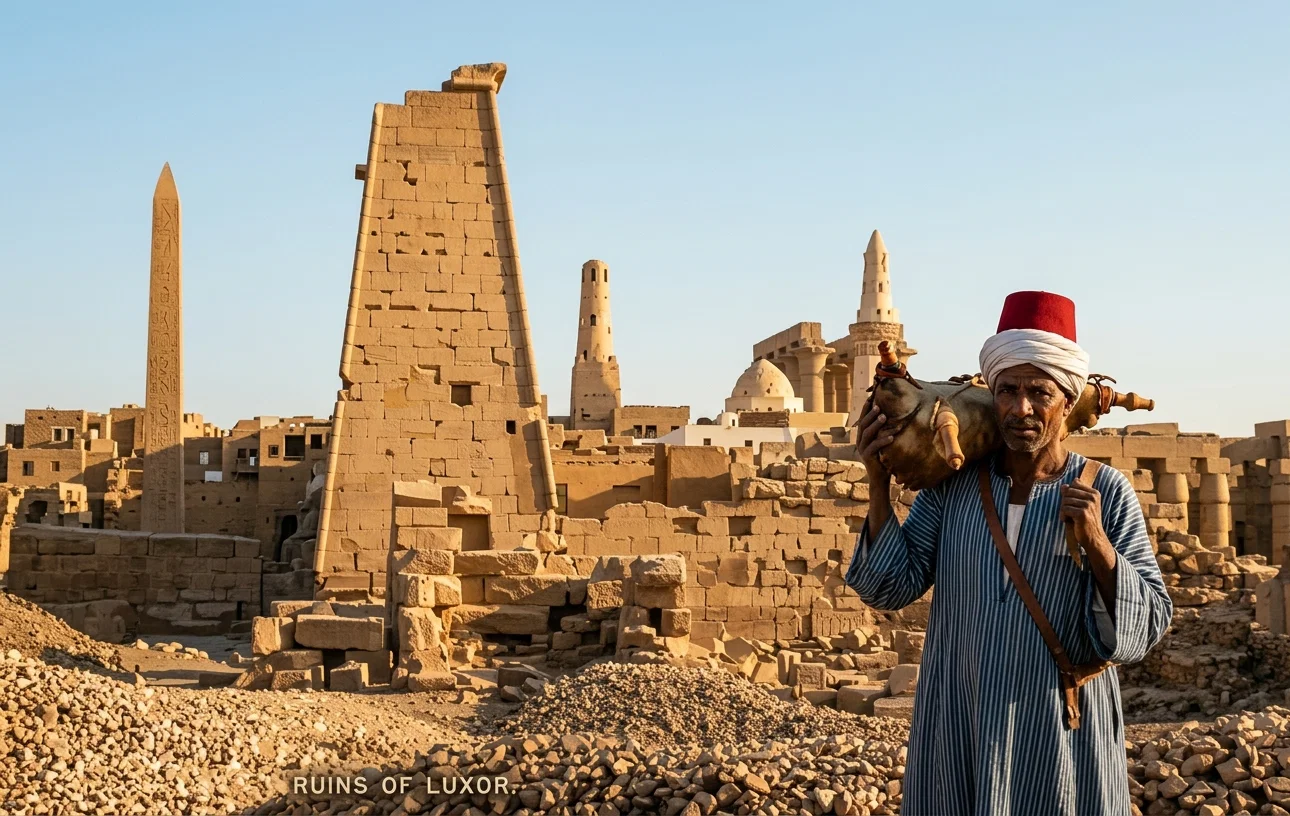
RUINS OF AN ANCIENT TEMPLE AT LUXOR, EGYPT. A NATIVE WATER-CARRIER
We visited a number of native homes, some of which were poor types of what we would call homes. At one place where we held a Bible study through an interpreter, we found several women gathered, all sitting around on the floor, which was by no means clean. When Mr. Nethery entered, they all began to draw their head coverings over their faces, as it is counted a shame for a woman to have her face uncovered in the presence of a man, unless he is a relative. The Mohammedan woman wears a veil stretched across her face just below the nose. She also wears a nose-piece, which covers her nose, so only her eyes are visible. But the Coptic woman, who believes in Christ, wears a black mantle with a cape over her head, which she holds together under her chin with her hand; but when she is out on the street, and sees a man approaching, she shuts the cape together over her face. It seems a very bad custom; but very few natives can be induced to dispense with it, except some of the girls who are being trained in mission schools. Even our Egyptian sisters follow their old customs.
Brother Awada dresses in European costume when on the street, except the red felt tarbush, which he wears all the time. The higher class of natives wear this article of head-dress, as it is counted a dishonor to one's country not to wear the tarbush, unless it is replaced by the turban, which is worn by all classes, and consists of a twisted strip of cloth wrapped around the head. They never remove their head-gear while in the house; and with such heat on their heads, both summer and winter, a great number of them are bald. Most of the men who live in the cities wear long flowing black gowns, which sweep through the dust as they walk.
We tried to eat dinner in real native fashion, in one of the Egyptian homes. There were no plates, knives, or forks. A bowl of soup was placed on the table, in the center, and a part of a loaf of bread was put at each plate. Each person was supposed to break off a chunk of bread, and dip it into the soup, and partake. They all seemed to relish the soup, but my husband and I decided that we had poor appetites, after seeing several hands dip in. The women ate in the kitchen, on the floor; but as I was an American, they granted me the privilege of eating with the men. But we did not want for something to eat; for this same family had a beautiful orange-grove, laden with delicious ripe fruit. They also had lemons, pomegranates, dates, figs, bananas, and grapes, but oranges and lemons were the only fruits ripe.
It is just these kinds of homes that missionaries must enter to give the gospel. In this home there is one woman who has lately begun the observance of the Sabbath. And, although living almost in the same house with pigeons, goats, donkeys, etc., still we hope the Lord will lift her to a higher standard. The way some live is surely beyond description; but we know that there are going to be a few from Egypt who will be saved. We pray that the Lord will bring intelligent natives into the truth who can work among their own people. We are thankful for Brother Awada as a native laborer. And then there are two bright young men who have recently begun to keep the Sabbath. They speak English well, and are teachers, and we pray that ere long they may be developed into workers.
Alexandria, Egypt.