To take a journey in China requires not only time, but a great deal of patience, as conveniences for this purpose are very meager. Our mission station is located about eighty miles from the nearest railway station, and two hundred miles from Hankow, the nearest city, where we secure our supplies, so it is necessary for one of our workers to make this trip every few months.
Dec. 21, 1903, I left our mission station, en route for Hankow, traveling in a two-wheeled cart, drawn by two donkeys, one hitched in front of the other. The bed of the cart is fastened directly on the axle, so the occupant gets the full benefit of the bumps, which are many, the roads being very poor. In this part of China the roads are composed entirely of red clay; and if it should happen to rain during your journey, you would be compelled to wait until the roads dry, and in the meantime you would find no provision made for your comfort.
There are evidences in many parts of China, that there once existed great imperial highways, connecting the most important cities. Vast sums were expended in the construction of these roads, and it would have been easy to keep them in repair, but this has not been done, and they have of necessity been abandoned on account of the ruins. The people consider the roads, mountains, and rivers as belonging to the emperor; and if anything needs to be done to them, they let him do it. If a heavy rain washes some of a farmer’s land onto the road, he goes to the road and digs it out again, and takes more away than was washed into it, which results in making a road a canal.
We took our bedding with us, as the Chinese inn supplies its patrons with only a dirt floor to sleep upon. We left Sin Tsai Hsien (our station) at 5 A. M. The distance to the next town was one hundred and ten li, or thirty-seven miles. Every few miles we came to an inn, where our driver would stop for a smoke, and perhaps a cup of tea and small lunch. At about 2 P. M. we stopped for dinner. I remained in the wagon while the driver, and the evangelist who accompanied me, ate their dinner; during that time at least two hundred persons gathered around the wagon to look at me. Perhaps I was the first foreigner some of them had ever seen, at least I thought so; for many of them stood and gazed at me all the time we were there, which was about one hour. The native evangelist had several copies of the Gospel of St. John with him, and while he was eating dinner, he thought it a good opportunity to sell some of these copies, so held out the books, quoted them the price, and as a result sold four. Certainly China is ripe for the harvest. If a foreigner should stop at any place in the country, in a half-hour’s time he would have a large audience about him.
After dinner we resumed our journey, this afternoon meeting a Chinaman with a camel. He used the animal as a beast of burden, as the camel could carry more baggage than could be carried with the little donkey carts and wheelbarrows. Late in the evening we reached our stopping place, and prepared to spend the night in the Chinese inn, for there are no others.
The inn consisted of one room with no windows in it, but a door with cracks in it large enough for everything to pass through but the dog, and he would run back and forth through the door, often leaving it wide open. In one end of the room there were three horses and four donkeys, and in the other end we slept. It is a typical Chinese inn.
It might be of interest to know how the Chinese sleep. They carry very little bedding with them, simply stretching out on the floor, and spreading their cotton-padded clothing over them. In the winter time the Chinamen wear several coats, which are made of two layers of cloth with cotton between, like comforters are made in America. They wear as many coats as they can afford,13making their arms stand out from their bodies in a very queer fashion. They are all mouth-breathers, and make considerable noise during their sleep.
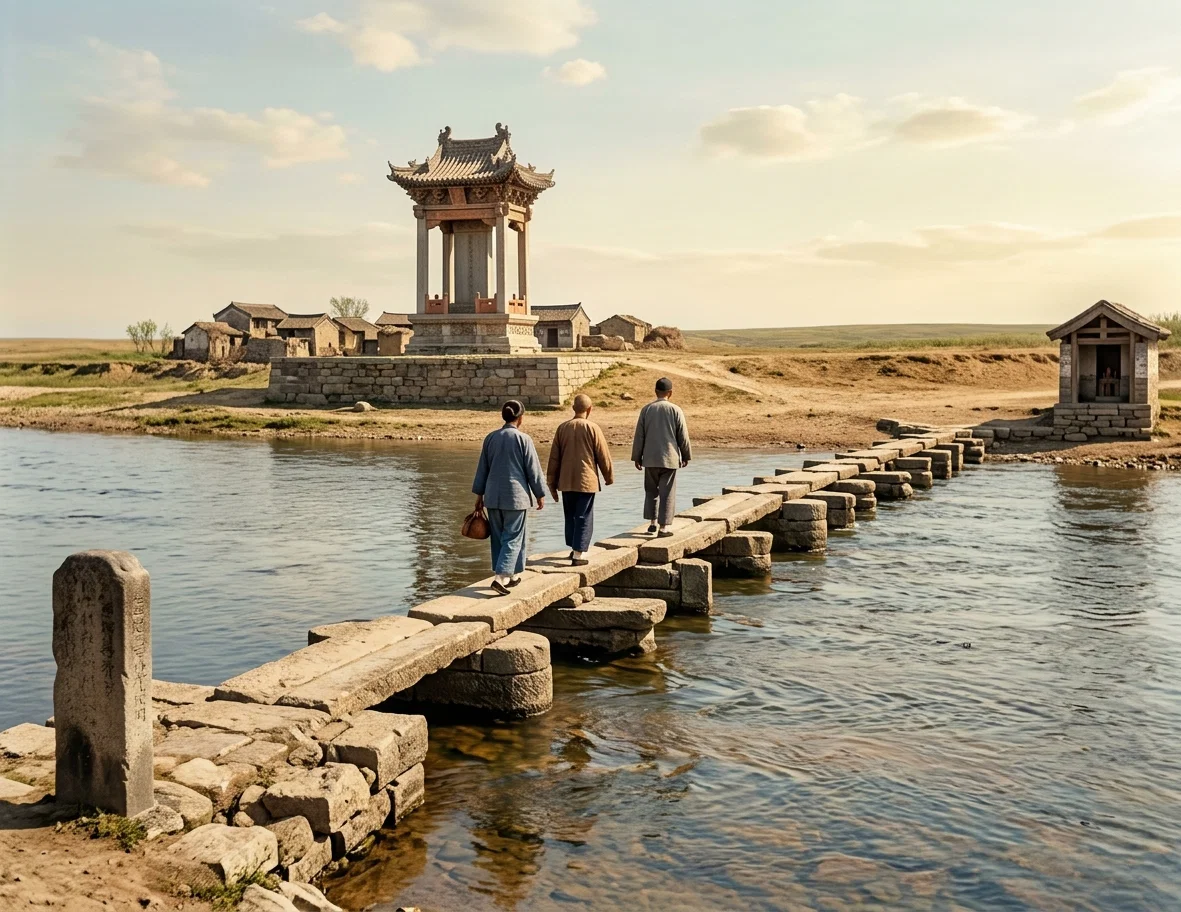
The next morning we resumed our journey, having a distance of thirty miles to drive. The roads were very hilly, and the bridges numerous. Chinese bridges are made of stone, and were all built several centuries ago, and have never been repaired. There is a rise of from six to eight inches in going onto the bridge, and a similar drop in going off. These bridges were built by wealthy Chinamen, who wished to bring their names into prominence in after generations; and with every bridge will be seen a monument, with an inscription on it bearing the name and history of the man who built it. Near a small stream which we crossed, we saw a large monument, but no bridge, as after building the monument, the man did not have enough money to build the bridge. All the rivers without bridges are crossed with ferry-boats, and this always takes a great deal of time, as the Chinaman moves very slowly.
We arrived at our station at sundown, and lodged in another inn similar to the first. We were quite chilly, and the Chinamen’s feet, which are poorly clothed in winter, were very cold, so they built a straw fire, but the smoke was almost as disagreeable as the cold.
The next morning we changed our mode of travel, finishing our journey to Hankow by rail. About one half the distance is mountainous. We passed through a tunnel one-half mile long. Every few miles we passed a Chinese village, and graveyards are never out of the foreigner’s sight while in China. The location of the grave is indicated by a conical mound from one to eight feet high, varying in height according to the wealth of the occupant. The grave is not dug very deep, the coffin being placed on the ground, and dirt thrown over it. A great many men are needed to carry coffins, as they are very large and heavy, being made of wood from four to six inches thick.
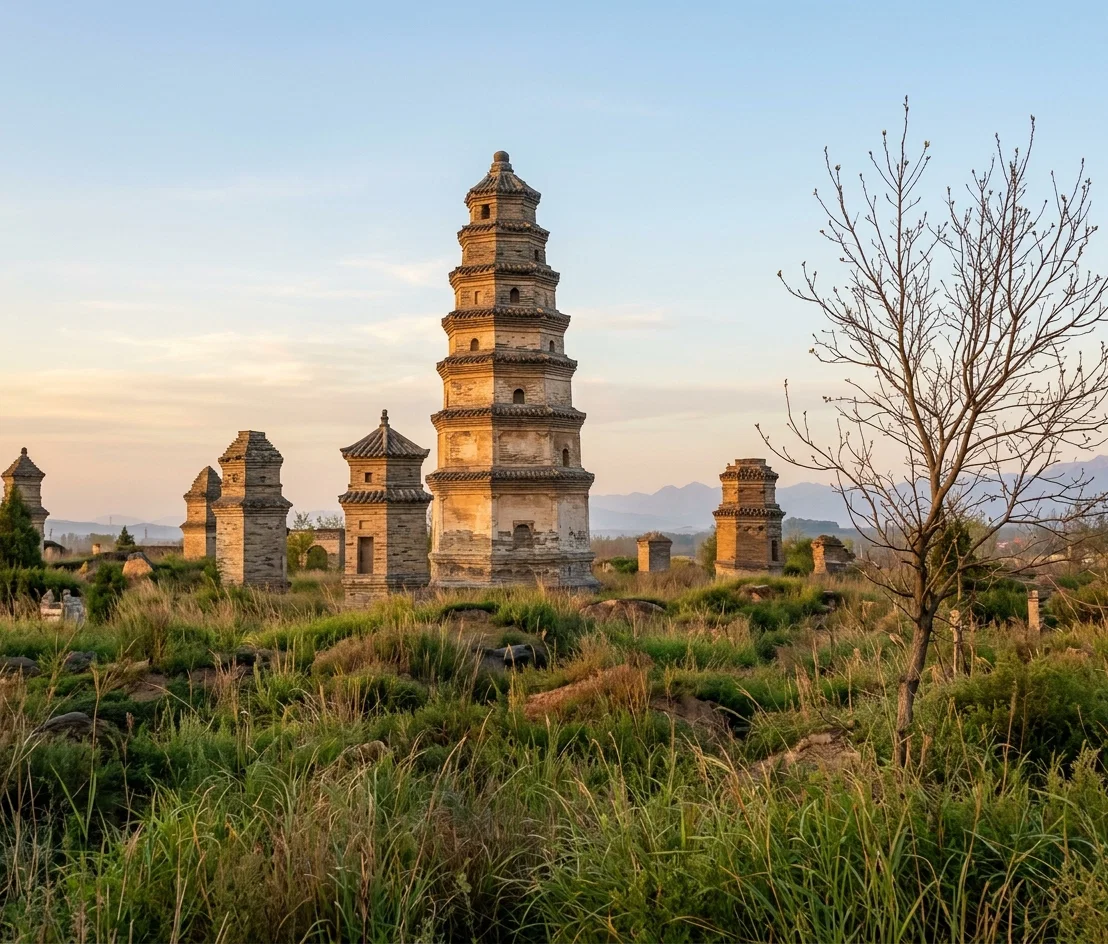
Many small temples are to be seen along the road, filled with idols, and the pagoda affords a striking spectacle to the Occidental. These structures are usually built seven or eight stories high, with no windows or stair steps. The Chinese claim they are a protection against the evil spirits, and have them in or near the graveyard, although they are found in other places.
We see nothing recently built in China; everything is in decay. There are no new cities, walls, roads, or pagodas. They have lost the spirit of enterprise and patriotism. One of the ancient classics of the Chinese has a proverb, “May it rain first on our public fields, and afterward extend to our private ones.” This was true of the people before and during the Chou dynasty; but to-day the Chinaman has changed: “I must look out for myself,” and if he thinks of the government, he says, “It is old enough and strong enough to take care of itself without my help.”
The Chinese not only feel no interest in public property, but if it is unprotected and available, they will appropriate it to their own use. The walls that are crumbling they carry away to build their own houses.
Hankow is the great commercial center of China. The foreign portion of the city has been built during the last decade. It is the Chicago of China, located on the Yangtse Kiang River, which puts it in easy communication with Shanghai on the coast; and this river and the Han River, which joins it at Hankow, connects it with Western China. The railway between Hankow and Peking is nearly finished, and the one between Hankow and Canton is in process of construction.
The city has all the modern improvements except the street-car, which is not needed; for there are plenty of comfortable jinrikishas, and coolies to draw them.
The improvements are not made with machinery, but by hand labor. Pilings are driven by a company of Chinamen, and by raising a large stone and allowing it to drop on the pole. The iron-roller is drawn by thirty Chinamen, instead of by a steam-engine.
As you pass from the wide, roomy streets of the foreigners into the narrow, crowded streets of the Chinese city, a great contrast is noted. These streets are choked with every form of industrial obstruction; the butcher, the barber, the itinerant cook with his travelling restaurant, the carpenter, the cooper, the tailor, and countless other workmen station themselves by the side of the small passage which beats with the life of a great metropolis, and do all they can to form a strangulating clot. The tanner spreads his hides in the street, the women bring out their quilts and spread them, for they have no room in their own close quarters. Nearly all that the Chinese do is done on the street.
Nor are all the obstructions of a movable character. The carpenter leaves a pile of huge logs in front of his shop. The dyer hangs up his long bolts of cloth to dry, and the flour dealer his strings of vermicelli. These all hang across the principal thoroughfare; for they claim the space opposite their shops. On account of the large number of people walking in both directions, especially coolies carrying luggage, the passenger makes very slow progress, and comes in direct contact with Chinamen.
But in this vast number of people crowded together, we must stop to think about the gospel which is to be given to them in this generation.
The reader would comprehend better the work to be done in China if he could have a view of the average farmhouse family grouped together. There are enough people at every farmhouse for a good congregation. The farmhouses are especially numerous on the great plain, where we are located. The Chinamen in the country seldom sit down to take their meal, but stand around the stove while eating the contents of their bowl.
CHINESE BRIDGE, SHOWING THE MONUMENT
A greater work is needed in China than ever before, and a greater work than man can do. Let all our people in America pray God that his Spirit may be poured out in these last days upon China.
LARGE AND SMALL PAGODAS FOR TRANSMISSION OF SPIRITS
OF THE DEAD