This Machine Madness

4%

Pacific Press Publishing Association · Mountain View, California, U. S. A. · Jul 8, 1930

FromSigns of the Times, Vol. 57, No. 26.

Read the full edition

This Machine Madness

MERLIN L. NEFF
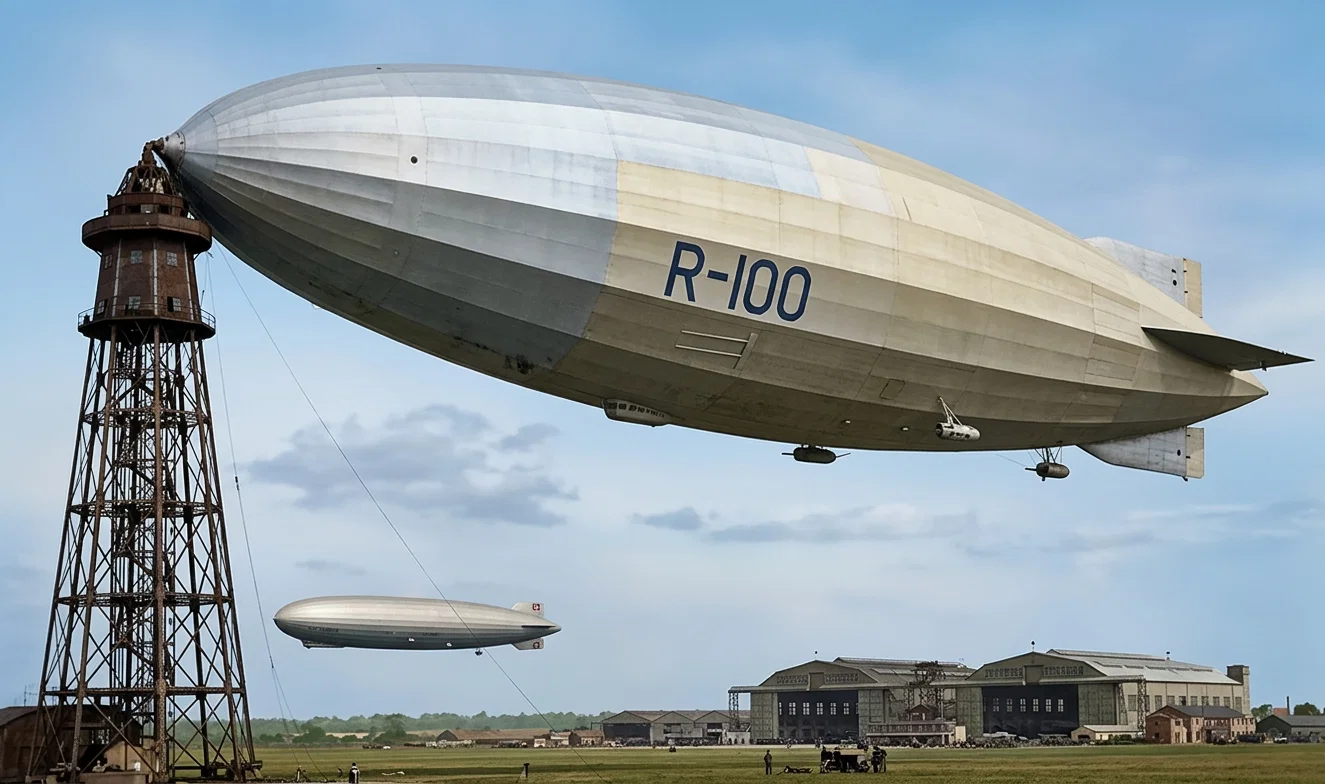
Two mighty machines of the air. In the distance is the “Graf Zeppelin,” as it flew over the airport at Cardington, England, on a recent trip and moored at the mast is the English dirigible, “R-100.”
A BILLION horses are doing the work of America to-day. Not flesh-and-blood animals, it is true, but machines that produce the horse power to turn our wheels of commerce, industry, and pleasure. Nations in the past have risen upon the power of conquest, money, trade, and slavery. Our modern civilization rests upon the power of the machine. It is the greatest influence on modern life, and no matter which way we may turn it affects us.
In the morning a mechanical contraption called an alarm clock awakens us. We press buttons and turn knobs to have light, heat, and boiling water to aid in our toilet. A hurried breakfast is prepared on some electrical appliances, and we are off to work. With thousands of others, we rush to street cars, trains, busses, or automobiles. But our speed is halted at times, for we must obey red and green flashing signals.
Eventually we arrive at the office, and our watch informs us that we are late by half a minute. At the desk we are the servant of the telephone and a half-dozen other office implements. At noon we partake of a bite of lunch from the automat or quick-lunch counter. The afternoon wears away, and we make our way home. The evening finds us reading the newspaper that has been turned forth from a giant press in a half-million-copy edition. While we read, we listen to the radio or phonograph with its mechanical music.
Such is the influence exerted by machines in the average city individual’s existence. In the country the farmer is not free from the machine. It has assisted him to a great degree. Twenty-five years ago he possessed two or three horses to help in the heavier work. To-day he has a forty-horse-power automobile and a powerful tractor, while gasoline or electric engines lighten his chores. The carpenter has a dozen machines to saw and plane where human hands once worked, and the doctor must always be adding new apparatus to his office to combat disease.
The ever-multiplying horde of mechanical inventions have lightened man’s work. They have given him an ease and a luxury that he has never previously enjoyed; but with the assets have also come serious liabilities. The machine age has given him prosperity, but very little more contentment. It has shortened the working hours of labor from twelve and fourteen hours a day to only eight, but it has occupied him with so many complexities that he finds no time for leisure or reflection. With all the swift strides forward in science and invention he has not grown in similar proportions in mental, moral, and spiritual powers.
A serious danger faces men who bear the responsibility of a billion horse power yet have not developed increasing spiritual and moral stamina to control this newborn Hercules. A man without regard for law and order is far more dangerous with a machine gun, tear gas, armored car, airplane, and speed boat, than he was with a six-shooter and a horse. We point with pride to the airplane skimming the clouds at two hundred miles an hour; but let us not forget that a fleet of five hundred such machines loaded with bombs might destroy the largest city on earth within a few hours. (This subject will be discussed more fully in a later article of this series.) America boasts of 25,000,000 motor cars, but she also faces the fact that 26,000 persons were killed by these machines in 1929.
Machines have provided speed; yet if this impetus forward is misdirected, what shall it avail? Why do people need cars that travel seventy or eighty miles an hour if they only hurry them to road houses or cabarets? Why have airplanes of such swift proportions if they carry groups of Londoners to Paris for an evening of gay revelry without sober thought or a worthy mission?With greater speed and power must come greater wisdom if such talents are to be used rightly. A recent Western football game drew some thirty thousand fans from a sister city five hundred miles away. A dozen special trains carried eight thousand persons, while automobiles, stages, and every available airplane carried excited crowds to the stadium to watch twenty-two men wrestle for an air-inflated pigskin. If machines are for no better and more worthy purpose than merely to popularize sport, we should seriously weigh the relative values of our age.
The radio is one of the marvels of man’s creation. To turn a dial controlling a few tubes using electrical energy and pick up the human voice thousands of miles distant is indeed a wonder. But if the material broadcast deals chiefly in popular songs of the cheapest vintage, foolish talk, and sordid advertising propaganda, are we worthy to use such a powerful machine? Again, if this machine takes so much of our spare time that we fail to improve our own talents of music, literature, and art, where shall we drift?

A GREATER RESPONSIBILITY

These questions are suggested that the reader may challenge the relative worth of our so-called age of enlightenment and science. A myriad machines have given us more time and ease; yet are we using this talent for a worthy cause? “It is hard,” said Emerson, “to carry a full cup.” The responsibility that is ours in the possession of time, power, and potential good, demands serious thought. “The trouble with New York to-day,” admits Prof. William Montague of the Philosophy Department of Columbia University, “is the wide misuse of sudden leisure.” And in his message to the National Recreation Congress held in 1929 in Louisville, President Herbert Hoover said: “This civilization is not going to depend on what we do when we work as what we do in our time off. We are organizing the production of leisure. We need better organization for its consumption.”
Having become overinfatuated with machines, we feel that we must use them constantly. When we are not at work, we are running over the highways in motor cars. It is estimated that one third of the population of the United States were in automobiles at one time last summer. Such a thing is not an evil in itself; but if it occupies our minds and energy to such a degree that we have little time or inclination for the spiritual values of life, it is a curse. The church complains that the automobile has ruined the spirit of worship, for people seldom attend services. Instead of listening to the word of God, the cry is, Speed! And on the highways the serious, sober realities of eternal value escape in our scurry hither and yon.
Distance has been condensed by rapid means of travel, until man is seldom alone to-day. Solitude is a forgotten blessing. Man alone with his thoughts is restless and miserable. The crowd continually presses in upon us. We follow the majority, lean upon their thinking and acting for our conduct. Religious life has been sadly neglected. Prayer and the family altar once found in almost every American home are almost obsolete. Intoxicated with the power and speed of to-day, we have forgotten God and gained overconfidence in self. “Certain machines,” declares Stuart Chase, “particularly the automobile, have tended to expand the ego, promote self-confidence.” The grind of machinery keeps men so occupied in their work that they seldom acknowledge a Creator. Solomon declares, “God hath made man upright; but they have sought out many inventions.”
“The world is too much with us.” We seldom break from the stress of life. We are burning the candle at both ends and reaping a tension of nerves that is unprecedented. Silas Bent, in an article, “The Machine,” in the Century Magazine warns us that “we are restless beyond precedent. . . . All of us are tense with a corroding effort to telescope the calendar.” From the time young America starts to school until he comes to the end of the way, he is in a hurry. Traffic must be speeded up. Speed limits are raised from thirty to forty or fifty miles an hour. Stop signs are a nuisance, for they retard our breakneck pace. Two minutes in a traffic blockade causes motor car horns to begin an impatient tattoo. Such madness is wearing down man’s physical endowments. A group of physicians recently discussed the medicine they most frequently prescribe. The result of their comparisons disclosed a unanimous verdict in remedy—it was a nerve sedative. If this is an index to our age, it is indeed a poor compliment.

LUXURIES HAVE MULTIPLIED

Mass production from machines in factories has brought a new problem in economic living. Hundreds of articles are placed before the public to-day in such a manner as to cause them to spend more money for luxuries. A hundred years ago it is estimated that there were some three dozen actual necessities in life and some ninety-seven luxuries. To-day we have a hundred necessities to common living and five hundred or more luxuries. A single mail order catalogue lists one hundred thousand separate articles to sell. Thus we spend so much time working to buy luxuries that we lack time to use and enjoy the luxuries, and thus we continue in a vicious circle.
Machines and scientific wonders are not injurious in themselves, but we can make them our god when we use them to the detriment and the disuse of the primary talents and necessities of right living. Machine madness is captivating. It is a rushing, pressing, hurrying, moving throng. But we cannot always mingle with the crowd in this age and keep our contact with God. Jesus Christ mingled with men. He healed the sick, He blessed the children, He fed the multitudes, and taught them words of life, but for His source of spiritual power and meditative thought He went into the quietness of the mountains, and was alone. “When He had sent the multitudes away, He went up into a mountain apart to pray: and when the evening was come, He was there alone.” Matthew 14:23.
The Christian dares not lose his hold on things spiritual if he is a successful follower of the Master. In the blare of the city, the congestion of the milling throng, he must step aside and with the sons of Korah heed the command, “Be still, and know that I am God.” Psalm 46:10.
When Israel turned away from God and
(Continued from page 2)
the word of the Lord, Isaiah was told to declare this remedy: “In returning and rest shall ye be saved; in quietness and in confidence shall be your strength: and ye would not.” Instead of serious thought and quiet contemplation, they took a course somewhat similar to our modern age. We read further, “But ye said, No; for we will flee upon horses; therefore shall ye flee: and, We will ride upon the swift; therefore shall they that pursue you be swift.” Isaiah 30:15, 16. Instead of horses of old, we can modernize the picture and find men fleeing from the ways of God in swift-moving machines of their invention. God’s decree remains unchanged: “Blessed are all they that wait for Him.” Verse 18.
While machines in factories and on the road depend upon motion and speed for their best service, the human being must find time for meditation and quietness. When the world is on wheels, Isaiah declares, “Their strength is to sit still.” Verse 7. Let us not become so infatuated with the whir of motors, the noise of motion, the speed of wings, or the magic of distance that we forget to look upward to God whence cometh our strength and blessing.
This danger of forgetting God in a time of power and leisure was well emphasized by Dr. John Grier Hibben of Princeton University, when he said, “We must all be on guard against allowing a sense of power to dull our sensibilities and to use prosperity as a means to unworthy ends. Nor must we allow a starvation of the soul. With the growth of wealth and expanding resources of increased power, there is the danger that the soul may become small and mean and debased. Finally, we must be careful not to let prosperity become alien to religious impulse and aspiration. We must remember that religious inspiration is just as necessary in times of prosperity as in adversity.”

BEWARE OF HASTY DEDUCTIONS

Miracles of the workshop and laboratory have caused men hastily to conclude that the Utopia is near on this earth. But let us beware of hasty deductions. Because of increased knowledge we may not also have acquired an increased amount of spiritual wisdom. The answer is not found in machines. Elijah did not find the answer to his soul’s longing in the blaze of fire, the mighty wind, or the earthquake. He found God in the “still small voice.” Let us beware of machine madness that infatuates men until they forget God and become so occupied with the material things of the world that their souls become dwarfed and ossified. “Thou wilt keep him in perfect peace, whose mind is stayed on Thee: because he trusteth in Thee.” Isaiah 26:3.