The astronomer is ever reaching out in an attempt to measure space, but he never will achieve his goal, because of the human limitations to his powers. This article ends the present series.
IN THE previous article we found that space is filled with great island universes, and that the Milky Way is the island universe to which our sun and earth belong. We learned that it is 300,000 light years in diameter, the light year being the distance that light covers in one year, traveling, as it does, 186,000 miles a second, or nearly six trillion miles a year. And so the spiral nebula to which we belong, the Milky Way, is six trillion times three hundred thousand miles in extent.
The basic principle involved in ascertaining these great distances is quite fully explained in the book, “Astronomy and the Bible,” pages 106-121, so we need not take time for it here.
It is said that when a certain farmer saw a camel for the first time, he exclaimed, “There isn’t any such animal.” And so when Lord Rosse, in 1845, announced his discovery of the first spiral nebula, astronomers said there was no such thing, and that his imagination had run away with him. Now astronomers know that there are at least a million of these spirals, or island universes, each one having its own family of thousands and millions of suns, and traveling in a path of its own, separated from its fellow spirals by at least ten thousand light years.
BILLIONS OF SUNS
Our galactic system is composed of billions of suns. But in some of these other island universes there are stars, or suns, very much larger than any in our system.
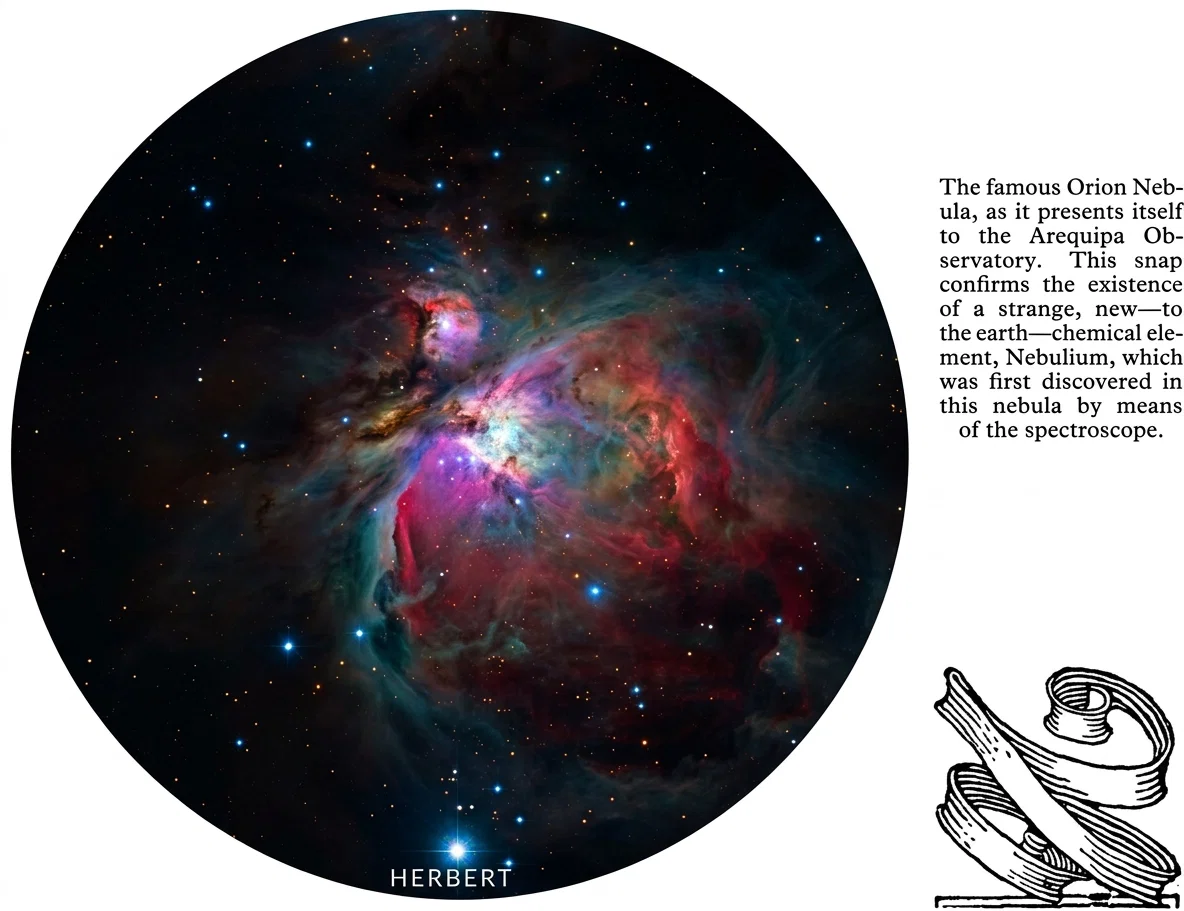
The famous Orion Nebula, as it presents itself to the Arequipa Observatory. This snap confirms the existence of a strange, new—to the earth—chemical element, Nebulium, which was first discovered in this nebula by means of the spectroscope.
S Doradus, in the large Magellanic cloud, is the most luminous object known, its emission of energy being 600,000 times that of the sun. It radiates away 2,500,000,000,000 tons of its mass every second.
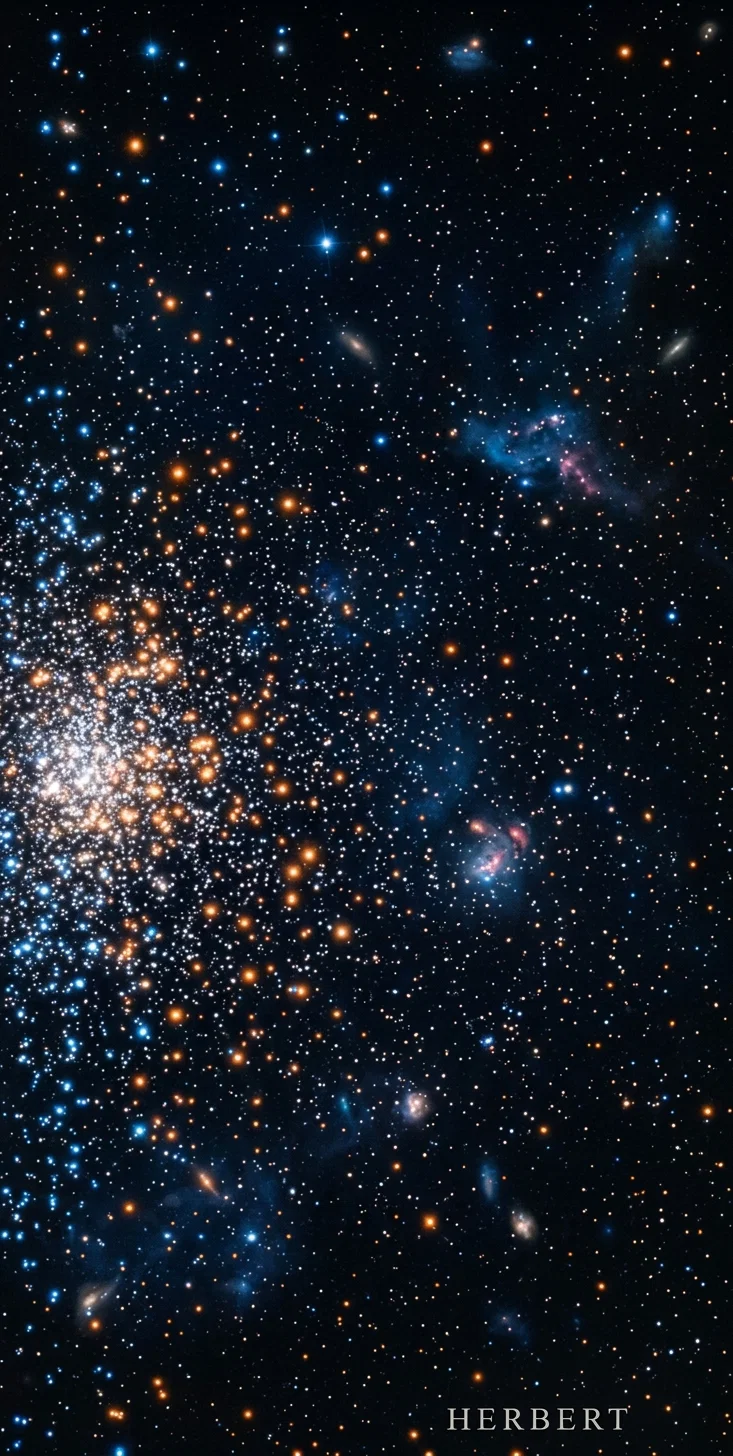
N. G. C. 6822 was discovered by Professor Barnard forty years ago, with a six-inch telescope, at Nashville, Tennessee, and is now known to be a star cloud 750,000 light years from us.
Shapley and Hubble have estimated the distance of the clusters in Virgo and Coma Berenices at 10,000,000 light years, while other smaller clusters of fainter appearance may be much more distant.
The astronomer of the University of Paris says that at a low estimate it will take from eight million to ten million years for light to reach us from some of these nebulae that are visible with the telescope. And he observes that the cosmos seems to be composed of millions of Milky Ways separated by oceans of uninhabited space, soundless voids, which light, swiftly as it travels, takes thousands of centuries to traverse. And he further remarks: “To-day the spiral nebulae represent, after the stars themselves, the most profusely scattered bodies in the universe.”
Mr. Curtis of Lick Observatory estimates the number at present observable at one million. These are such as are capable of being photographed with the 36-inch Crossley reflector of the Lick Observatory.
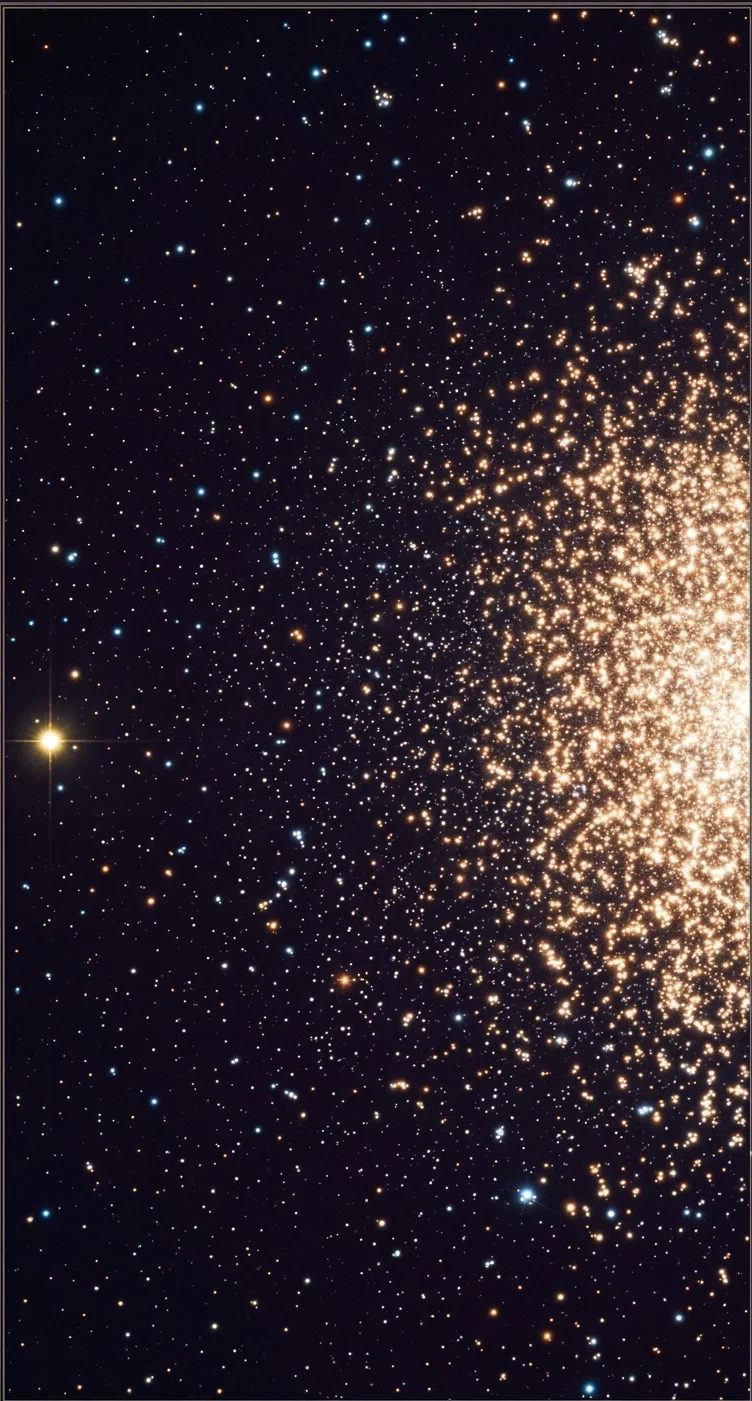
A close telescopic view of Omega Centa
across, as it is viewed from the Harvar
numerable suns, which scientists believe
speculations
Hubble has estimated that island uni verses are on the average not much closer to one another than 10,000 light years. They are certainly not much crowded for room.
LOTS OF ROOM IN UNIVERSE
The astronomer estimates that the now-visible universe is probably one hundred billion light years in diameter. “This does not mean that there is nothing beyond, but only that we terrestrials, living and thinking in three dimensions, could never hope to observe it.” The astronomer cannot penetrate into space more than one hundredth of this greatest distance.—William J. Luyten, in “The Pageant of the Stars.”
“What is the outcome of all this new information?” he asks. “Our giant telescopes have temporarily brushed aside the eternal veil of empty space, and in less than ten years we have advanced our milestones from one hundred thousand light years to one hundred million, only to find that more are awaiting us. The ‘eternal silence of infinite space,’ which so frightened Pascal, has ceased to exist for us. Silence reigns no more in the realms of space, but has given way to . . . light messages from countless island universes. . . . In a perhaps not entirely futile attempt to comprehend this time scale of the cosmos, we have fatigued our imagination to the breaking point, only to realize that in our apparent advance against infinity and eternity we never really gain ground. Our mind stands perplexed, our intellect overwhelmed, before the joint concept of infinity existing throughout eternity.”
that measures many billions of miles
Arequipa, Peru. It is made up of in-
the dim ages of time far beyond the
dreamers.
Astronomers have a larger measuring unit than the light year, which they call the parsec, and is the distance that light travels in three years and three months. It is the distance measured by a heliocentric parallax10of one second. But many astronomers prefer the light year; for, as Shapley says, it expresses not only distance but also time. It is the distance that light traverses in one year of time. And it is to this that Luyten refers when he speaks of the “joint concept of infinity existing throughout eternity.”
The infinity is that infinitude of space that the astronomer is ever approaching in his measurements and that he will never actually reach because of the feebleness of his powers. But his labors are not in vain, for he comes to believe in the actual reality of an infinity of space. And as he thinks of the gigantic measure of time thus involved, there is born within his mind the concept of a real eternity of time, though he can never live long enough here to demonstrate it. How can the finite measure the infinite? How can the temporal comprehend the eternal?
HERE IS THE ANSWER
And so this is our answer to the question, How big is the universe? It lies out before us in an expanse of space that hints to us of the immeasurable. It reveals ages of time that whisper of the eternal.
As the poet has declared, so now in the light of the past ten years of astronomical research do we declare, “End is there none to the universe of God; lo, also there is no beginning.” “Whose goings forth have been from of old, from the days of eternity.” Micah 5:2 margin.
And all this should, in a measure, humble us, but not too much; for we are feeble and of only a few years’ existence. The ages of the stars long years of durance teach us.
“The elders of the night, the steadfast stars,
The old, old stars which God has let us see,
That they might be our soul’s auxiliars,
And help us to the truth how young we be.”
At night alone the sight to us is given,
To humble us, His glorious ageless heaven.
Rejecting the gloomy doctrine of Erasmus Darwin’s poem, we might paraphrase and recast it to tell this great truth declared by the prophet of old,—“For that He is strong in power; not one faileth.” Isaiah 40:26.
And so we sing:
Roll on, ye stars; exult in youthful prime;
Mark with bright curves the printless steps of time;
Near and more near your heavy cars
approach;
Yet never star on fellow star encroach.
Flowers of the sky, yet ne’er to age shall yield
Like your frail, silken sisters of the field.
Though star on star from heaven’s high arch
shall rush;
Yet star on star or system ne’er shall crush,
Headlong, extinct, to one dark center fall,
And death, and night, and chaos mingle all;
For He that made and kindled you with light
Shall still uphold and gird you with His might.
Your message, this, I ever firm shall hold:
His perfect work can nevermore grow old.
There waits for me, for you, times vast eternal,
And room unmeasured in a light supernal.
Says Prof. Charles Young of Princeton, “If I were to say what I really believe, it would be that the motion of the spheres of the material universe stand in some such relation to Him in whom all things exist, the ever-present and omnipotent God, as the motions of my body do to my will.” Yes, they are all under His control.
IMMENSITY FAILS TO MOVE GOD
In viewing the immeasurable universe, its gigantic bigness gives us an overwhelming conception of God’s almighty power and wisdom. The vision of these great things of eternity and immensity, if looked on alone, might weary and oppress us, and this by our comparing them with our mortality and frailty. To inspire us, to uplift us, God has [[FIGURE]] given us the spectacle of the cross to show us that there is a bigness of love for us that outweighs any mere bigness of purely material things.
It is not material bigness that has most moved the heart of God. He has not often called the great nation or the great person to do His work, but rather the smaller, the less significant, and even the despised. We are not to think that our importance as a world demands that the earth be at the center of the universe, with all other created orbs rotating about it. Mere position and size do not appeal to God. He who has chosen for His work the younger and the less-esteemed brother, the humble, neglected person, has in His wisdom and mercy chosen a small, fallen world where to manifest His greatest care and tenderest love. It is the one lost sheep that calls to the great heart of the true Shepherd.
Agnes Gibérne and Dr. Pritchard were together outside his observatory at Oxford. Agnes had made some remark about the earth’s insignificance because of its small size and humble place in the cosmos. He opposed with emphasis.
“You think,” said he, “a great deal too much of mere bigness! I find as much in one little flower in my garden to arouse my wonder and awe as in all the stars of the universe.” And this from an astronomer.
Size or distance are as nothing with God. Since a thousand years are in His sight as but one day, so a billion miles are as one mile to Him. A blazing sun a million miles in diameter is after all only a big fire; but a world filled with blood-bought souls is worth more than millions of suns, for it is the purchase of the Son of God, and the price He paid is His own valuation of its worth, the worth of His life, His own precious blood.
Since the “heavens declare the glory of11
The Infinity of Space
(Continued from page 9)
God; and the firmament showeth His handiwork,” so indeed does the earth manifest the unmeasured riches of His grace that have been here displayed, and the uncounted deeds of His love that have here been performed.
Our vast need of salvation from sin and restoration to righteousness have drawn upon Him with a measure that outweighs all the gravitational pull of all the material worlds of the universe.
And as our need drew upon Him, so now does His love draw us, and we realize anew how forever He upholds, and heals, and saves.
Therefore, as you meditate on the might and the majesty, the vast power or force, the swift movement of ponderous balls of fire whirling and whizzing through space; as you view this awful spectacle of gigantic systems in the far-off chasms of immensity moving in order and rhythm; as you get the concept of these overmastering examples of material infinitudes, do not fail to neutralize its humbling effect by gazing long and earnestly and believingly upon that rugged cross where hung in agony for you the very heart of God.
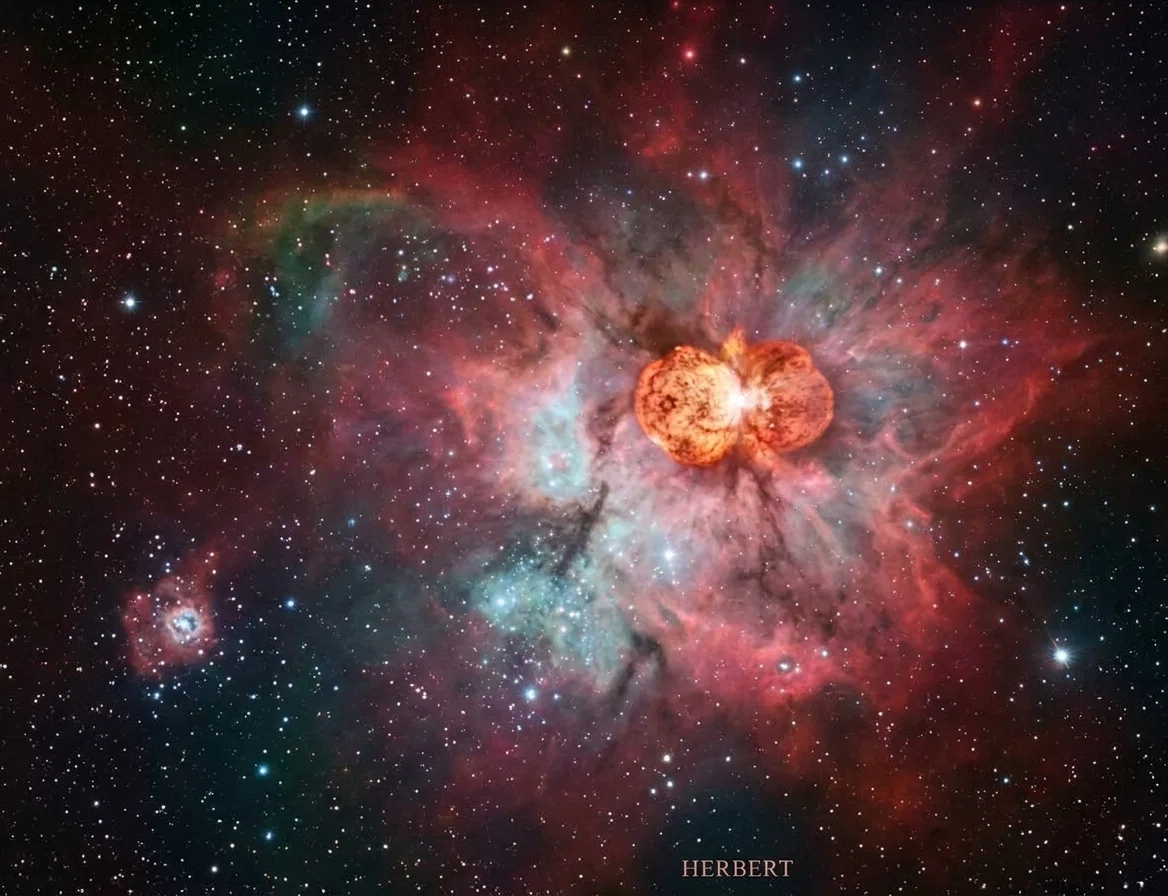
Eta Argus, the finest nebula in the southern heavens, and probably the most wonderful that is visible from any part of the earth. This nebula furnishes valuable proof of the existence and some of the characteristics of another of the chemical elements of nature.