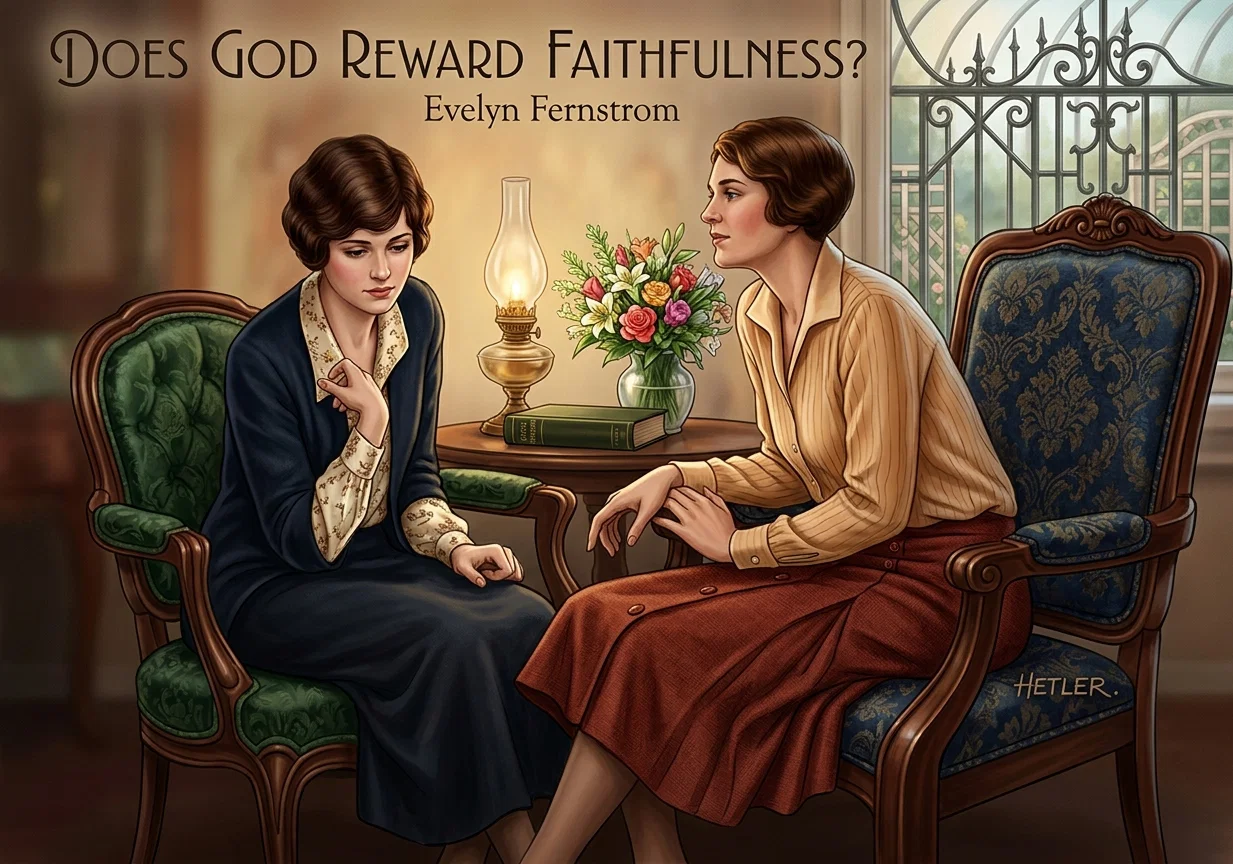
“She was not such a peculiar girl after all, yet I had made up my mind that I would not let her ideas influence me.”
The story of two friends who worked in the same office, but had different ideas concerning stewardship and what God had intrusted to their hands.
Evelyn Fernstrom
Jean, have you seen those lovely fur coats at Mandel's? They are gorgeous; I went past there this noon, and I just can't forget them," I said to my friend as we were both trying to adjust ourselves to our afternoon's work.
"Yes, I noticed them. They are beautiful, just what we need for the long, cold, Montreal winters," Jean replied.
We had worked together in the same office for one year. Jean was a lovely girl, but somewhat peculiar. She had a heart of gold, was always pleasant to every one, but somehow she was not really one of us, and we had not become very intimately acquainted with her.
"Let us each get a fur coat," I suggested. "You are making as much as I am, and we could begin saving for them at once, and soon we would be beautifully clad," I urged.
"I'm willing," she remarked.
"Good; we'll go down to-morrow and look them over. I'm really thrilled."
The next noon we each decided that we would need one hundred fifty dollars before we could get our coats. This would not take us so very long, we promised each other.
JEAN IS A GOOD NURSE
During the next week it was necessary for me to look for another apartment. I told Jean of my plight and upon her suggestion I moved in with her. It was not long until I became sick with the "flu." Jean insisted on nursing me. I must confess that she knew almost as much about taking care of sick people as a trained nurse would. She was not such a peculiar girl, after all, yet I had made up my mind that I would not let her ideas influence me. I was satisfied with my manner of living, and if she was satisfied with hers, then I felt everything was all right. Another thing, she did not work on Saturdays; nevertheless, I could not help liking her, especially now that I was ill and she was so kind to me; but before I had fully convalesced, I had learned to love Jean. She was like all other girls, full of joy and kindness, but, besides, she had sterling qualities that very few girls possessed.
One evening some time later, as we were sitting in our cozy living room, our conversation led again to fur coats. "I think I have enough saved so that I can purchase mine next week!" I exclaimed. "You have, too, haven't you, dear?"
"No, I really haven't," Jean admitted.
"Oh, I am sure you have. We earn exactly the same, and spend just about the same amount." "I think I lack just exactly fifty dollars."
"Impossible! You must have made a mistake somewhere."
"Why, no, but you know that I give one tenth of my income to the Lord, and, therefore, I have not as much money as you, just now."
"Oh, I had forgotten about that. Well, really why do you do it?" I asked.
JEAN EXPLAINS THE BIBLE
Jean explained that the Bible told us to do this. At this time we were interrupted by some friends who came in, and I forgot about Jean's and my previous conversation. The following day Jean went with me when I purchased my coat. The weather was extremely cold, and I was more than glad that I had finally bought it. "I'm sorry you haven't yours," I said.
That evening, in the course of our conversation, Jean explained that God owned everything, and that all nature gave. She said that we had nothing of our own; God had only appointed us as stewards over His goods, and that God wants His stewards to be faithful in everything. She read the parable in Matthew 25, of the man who traveled into a far-off country. As I listened to her, I could not help seeing the remarkable faith she had in God.
"Why do you have to give one tenth of your income to the Lord?" I asked.
She said that tithing is an expression of our stewardship in giving. We tithe our income in recognition of God's ownership of the whole, just as a tenant pays rent in recognition of the landlord's ownership of, or rights in, the house. Although paying rent entitles the tenant to use the house, it does not make him the owner of it. The tithe is not paid simply because it is the Lord's but because all one has, or acquires, is His.
NOT A NEW DISCOVERY
"I suppose this is something new that has just been discovered," I said.
"No," Jean replied; "we find that Abraham honored God by being faithful in giving the tenth part of his increase to the Lord. This is the first recorded instance of tithing in the Old Testament. To Abraham it was a moral obligation. It was a duty universally recognized by the nations in Abraham's time and long before. Traces of it as something old and well understood appear in the earliest historic times among nations having little or no intercourse with the Jews or with one another. To suppose that so many people all hit upon the tenth is out of the question, and the only reasonable conclusion is that they all got it from the altar, and that it was a part of God's moral law originally revealed to man, and as such was obeyed by Abraham. Abraham's act was, undoubtedly, an expression of his gratitude to God for His goodness to him. It was in full recognition of God's ownership of all things."
"I surely did not know that before. Is there anything else in the Bible about the tithe?" I asked. I wanted to find out all about it, but still I knew that it could hardly be meant for us. It was just one of Jean's peculiarities, but it would do no harm to know how she felt about it.
"There are many references made to it," Jean explained. "I will tell you of a few. The Lord says in Leviticus 27:30, 'All the tithe [tenth] of the land, whether of the seed of the land, or of the fruit of the tree, is the Lord's: it is holy unto the Lord.' In Numbers 18:21 we read that God had given the children of Levi all the tenth in Israel for an inheritance for their service. Jacob vowed a vow at Bethel that of all that the Lord would give him, of that he would surely give the tenth unto the Lord. Christ Himself approved of tithe paying, for we read in Matthew 23:23, 'Ye pay tithe of mint and anise and cummin, and have omitted the weightier matters of the law, judgment, mercy, and faith: these ought ye to have done, and not to leave the other undone.'"
"Christ did not censure them for paying a tenth of even the mint and rue and every little herb. They could not be too strict or too careful in paying debts to God. These they ought to have done. What He reproached11them for was that they were content with this and omitted the equally important matters of justice and real love to God.
"In Deuteronomy 16:17 we are told, 'Every man shall give as he is able, according to the blessing of the Lord thy God which He hath given thee.' We can give according as God has prospered. There is equality among the rich and poor. We need to give only one tenth of our income."
"I did not have any idea of the system that God has requested. I am glad that you told me about it," I exclaimed. I thought that it was a good way, but did not think it was necessary for me to do it. It was right, I knew, but I was not going to become like Jean. Anyhow, was Jean any better off because she paid tithe? I could not see much difference between her and me except that she had less money than I.
THE REWARD
The following day we passed Mandel's during our noon hour, and we could hardly believe our eyes. There were the coats that we had been looking at, and they had been marked down to ninety-nine dollars. Jean and I walked in, and Jean purchased her coat, the identical one she had selected a few weeks before, and which yesterday had been marked one hundred fifty dollars. Jean was fortunate. "Jean," I said, "Do you suppose there is something to this tithe paying?"
"My dear, of course there is. God challenges man to test Him. God says, 'Prove Me now herewith.' When I was saving for my coat, I was tempted to use my tithe so that I could purchase it at the same time you bought yours. I wrestled with the thought that it was cold, and that I needed my coat. I also wondered if it made so very much difference if I used the money and then paid it back at once. However, I finally decided that God wanted me first to give Him the portion that He has asked for; and now I surely am glad that I did so."
I could not forget the experience that Jean had had, and Jean's peculiarities became to me beautiful traits in her character. Jean became a new girl to me. Finally I tried to become like her. God has richly blessed me. I have been paying one tenth of my income to Him, and have in every other way tried to follow Him. I shall always thank Him for bringing Jean into my life.