It is unless the rainbow of promise that colors the present storm clouds darkening the skies of the social, the economical, and the moral world is detected through eyes of faith.
VARNER J. JOHNS
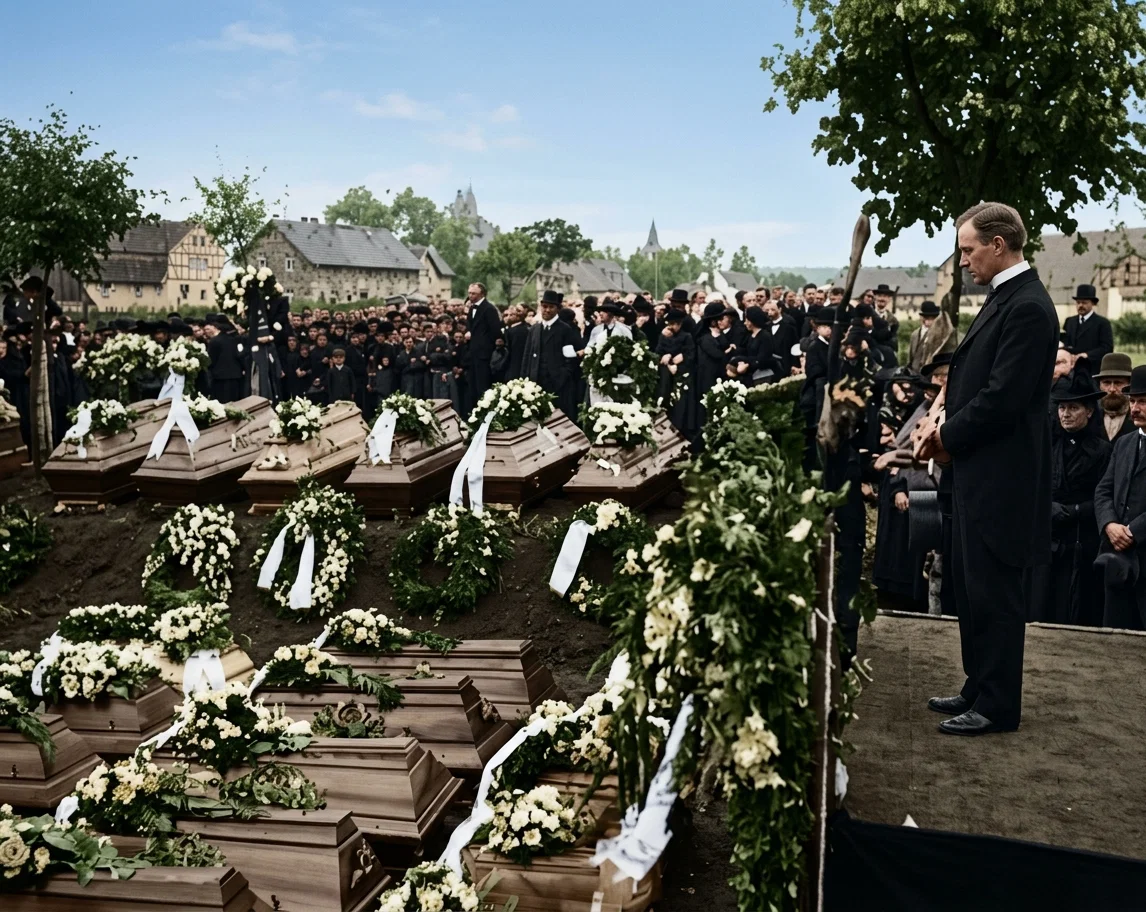
The tragic sight of the burial of some of the 157 ill-fated miners who were killed when an explosion occurred in the shaft of the Winzeslaus Mine in which they were working, at Hausdorf-on-the-Neurode, Germany.
Dark, impenetrable, unknown—is this the message that must be written over the gateway to the future? or is the path of to-morrow a lighted way, radiant with prophetic sunshine? For the man whose confidence is in the Bible, the answer is not difficult. Jesus is coming! The rainbow of promise colors the storm clouds. The hope of salvation brightens the dark picture of crime and corruption, injustice and oppression—a world filled with selfishness, torn with dissension, cursed with hypocrisy, and tottering in perplexity.
Multiplied thousands believe in the nearness of Christ’s coming. They realize that the world’s only salvation from utter ruin is in the coming of the Redeemer. But more important by far than the fact of His coming is the response in your heart and mine to the call for preparation. “Are you ready for the Bridegroom when He comes?” is the heart-searching question that echoes round the world.
The call of the Christ in this tragic hour of fearful apostasy is a call to completeness in consecration. In days of old the multitudes listened to the sweetest story ever told. They heard the wonderful words of life from the lips of Jesus. They witnessed the wonderful works performed by Jesus. And yet, as His words burned into their hearts and touched the hidden doors of selfishness and love of the world, they turned from Him and rejected His message. In anguish of soul Jesus turned to the twelve. “Will ye also go away?” He exclaimed, and His heart of love was broken.
WHY REJECTED BY WISE MEN?
Sometimes people say to me, “Brother Johns, if the Adventist message is true, if the seventh day is the Sabbath of the Lord, if the Ten Commandments are the divine rule of righteousness, why do not the doctors of divinity, the great men of religion, accept it?” And then I have to turn to the words
of Paul and read, “Not many wise men after the flesh, not many mighty, not many noble, are called.” The way is too straight and the gate is too narrow for the masses of men to find it. Their eyes are blinded and their hearts are hardened, because they are unwilling to take the way of the cross. But, thank God, from every nation, kindred, tribe, and people, thousands upon thousands have heard the call to consecration, the call to commandment keeping, and are walking in the way that leads to the city of God.
The last message of mercy is now being proclaimed to a dying world. It is a reformatory message. It is a back-to-the-Bible message. It is a message that prepares a people to stand in the presence of Christ at His coming. It is a message against the Christless Christianity and the deep-seated apostasy of our time. It is a message that exalts every Bible truth as fundamental. And it is a message of salvation. In the last two verses of the Old Testament a prophecy was written of the very message that is now being carried into all the world. “Behold, I will send you Elijah the prophet before the coming of the great and dreadful day of the Lord: and he shall turn the heart of the fathers to the children, and the heart of the children to their fathers, lest I come and smite the earth with a curse.” Malachi 4:5, 6.
This prophecy met a partial fulfillment in the days of John the Baptist. “In the spirit and power of Elias.” John came and sounded forth the call to repentance. “Make straight the way of the Lord,” was the burden of his cry. Under his burning message of reproof, the hypocrisy of the Pharisee was unmasked, the iniquity of King Herod was laid bare, the sins of the multitudes were exposed. With meaningless forms and pious platitudes, the doctors of divinity had darkened the way of truth. John the Baptist stripped from Pharisaical shoulders the cloak of hypocrisy and removed from the neck of groaning humanity the yoke of oppressive religion.
A TYPICAL WORK
The work that was done by John the Baptist in little Judea is typical of a world-wide call to repentance of heart, a world-wide challenge to straightness of religious teaching, just before “the great and the terrible day of the Lord.” In these days of gilded sin, corruption of heart, and widespread apostasy, the Elijah message is encircling the world with a ringing challenge to “make straight the way of the Lord” and “to make ready a people prepared for the Lord.”
On the heights of Mt. Carmel in ancient Israel stood a rugged prophet of the Lord. Alone amid a hostile throng of apostate priests and false prophets stood Elijah the Tishbite—alone, but for the host of unseen angels who always stand by the side of the man of faith. Four hundred fifty prophets of Baal and four hundred prophets of the grove, protégés of wicked King Ahab and vile Queen Jezebel, were there to challenge the supremacy of the God of heaven.
Elijah was in the decided minority on that memorable day. The old prophet of the Lord thought that he alone, throughout the realm, had not bowed the knee to Baal. But God showed him that there were yet seven thousand whose hearts were true. The Lord knows the loyal in heart, and loves them. He knows what it means for them to stand alone for truth and righteousness when all about them men are bowing low to error and unrighteousness. His people are always in the minority with men, but if the Lord of hosts is with them, if Jesus is on their side, if the angels that “do His commandments” are for them, it matters little if the world is arrayed against them.
It meant something to be true in those days of apostasy. It meant something to be a Christian even when Jesus walked amongFive
men. To be cast out of the synagogue was to be cut off from friends and loved ones, to be cut off from the inheritance, to be cut off from employment. The Christian in those days was an outcast from society and without a friend in the world but Jesus. No wonder Nicodemus came to Jesus by night. No wonder the parents of the blind man would not acknowledge Jesus. No wonder that Paul, the intellectual giant, was imprisoned, beaten, stoned, and killed for his faith in Christ.
“Oh, how cowardly!” we exclaim, as we read the story of Pilate’s indecision before the frenzied mob. Pilate knew that Jesus was the Son of God. He couldn’t condemn Him and he wouldn’t accept Him, and he thought to shift responsibility for His death by washing his hands before the Jews. Sometimes the character of Governor Pilate is painted in dark colors by a doctor of divinity who knows deep down in his heart that the seventh day is the Sabbath of the Lord his God, but who knows that he will be cast out of the synagogue, that he will lose his position and his popularity if he accepts it. Tens of thousands who minister in the name of religion would have stood with the scribes and the Pharisees and with Governor Pilate had they lived in the days of Jesus. They build monuments to the name of Jesus and then knowingly and willingly reject the Sabbath that was established by Jesus, kept by Jesus, and commanded by Jesus in His Sacred Word. For popularity’s sake, for convenience’ sake, they reject one of the Lord’s commandments and follow the majority in exalting a spurious rest day of heathen origin.
“If the Lord be God, follow Him; but if Baal, then follow him,” was the challenge that echoed across the hill of Carmel. And the echo has been ringing on down through the ages. In the days of Elijah, apostasy manifested itself in the worship of the sun god. In these days the mark of universal apostasy in religion is the sun-day of pagan origin and papal adoption. Sunday is a counterfeit sabbath. It never has been and never will be the Sabbath of the Bible. It always has been and always will be the mark of apostasy. And the challenge that rings out to the ends of the earth in the Elijah message of our day is a challenge to the keeping of the commandments of God. “If the Lord be God, follow Him,” observe His precepts, hallow His Sabbath; “but if Baal,” the sun god, is god, then exalt the sun-day, the “wild solar holiday” of the ancients, and trample upon the Sabbath of the Lord.
THE ONLY ROYAL HIGHWAY
The path of God’s commandments is the only highway that leads into the city of God. There will be a people standing in this world when Jesus comes who will be keeping “the commandments of God, and the faith of Jesus.” “Here is the patience of the saints: here are they that keep the commandments of God, and the faith of Jesus.” The words that I have just read are from the fourteenth chapter of the book of Revelation, and follow the words of the last warning message to the race of men. The warning against apostasy develops a people whose faith is in the Bible and the Christ of the Bible, and whose lives are in conformity with God’s Ten-Commandment standard of righteousness.
Are you looking for the true faith of the last days? Are you seeking the way of truth and righteousness? Are you listening for the voice that rings true to the Bible? If you hear a man preaching about the commandments, exalting them even as God exalted them, and keeping them through faith in the Lord Jesus, you may have the assurance that he is giving the Elijah message for today. But if you hear a minister tearing down the Ten Commandments and rejecting the Sabbath of the Lord, you may know that he is numbered with the prophets of Baal and not with the people of God, though he speaks with silver tongue in declaring his allegiance to God.
COMMANDMENTS STILL HOLD
“The Ten Commandments have been done away with,” people sometimes tell me; and when I witness the crime and corruption, the atrocious murders, the unbridled lust, the wholesale thievery in the world, I see the appalling results of such a God-dishonoring doctrine. If the nailing of the Ten Commandments to the cross will excuse one man for breaking the Sabbath of the Lord, then the same excuse will make a righteous man out of a murderer or a thief. There is no difference in the sight of Heaven between the breaking of the fourth commandment and the breaking of the first or the fifth commandment. All were given by an infinite
God. All were ordained by Him and proclaimed by Him. Face to face with wicked Ahab, the prophet Elijah voiced the cause of the dreadful calamity that had befallen Israel. “Ye have forsaken the commandments of the Lord,” was the charge of Heaven against the apostasy of men. And here is the key to the appalling wickedness that threatens our modern world with the curse. When teachers of religion tear away from the Word of Truth the Ten Words that were proclaimed upon Mt. Sinai, when they trample underfoot the divine precepts, it is not to be wondered at that the floodgates of iniquity are opened wide and that the world is deluged with degradation.
“How long halt ye between two opinions?”—Elijah is speaking to apostate Israel and to us—how long halt ye between the Sabbath of the Lord and the Sunday of tradition? How long halt ye between the Christ of the Bible and the gods of selfishness and sinful pleasure? How long halt ye between the way of the cross, the path of God’s commandments, and the intricate bypaths that lead to destruction? Must the years of time roll on into eternity before you renounce error and accept the truth? Must the door of mercy be closed and the gates to eternity be opened before you decide to tread the pathway that leads to the gates of the city of God?