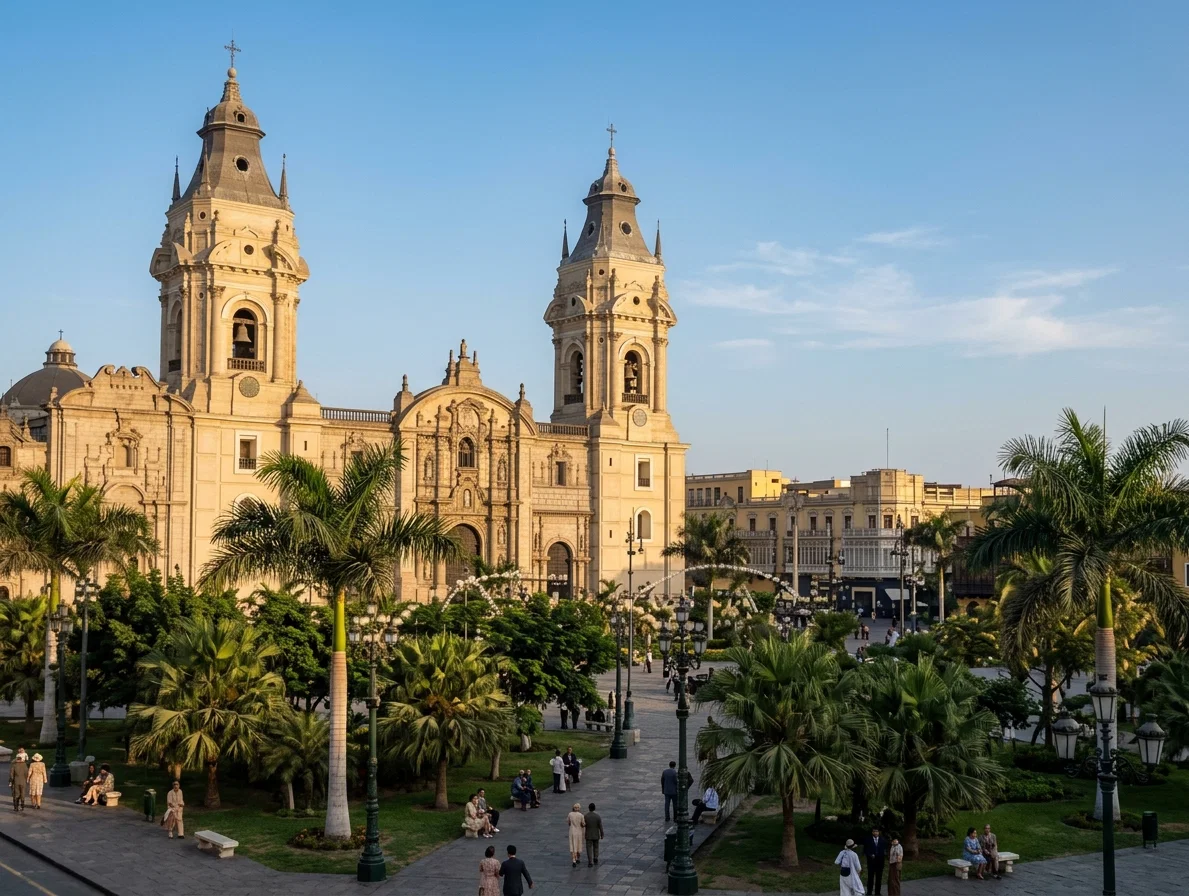
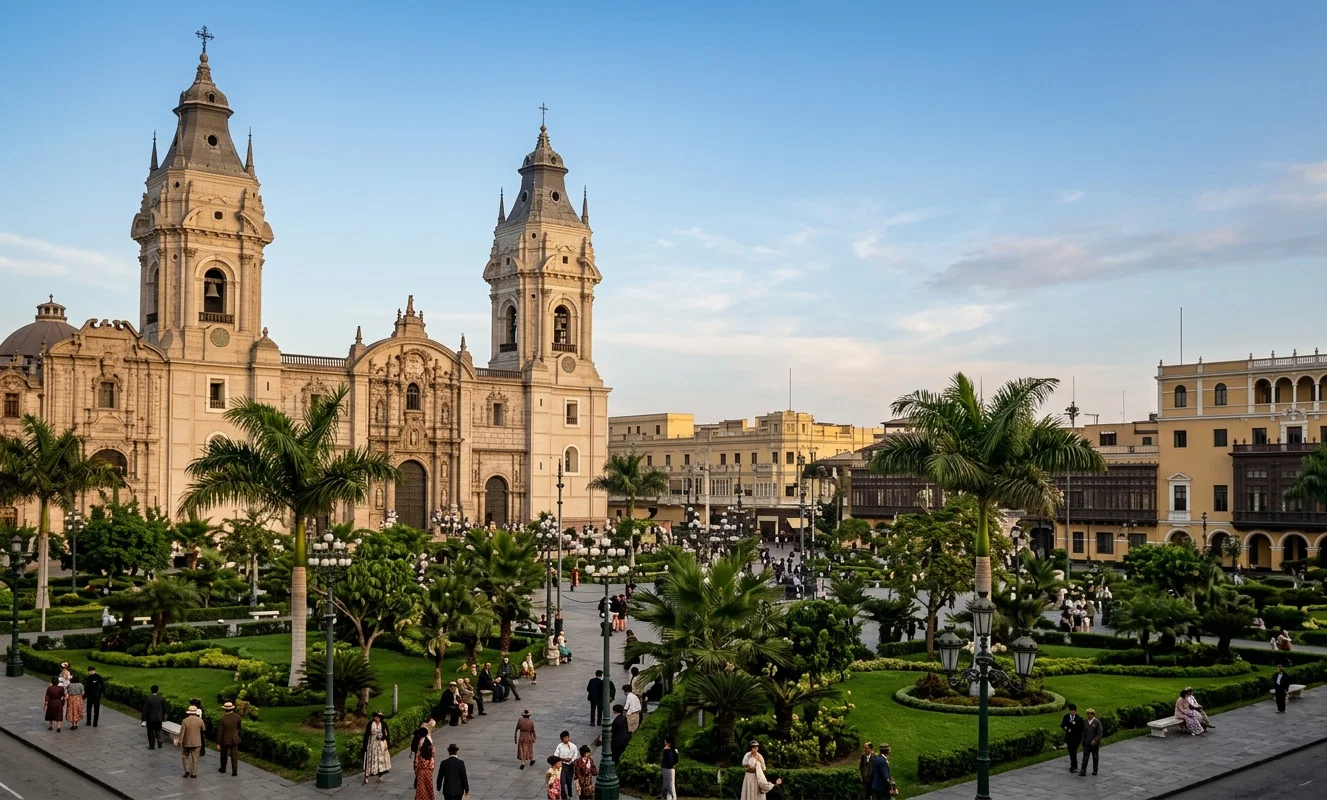
The famous cathedral
of Lima, Peru, facing
the Plaza de Armas,
the center of the city.
The old cathedral was
started in 1535, conse-
crated in 1625, practi-
cally razed by a great
earthquake in 1746. It
was rebuilt in 1758. It
has double aisles and
ten richly decorated
chapels, in one of
which rests the remains
of Francisco Pizarro,
conqueror of Peru.
The PERUVIAN Revolution
By James T. Thompson
By an eyewitness
JAMES T. THOMPSON, Lima, Peru
Latin America has had five major revolutions this year, wherein the presidents of the Dominican Republic, Haiti, Bolivia, Peru, and Argentina have been forced out of their chairs.
A most interesting commentary on the increased speed of communication in this world of ours is furnished by the fact that Mr. Thompson wrote this article in Lima on Thursday, August 28, and the next Wednesday, September 3, it arrived on the editor’s desk, thanks to the air mail.
“Down with Leguia! Death to the tyrant and tyranny!” Hoarse shouts from many overstrained throats rent the air that sunny morning of August 25 as a dense mass of people crowded the Plaza de Armas in front of the government house. What had brought about this apparently sudden reversal of feeling? Only yesterday, when the president appeared at the Sunday races, he was cheered and acclaimed by the multitude. To-day they clamor for his blood. What has happened to the hero of 1919? Legally elected at that time by an overwhelming majority, when the government in power attempted to prevent his assuming the presidency, the people rose in his defense and placed him there.
For eleven years he had occupied the throne of the Peruvian Republic, giving to it greater material progress than any other man in its history. Great improvements in the city of Lima had placed it in the front rank of the capitals of the South American countries; extensive irrigation projects were promoted in the coast country; a network of roads in the mountainous regions was begun; the construction of a port terminal in Callao, and many other projects for the improvement and betterment of the country might be mentioned.
What means it, then, that this man whom they had fêted and applauded, banqueted, and be-medaled until it would seem that the weight of gold medals would have crushed him had he been compelled to wear them all at one time, has fallen from public favor?
As much as might be said in favor of Leguia’s government and the progress the country has made during this time, in order to maintain his position and carry out his plans, certain2policies were thought necessary that produced many enemies who only awaited the time to wreak revenge.
From the first he would brook no opposition; a word of dissent sufficed to send one to prison or exile. Many of Peru’s brightest intellects and most able men have spent years in foreign countries. The press has been muzzled; not a word of criticism has been permitted. Elections were a farce, with only one candidate for each office. Votes could be cast only for the man he had designated, and a rival was not permitted to appear on the ballots.
The national debt increased from eighty million to six hundred million sols. Strikes by the laborers were suppressed with a strong hand; ultraliberal ideas of the university students were sternly repressed and the university put under government control. That which especially aroused the hatred of these two classes was his almost complete surrender to the clergy. Reputed to be a high degree Mason, his permitting the educational system to be controlled to a large extent by clericals caused great indignation, and his frequent participation in religious ceremonies was considered by many as highly hypocritical.
All this and more that might be mentioned had been accumulating during the years, causing a pent-up feeling that some day had to burst forth. Undoubtedly the evil day might have been postponed had it not been that the universal financial depression struck Peru as well. The sol began to toboggan, business to slacken, unemployment to increase, and then naturally the whole country began to blame the president. He who had been instrumental in bringing prosperity was now the victim for its reverses. However, right-thinking men do not blame him so much for mistakes and policies as they do those that surrounded him. He was ambitious, but patriotic. There is no doubt that he had the welfare of Peru at heart, but it was a task that one man cannot carry through alone; and he was surrounded by men that sought only their own selfish interests and dragged him to his ruin.
On Friday, the twenty-second of August, the army garrisoned at Arequipa revolted and ousted the civil government in that region. The central government issued a manifest, denouncing it as unjustifiable treachery, and decreed the blockade of the port of Mollendo and the city of Arequipa. At first the uprising was not taken seriously, but by Sunday the reports evidently spread alarm through government circles. In an interview with an army officer that was present when the president signed his abdication, the statement was made that the president had decided at noon Sunday to resign, but to do it in such a way that he still would retain his power, namely, by appointing a military committee, or cabinet, to take charge of affairs. These men, naturally, were but to carry out his bidding.
DEMAND PRESIDENT TO RESIGN
While the naming of this cabinet was being discussed, military officers in another part of the city were at work and, when they heard of what was to be done, hurriedly appointed a revolutionary committee and presented themselves before the president, demanding him to sign his abdication. He at first protested, but was soon convinced of the futility of further opposition, and yielded at three o’clock in the morning. Soon afterwards he was hurried by automobile to the port, and placed aboard the cruiser “Almirante Grau,” where he is still supposed to be held at the time of this writing.
So quickly and quietly was this done that the public was wholly unaware of the change effected during the night. Not until the morning papers appeared on the streets did it become generally known. Then excitement spread, and men began to rush wildly throughPage Threethe streets.
(Continued on page 5)
The Peruvian Revolution
(Continued from page 2)
Business houses that had opened hurriedly shut their doors and drew down the iron shutters over the windows. A crowd gathered before the government palace, clamoring for information. Soon members of the junta, or revolutionary committee, composed of army officers, appeared on a balcony. The leader attempted to address the multitude, but could not make himself heard for the tumult. For more than an hour he strove in vain until university students and labor leaders in the crowd had unburdened themselves. He gave the usual assurances that their requests would be considered, political prisoners freed, and, to please his hearers, added a few denunciations of the former régime.
MOB WREAK VENGEANCE
Then the crowd with one accord took up the cry, “Down with Leguia,” and like baying wolves rushed to the work of destruction. The first house to be sacked was that of a former cabinet minister that had made himself especially obnoxious to the public. Furniture was smashed, piled in the street, and set on fire. Barely had the work of destruction begun before others rushed to Leguia’s house, battered down the door and began their vandalistic work. Costly furniture, valuable paintings, and works of art were reduced to bits and carried away as relics. Fire was started in one of the rooms, and only the timely arrival of the fire department saved the whole house from flames. The police were powerless before the mob, and so quickly was it done that the army arrived too late to do more than to stop the looting and sacking from becoming general. The houses of several other prominent government officials suffered a like fate before the army gained control.
At the present moment all is quiet, but an unsettled feeling still prevails. The future is fraught with possibilities. The suppressed labor element has to be considered; dissensions among the army officers would produce a counter-revolution; political aspirants can cause untold trouble if led by selfish motives; insubordination in the army would turn it into a dangerous mob; and an innumerable number of things might furnish food for a pessimist. Our highest hopes are that true patriotism may inspire the hearts of those upon whom the responsibilities of government shall fall, and that a liberal, democratic rule may be granted us in the future.