Further evidence is here presented corroborating belief in the Mosaic authorship of the first five books of the Bible. The first part of this article appeared last week.
R. G. ENGSTROM
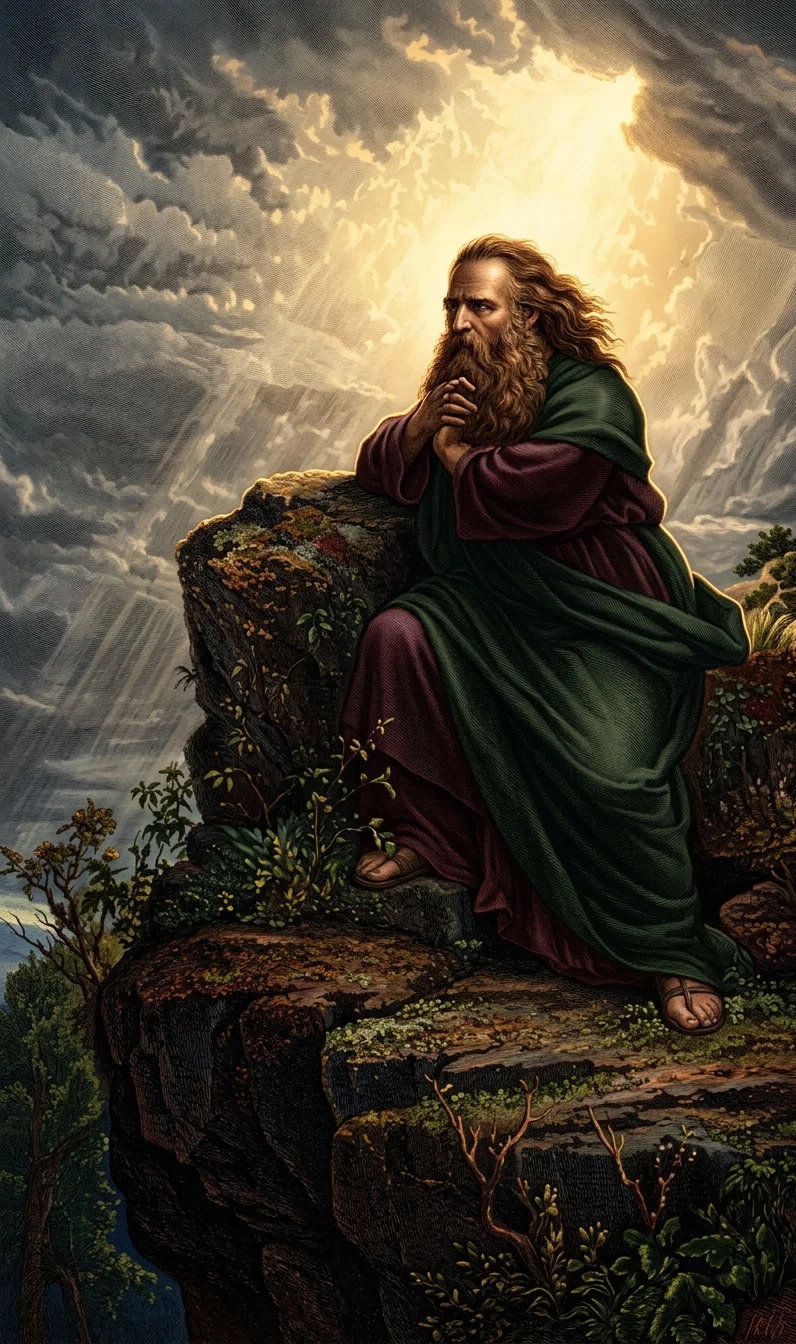
Moses, the great leader of the children of Israel, whose authorship of the Pentateuch has been contested by the modernists.
Last week the author introduced his discussion with the assertion that the Bible must be either accepted in its entirety or rejected altogether. As it would be quite needless to exhaust all the questions subject to controversy, he picked out a few of the outstanding ones. Last week plausible arguments were presented against the theory of the dual authorship of the Pentateuch; scientific discoveries and observations substantiating the Bible story of the Flood were also presented.
The destruction of the cities of the plain is one of the Old Testament’s most spectacular word pictures, showing God’s judgment as it was meted out to unrepentant men in the form of fire and brimstone. What conditions may we find pointing to the trustworthiness of this account?
The whole region of the great plain around the Dead Sea is found to be a burnt-out region of oil and asphalt. A thorough investigation by the Xenia Theological Seminary under the direction of Dr. Melvin Grove Kyle, made recently on the southwest shore of the Dead Sea, yielded some compelling discoveries. To quote Dr. Kyle:
DISCOVERIES POINT TO ACCURACY
“There is along the lower part of this plain a great stratum of rock salt, which on the western side of the plain shows itself in that great salt mountain known as Jebel Usdum. At its base is a stratum of rock salt 150 feet thick. . . . Mixed with the layers of salt and falling down over them also is a marl in which is much free sulphur, lumps of which we picked up along the sea. When the explosion of the gases took place, this stratum of salt mixed with sulphur was ruptured with the other strata, and the salt and sulphur carried up into the heavens red-hot, and also rained down upon Sodom and over the whole region, precisely as the Scriptures describe the rain of fire and brimstone from heaven. Mixed with the salt and sulphur was also the asphalt. These ruins witness to the great catastrophe that scattered the salt and sulphur far and wide, incrusted the mountain peaks, and so blasted the earth that it took 2,500 years of climatic influences to wash out the soil and make the plain again fruitful.” Thus are found to-day all the elements of the great tragedy that Genesis 19 records.
Of unusual significance also is the discovery of numerous pottery remains of the early bronze age, about 1800 B. C., known also as Abraham’s time. These have been dug up in the lower end of the valley at Mt. Jebel Usdum. But the astounding fact is that, while the relics belonging to this age are numerous, there occurs a break at this point, showing not a vestige of any further civilization for the next 2,500 years! An all-consuming catastrophe plainly must have destroyed all life and society itself in this section, just at the time when the last pottery was made. So the spade continues to confirm the Book.
DID WRITTEN LANGUAGES EXIST?
The argument that Moses could not have written the books accredited to him because a written language had not yet come into use in his age has been conclusively answered by the findings of recent archæology. It has been shown that the Mosaic era was a literary age, when written records were common, when it would have been strange for a leader not to put his deeds into written form.
The discovery of the famous code of Hammurabi, inscribed on a block of diorite nearly eight feet in height, and originally erected in the Babylonian temple of Marduk, shows a high state of literary and legal advancement. Hammurabi was the famous king who unified the Babylonian states and formulated the 282 sections of the legal code bearing his name.
At the ruins of the ancient Ur of the Chaldees, tablets have been found in which a man named Abraham bought an ox, another tablet shows a man named Abraham leasing land, and a third tablet gives Abraham’s receipt for land paid. This shows that Abraham was a common name at this time.
The Tel el Amarna letters, discovered in Egypt in 1887, yield overwhelming evidence to the existence of a high state of culture and communication. These three hundred or more epistles written some years before Moses, tell of great flourishing cities, of religious practices, of Egypt’s difficulties in extending her western territory, of numerous other subjects. The Mosaic era, instead of being an ignorant age, was a flourishing literary period.
OPPRESSION A HISTORICAL FACT?
Here again the findings of archæology come with a startling confirmation of the Mosaic record.
The recent expedition of the University of Pennsylvania to the Holy Land found an engraved stone monument of Rameses II on which he had noted the fact that he had collected certain Semites and made them build in his honor the city of Raamses-Mera-Amen, on the eastern delta of the Nile. This exactly fits the story in the first chapter of Exodus, which tells how the Israelites built the city of Raamses.
In ancient Pithom, the name of “Raamses” may be found stamped on the bricks used in some of the ancient houses. In palaces have been found pictures of slaves mixing straw and mud, just as the inspired story tells. And, stranger still, even as the Bible records how Pharaoh, in his attempt to make their oppression still more rigorous, compelled Israel to make bricks without straw, even so, some of the houses in Pithom have actually been found made with strawless bricks!
NEW TESTAMENT WRITERS TESTIFY
Finally we present the testimony of the Master Himself and of His colaborers in the beginning of the Christian era. Christ and His church on earth have been so immeasurably the most moving power in this world that His testimony and that of the inspired writers of the New Testament must carry a most convincing appeal.
Jesus believed implicitly in the writings of Moses, and taught them as the basis for a belief in Him, going even so far as to say that they could not believe Him unless they believed Moses.
“Do not think that I will accuse you to the Father: there is one that accuseth you, even Moses, in whom ye trust. For had ye believed Moses, ye would have believed Me: for he wrote of Me. But if ye believe not his writings, how shall ye believe My words?” John 5:45-47.
“Abraham saith unto him, They have Moses and the prophets; let them hear them. And he said, Nay, Father Abraham: but if one went unto them from the dead, they will repent. And he said unto him, If they hear not Moses and the prophets, neither will they be persuaded, though one rose from the dead.” Luke 16:29-31.
Jesus believed the creation record of Genesis: “The Pharisees also came unto Him, tempting Him, and saying unto Him, Is it lawful for a man to put away his wife (Continued on page 9)4for every cause? And He answered and said unto them, Have ye not read, that he which made them at the beginning made them male and female?” Matthew 19:3, 4.
Proofs of the Pentateuch(Continued from page 3)
JESUS TAUGHT VALIDITY OF DELUGE
In one of His most stirring appeals He taught the validity of the Deluge. “As it was in the days of Noe, so shall it be also in the days of the Son of man. They did eat, they drank, they married wives, they were given in marriage, until the day that Noe entered into the ark, and the Flood came, and destroyed them all.” Luke 17:26, 27.
He showed His faith in the trustworthiness of the account regarding Sodom’s doom: “Likewise also as it was in the days of Lot; they did eat, they drank, they bought, they sold, they planted, they builded; but the same day that Lot went out of Sodom it rained fire and brimstone from heaven, and destroyed them all.” Luke 17:28, 29.
Paul believed the worth of Genesis, and used it as the basis of many sermons: “The God of this people of Israel chose our fathers, and exalted the people when they dwelt as strangers in the land of Egypt, and with an high arm brought He them out of it. And about the time of forty years suffered He their manners in the wilderness.” Acts 13:17, 18.
OLD TESTAMENT WRITERS QUOTED
As we look into the epistles, we find that many chapters in Genesis are quoted by the New Testament writers, and used by them as their most convincing arguments for the veracity of the gospel.
Exodus is likewise indorsed by the same witnesses. Jesus said plainly that Moses was its author. (Mark 12:26.) Paul testifies in like manner. (2 Corinthians 3:13.) We come to Leviticus, and find the same certain authority there. The Master shows His implicit confidence in the fact that MosesPage Fivewrote the laws recorded there. (Matthew 8:1-4.) Paul again adds his evidence. (Hebrews 7-9.)
Numbers and Deuteronomy are attested to in identical manner. Jesus believed that Moses wrote them. Paul, Peter, James, and John all show their utmost confidence in the books of the Pentateuch. Their most powerful arguments stand with granite fastness on a foundation of Mosaic references. And in the closing chapters of the Bible itself, the promise of the new earth with its Edenic beauty is accepted with confidence because it sets forth a new creation like unto the first creation of Genesis, only now to remain forever, never to be marred by sin. So we see that the New Testament is built entirely on the foundations of the Old.
We have reviewed a few of the facts that attest to every candid mind the trustworthiness of the five books of Moses. We have had opportunity of making only a few “soundings,” but in every instance the inspired record comes off more than conqueror. While it is true that not everything recorded has been verified, yet whenever the findings of science and archæology have unearthed any remains or historical record bearing on the point in question, the Book stands vindicated. The records of ancient days were “written for our admonition, upon whom the ends of the world are come.”