Did you ever stop to think how many things insurance fails to insure, such as health for the unhealthy, a home for the homeless, rest for the tired, hope for the hopeless, success, good character, and reputation, wisdom, or a place of safety in time of trouble?
NEIL WAYNE NORTHEY
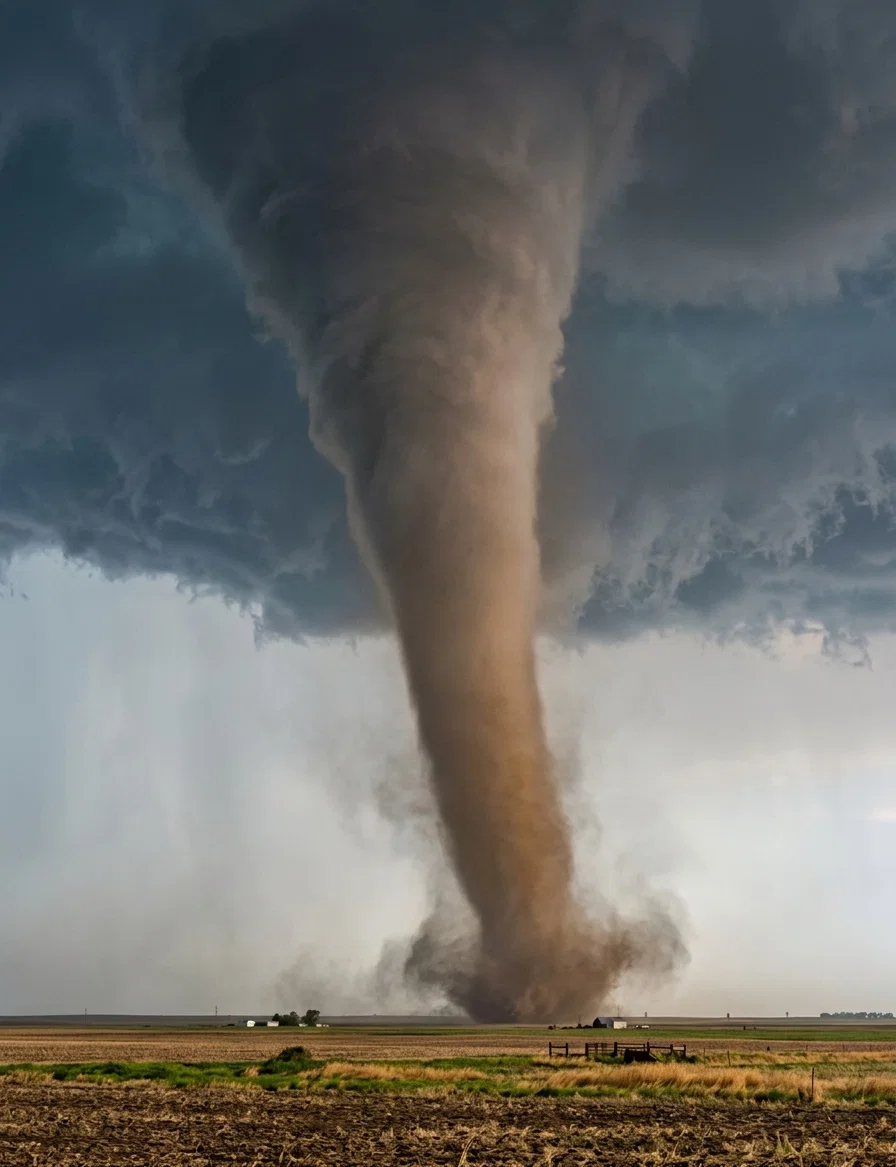
A tornado that touched the earth in a huge funnel-shaped cloud passing over the flat country near Hardtner, Kansas. Insurance may cover a financial loss but cannot restore a clean conscience or a good character and reputation once they are lost.
AMONG many other things that are to-day indicative of the time in which we live is the growing craze for insurance. Men have lost confidence in one another, in themselves, and in God. And while attempting to quiet their doubting souls, they put their trust in insurance. But while man may insure, only God can assure.
One needs but to consider the many forms of insurance in vogue to-day to know the true condition of men's minds, for it reveals, in spite of them, their feeling of distrust and doubt and fear, and the other characteristics of the ungodly. In every case, the best that insurance has to offer as a substitute for the loss of something is money. But money certainly is a long way from assurance. It has been estimated that at least sixty million Americans hold some form of life insurance; but that does not assure them life, either here or hereafter.
A FEW FORMS OF INSURANCE
According to the world's idea, there is scarcely an end to the different forms of insurance that the average man should hold in order to be fully “protected.” Some of the more important are: title insurance on his home; life insurance in favor of his wife; a clean-up policy to provide for his burial and the payment of his debts at his death; policies for each of his children; an endowment policy for himself; health and accident insurance for himself; fire insurance for his house and contents; burglary insurance; cyclone, earthquake, and hail insurance; fire and theft insurance for his automobile, as well as an accident policy to protect him against loss that might result from collisions; insurance against holdups; compensation insurance for employees; storm, fire, and burglary insurance on his business property, trucks, etc.; credit insurance; and even reinsurance to make sure the insurance companies will pay.
From a strictly business viewpoint, some of these forms of insurance are logical. If a man insures his home against fire and the home is burned and if he is able to rebuild it from his insurance, no substitution has been made. It is when the insurance of man tries to substitute a false feeling of security for the assurance that only God can give that it goes outside its bounds.
NO FEELING OF ABSOLUTE ASSURANCE
Even though some forms of insurance may be warranted and are apparently sound from a monetary point of view, they never carry with them a feeling of absolute assurance. One man has asked in the query column of a magazine: “Will you kindly explain what the true meaning is of the clause in a fire insurance policy that is known as the 80-per-cent clause?” The answer given was: “We are now arguing with our insurance company over it, without result as yet. I understand all fire insurance policies contain this clause, but it seems that few know it, as several men who carry insurance on their own stock and buildings, and whom I have asked to explain it to me, say they never heard of it. The local agent did not seem to understand what it meant until he had written on to the company.”
“The Lord hath His way in the whirlwind and in the storm, and the clouds are the dust of His feet.”
Nahum 1:3.
Another correspondent asks: “Is there any book published that will explain all the involved and mystifying clauses in my fire insurance policies?” And that just about expresses the absence of assurance that every man feels even though he is insured.
Now along with those forms of insurance that some might think are basically sound and justifiable, we also find other kinds that show the present-day search for peace of mind through money insurance instead of God assurance. There is scarcely any circumstance or condition or liability that men do not insure against in an attempt to obtain security.
UNUSUAL “RISKS” INSURED
At the present time if an unusual circumstance or “risk” arises, man's first thought is to take out an insurance policy to protect him against it. Anything and everything is insured. An undertaker in London was insured to cover the risk of shock to people at whose homes his careless employees might deliver coffins at night by mistake. A man applied for a policy to protect him in case he should lay violent hands on his mother-in-law. Another was insured against his wife's giving birth to twins. One man insured the life of a trick baboon for $25,000. At least one insurance company specializes in policies against divorce. A state insurance commission reports that for ten dollars a week aPage Fourcompany in that state insures bootleggers for ten thousand dollars against death “in line of duty,” and for two dollars a week pays five dollars for every day spent in jail. The hands of artists and musicians have been insured for thousands of dollars; but there is no record that the Son of God insured His hands—those hands of service that were nailed to the cross—when He was on earth.
Insurance may be satisfying to some who are contented to be reimbursed with money for a loss. But there are many things that insurance cannot assure.
Insurance cannot assure health to the policyholder (and after all it is health we want), for who can measure it in money?
It cannot assure rest for the tired, a home for the homeless, peace for the troubled, hope for the hopeless, courage for the discouraged, mirth for the downhearted, or comfort for the sorrowing.
It cannot assure us of success, a good character and reputation, wisdom, or a place of safety in time of trouble.
It cannot assure us that we will get mercy before any earthly judge, but the mercy of the Lord is promised “to those that remember His commandments to do them.”
Insurance cannot assure us of forgiveness; neither does any policy guarantee resurrection.
It cannot assure us of a faultless title to a home in heaven. In fact, there is nothing that is really worth while that insurance can assure. “Destruction cometh; and they shall seek peace, and there shall be none.” Ezekiel 7:25. That is exactly the condition in which the man will find himself who seeks peace through insurance.
If we will read the word of God, we shall find assurance for everything that insurance lacks. “The work of righteousness shall be peace; and the effect of righteousness quietness and assurance forever.” Isaiah 32:17. And then follows in the next verse one of the best property title insurance policies that were ever written: “My people shall dwell in a peaceable habitation, and in sure dwellings, and in quiet resting places.”
If you are looking for a good assurance policy,—a policy that covers every need in one paper and in which there is not a single “joker” clause,—read the thirty-fifth chapter of Isaiah. In it you will find property title, health, crop, travel, recompense, and happiness assured. And those who accept this policy will be assured against the only fire that really counts.