R. A. CALDWELL

5%

Review and Herald Publishing Association · Takoma Park Station, Washington, D. C. · Jan 9, 1908

FromReview and Herald, Vol. 85, No. 2.

Read the full edition

R. A. CALDWELL

Japan

R. A. CALDWELL

The great country of Nippon has many interesting features. Its inhabitants number more than forty-five million. On the whole, the people are very industrious and provident. In whatever phase of life you meet the Japanese, they are always courteous and agreeable. Their politeness, in fact, is too profuse. Upon first impression it seems laughable. At a railway station, when a train departs, almost all the people spend the last few minutes in bowing to their departing friends. When a servant answers your call, he—more usually she—humbly bows, and even touches the floor with the forehead. People have told me that it is all superficial. Perhaps that is so, but the probability is there are exceptions. In any case, it is not at all an unpleasant experience. It is much better than the stoicism that prevails in some Western countries. In this respect Japan is somewhat similar to her neighboring empire of Celestials; in fact, possibly, the high-class Chinese are more deliberate in saluting and farewelling their friends. The agreeableness, and the apparent patience of the Japanese on the whole, are very striking. Slowness to take offense, or to express themselves as offended, isvery strongly developed.
Quarrels are almost unknown, or at least are seldom encountered. Of course they have trouble and domestic unhappiness, which at times terminate fatally.
The marriage ceremony is cold and soulless. The affair is arranged by a go-between, when the parties concerned are deemed of age. This friend is one who inquires into the social standing and monetary position of the families on both sides, and when the match is completed, naturally is remunerated. The friends gather together on this event, and perhaps for the first time the couple meet, at least for conversation and acquaintance. A number of rounds of the favorite and inebriating saki, or rice wine, and the ceremony is over. It is finally reported to the local authorities, and is then binding—till the head of the house decrees otherwise, when his wishes are carried out.
The people are not very religiously inclined. Many of them have the forms of some of the different sects of Buddhism, but it is in many cases because of custom. Of late years the idea of Christianity has been, taking hold of them to a great extent. Whether they realize what it really means to them, only time will determine. It has been stated that one reason for their acceptance of Christianity is commercial advantages. Undoubtedly this is true in many cases; but is this unlike many people of your acquaintance in more favored Christian lands? That is something to be encountered the world over.
Numerically the Protestant societies have something to show for their efforts. The Salvation Army has been at work a little over a decade, and thus far has a corps of about two thousand. The martial arrangements of their followers are very attractive to the patriotic, aggressive Japanese.
Along the lines of industry the Japanese rank very high. It is impressive to note that their large towns are given over to factories. This indicates that commercially this country will in the near future be a strong competitor for trade in this far Eastern world. But for some time to come, strenuous efforts will be required to develop and build up its recent possessions. One of the methods used to provide revenue for the island of Formosa is a monthly lottery, the first prize of which represents twenty-five thousand dollars.
One of the largest enterprises is the handling of ships in the Kobe dockyards, which provides employment for more than six thousand men. In the vicinity of this town is a large manufacturing city of upward of a million inhabitants. Situated on a river, hundreds of bridges are required for the passing traffic. These are all fairly substantially built. In the town there are a museum and library, the latter containing many books in the English language. The electric street-cars and the steam railway are not feeble by any means. A fast service, at frequent intervals, is well patronized; for the Japanese are very fond of traveling and sightseeing. The railways are numerous, and have a total mileage of almost five thousand miles. They have all been controlled and operated by natives, but are gradually coming under government control. It is well known that the government manifests a fatherly interest in the welfare of all industries, especially when the financial returns are satisfactory. Many of the trades are exclusively in its hands, and entirely monopolized. The rate of duty on practically all goods is enormous, and is almost prohibitive to foreign merchants.
As regards cheap labor, this country can take the lead. The highest rate for skilled labor is one shilling and twopence—about thirty cents gold—a day; while ordinary laborers receive as little as sixpence—twelve cents—a day.
Very few of the women have adopted Western customs, but among the men it is becoming very common. Many can be seen who have adopted some foreign item of clothing, the more common being footwear and hats.
The people are by no means good musicians, though under good training they can do creditably. Only a few evenings ago it was my privilege to hear the naval band discourse some excellent pieces, which were well rendered. On Sabbath the members of our little church make a noble effort to carry the singing, believing in that scripture which says “singing and making melody in your heart to the Lord.”
The capital of Japan is an excellent place for mission work. Among the eighty thousand students are about ten thousand from China, many from the higher class. A few well-behaved and attractive boys attend the English Bible class every evening. And it is good to hear, as I did on more than one occasion, the voice of prayer ascending to the true God in several different languages. The missionary meetings are much the same as in the home land. Papers are wrapped and sent out, prayer is offered on behalf of these silent messengers, and experiences are related, and donations received for aggressive work.
The Japanese are all anxious to learn English; and while waiting at the depot, or traveling in the train, one will approach you, and expect you to correct his composition or help him with his reading lesson. Even one of the servant class, while waiting on you, will inquire the name of articles, and make reference to a note-book, which is his constant companion.
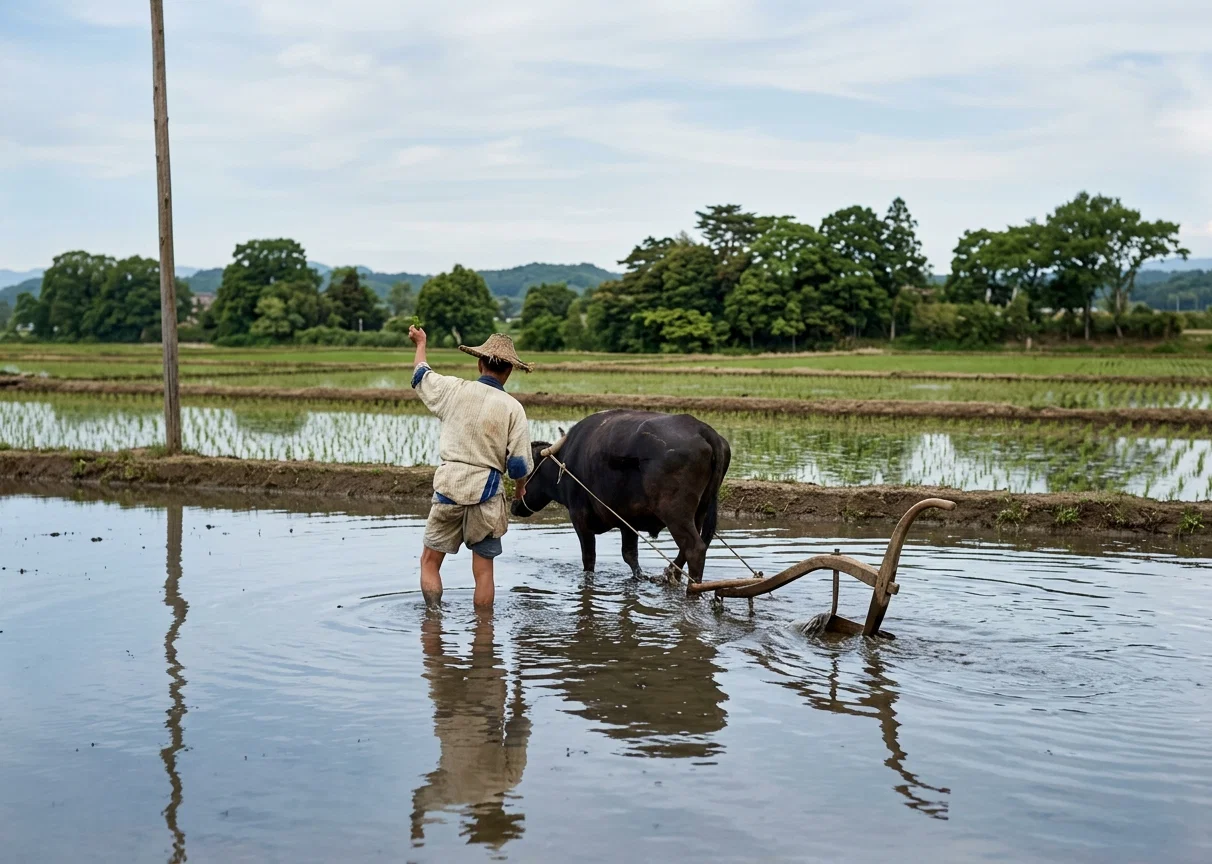
The country has many attractions. It is very mountainous, and the surrounding plains are well populated with agriculturists, or, rather, gardeners. It somewhat resembles a great patchwork quilt. The shapes and designs of the various plots of the different products under cultivation form a pleasing scene. Plots of the tobacco plant and peanuts, and here and there a patch of tea plants, as well as many different vegetables, not, of course, excluding the inevitable rice (the accompanying cut shows how the rice-field is prepared for sowing), with larger fields of the mulberry shrubs for the benefit of the silkworm, form an interesting sight. The world-famed lotus plant, found in every pond, with its beautiful and exquisite blossom, is indeed pleasing to the eye.
One attraction is mountain climbing. This was enjoyed by the writer, with a party of three, during the past summer. Securing two coolies to carry our blankets and provisions, and a pair of ponies to carry us over a portion of the journey, we set off in the rain. By nightfall we were at a high elevation, and had just passed a few patches of snow in some of the valleys. The surface of the mountain was strictly volcanic. As we ascended, the vegetation decreased, until it was entirely absent. A few hundred people were on the path, most of them on the return trip. This is to many a sacred mount, and as many as ten thousand had already made the ascent during the summer.
The accommodation house, or shed, consists of one room. There we were packed like sardines—forty of us—only one other foreigner being among the number. In the morning another two miles remained before reaching the summit. A dense fog obscured everything, and rendered the atmosphere damp. As we neared the top, a little snow was under foot, and by the time we shouted “Banzai,” it was about two inches deep. There we were, twelve thousand feet above sea-level, in the stillness of the early morning, with the throat of the yawning giant at our feet. We could indeed feel our nothingness. It was an experience long to be remembered. The descent was made in a driving rain-storm.
Earthquakes are of very common occurrence. Almost every week one is felt. A few weeks ago we had a tremor that lasted four minutes. These tremors have been going on for years, and rarely anything approaching seriousness has occurred. It all reminds one of the uncertainty of things earthly, and calls us to build on the sure foundation, so that when the mountains shall “be carried into the midst of the sea,” we shall not fear, nor be ashamed.
Tokyo.
PREPARING RICE-FIELD FOR PLANTING