A New and Needy Field

7%

Review and Herald Publishing Association · Washington, D.C. · Jan 14, 1904

FromReview and Herald, Vol. 81, No. 2.

Read the full edition

A New and Needy Field

L. R. CONRADI
Africa has not been styled the “Dark Continent” without good reason. Millions upon millions are there waiting for the light of the gospel. While something has been done, yet it is very little in comparison to the awful needs of the masses who have yet never heard the “glad tidings. But when it comes to the presentation of present truth, we have scarcely touched this mighty continent with our finger-tips; and yet we owe to these millions of human beings the same duties that we owe to their brethren in the South, or to the natives of any other country. Indeed, the African in his native environment has less opportunity and fewer privileges than do peoples living in more favored lands.
The Dark Continent has wonderfully developed in the last few decades. A short time ago the interior was but a blank upon the maps. It was unexplored and unknown save to a few daring adventurers, who had crossed the land. Cruel rulers oppressed the people, and the European traveler was constantly in danger of losing his life. The terrible slave trade decimated the population.
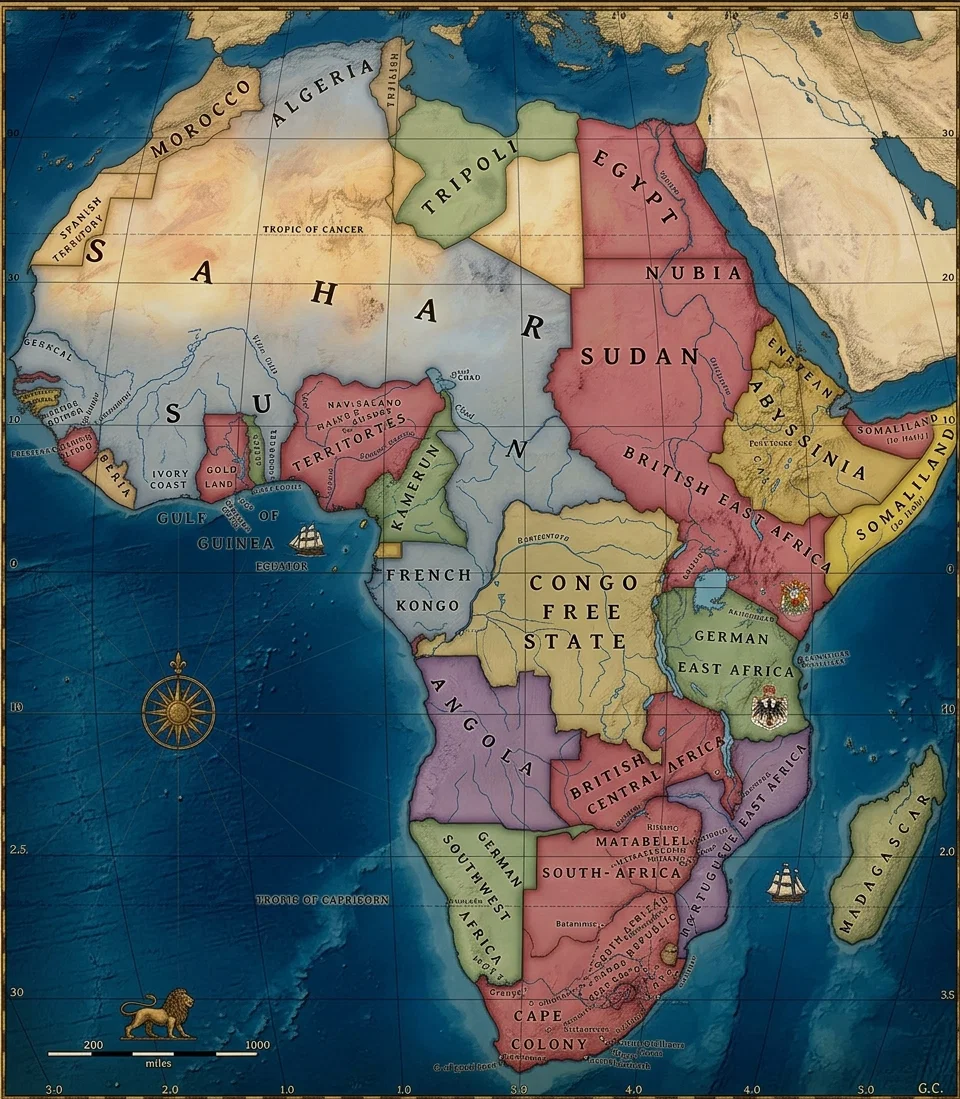
All this has changed. Africa to-day is fast becoming a large European colony, owned by Great Britain, Germany, France, Belgium, Italy, Spain, and Portugal.
The German possessions are the more recently acquired. On the west coast, Germany has Togo, Kamerun, and Southwest Africa; on the eastern coast is German East Africa, the most important of the German colonial possessions, with the largest population (about 6,000,000). While thus far only about fifty miles of railroad has been laid, still the German government has built a number of well-constructed roads, and planted military stations all over the land, so that order and peace are established among the natives, and the slave trade is nearly extinct. The land in general is fertile, and there are a number of mountainous districts quite salubrious for Europeans.
As the work in Germany has steadily advanced until our membership is now about three thousand, our eyes naturally turn to the German colonies. Wherever the subject has been presented to our people, they have felt a desire to help in the great work of enlightening the people who live in heathen Africa. Two thousand dollars has been raised toward meeting the initial expenses in opening up the mission, and the German Union First-day offerings are to be devoted to this field.
We have spent considerable time in investigating the country, and the Hamburg Seventh-day Adventist Association has received the governmental right to acquire and hold mission property in German East Africa,—indeed, the Colonial Department accords to us the same privileges that it grants to other missionary societies,—and we have the colonial governor’s hearty personal invitation to come.
Brother J. Ehlers, a practical gardener of many years’ experience, will be in charge of the mission. He is a man about thirty years of age, and has been a faithful believer in the message for a long time. His previous experiences have been such as to well fit him to undertake the establishment and direction of the mission. He has spent about one year in our Friedensau school. He is accompanied by Brother Enns, a trained nurse from America—a man who, for a number of years, has felt himself called to the work of a medical missionary in Africa. They sailed from Naples, October 23, on the steamer “General,” German East African Line, reaching Dar-es-Salaam, November 12. This port is about twenty-five miles south of the island of Zanzibar.
At this time we can not definitely state just where they will settle, but we expect that they will report soon. They planned to confer first with the colonial governor. We have rather hoped to establish ourselves northwest of Victoria Nyanza, not far from British Uganda. The place could be easily reached by the Uganda road, which crosses from Mombasa to Lake Victoria. Freight can be transported across the lake. As soon as a location has been decided upon, theywill undoubtedly call for means to assist in establishing the mission, and for more workers.
While the German Union has provided so liberally to open up the station, it would seem that our brethren across the waters should be asked to lend us a helping hand. The General Conference voted five thousand dollars toward this enterprise, but as yet this money has not been raised. Of course the Mission Board can not create the funds—it can only receive them. Among the friends of the cause and of missions are there not a number in America who will donate from one dollar to one hundred or more dollars toward the German East African Mission? As we in Germany, with only three thousand members, have already raised three thousand dollars, it seems to me that in a short time the five thousand dollars might be sent to the headquarters of the General Conference in Washington, if those whom God’s Spirit touches will only respond. Brethren, the German Union has two hundred and sixty-five millions of souls to warn of the soon-coming judgment.
Can you not assist us by raising two dollars in the States to our one? We need your co-operation and help, and perhaps the liberality of our American churches in this matter might bring rich showers of blessing to themselves. Would to God that such a wave of giving might visit you that a subscription list in the Review, headed “Five Thousand Dollars for German East Africa,” would quickly be opened, and the list rapidly completed and closed; and above all, brethren, remember in your daily prayers the workers so recently sent out to this new and untried field.
Address your offerings to the Treasurer of the General Conference, 222 North Capitol St., Washington, D. C.
Hamburg, Germany.