The German Union Field

6%

Review and Herald Publishing Association · Washington, D.C. · Nov 5, 1903

FromReview and Herald, Vol. 80, No. 44.

Read the full edition

The German Union Field

L. R. CONRADI
We are grateful to see continued prosperity in the German Union Conference. I think it would be interesting to the readers of the REVIEW to take another glance at this important part of the European continent, with its two hundred and sixty millions of human souls.
The main strength and financial backbone of the German Union Conference are in the German empire, with a population of nearly sixty millions. At present there are four organized conferences in Germany; and it has been voted to organize a fifth conference near the close of 1903. The membership of these conferences is 2,773, and as they showed an addition of two hundred and seventy-two last quarter, we have good reason to hope that this number may reach three thousand by the last of the coming December.
West German Conference.—In this field are the Prussian provinces of Westphalia, Hanover, Schleswig-Holstein, Hesse-Nassau, and Saxony; the three free cities, Hamburg, Bremen, Lubeck; the grand duchies of Mecklenburg-Schwerin, Strelitz, Oldenburg, and Saxe-Weimar, with eleven smaller principalities. In this field are located the union publishing house at Hamburg, and the industrial school and the sanitarium in Friedensau. The conference contains thirty-two churches and companies, with ten hundred and twelve members. Here, to a population of sixteen millions, we are receiving a tithe of nearly ten thousand dollars. The conference pays a second tithe to the German Union Conference, and supports the Bible teacher in the Friedensau school. At present there are three ordained ministers and seventeen licentiates and Bible workers in the field.
Rhenish Conference.—Last winter this conference was organized from the territory of the West German Conference. It is composed of Rhenish Prussia, and has about six million inhabitants. Although the province is but little larger than Massachusetts, yet it has twice as many inhabitants. Here are the large industrial cities, of which Cologne, called the German Rome, is chief. A church of fifty-five members has recently been organized here, and the field now has eight churches and two hundred and sixty-eight members. Last quarter's tithe was seven hundred dollars. Although this is a young conference, yet it has from the first paid a second tithe to the union, besides carrying on the work in its own territory. The only ordained minister is the conference president. He has five other workers associated with him.
East German Conference.—After the proposed division is made, this conference will be composed of the provinces of Brandenburg, Pomerania, Posen, and Silesia, and the kingdom of Saxony, with eighteen millions of people, and a membership of seven hundred. There are twenty-six churches and companies, five of which are in the city of Berlin. As large as this field is, it actually has but one ordained minister now that Brother Wagner has gone to America, and Brother Oblaender is to take the presidency of the new conference. However, it has been voted that Elder D. Voth—who has just been ordained at the German-Swiss meeting—shall labor in Silesia, and perhaps there may be another minister ordained in the field this winter. In all, there are about twenty workers here. The tithe for 1902 was $7,209. They regularly pay a second tithe to the German Union Conference.
Prussian Conference.—This new field will be composed of the two provinces known as East and West Prussia, in the extreme eastern portion of the German empire, and it will have a population of three and one-half millions. This is the poorest field in Germany. The principal industry of the people is farming. Only in this section do we find any considerable number of our rural churches. There are nineteen companies of believers here, with a membership of about four hundred and seventy. Their tithe averages about three hundred dollars a quarter, but this will undoubtedly increase if the field receives more careful attention. The only ordained minister will be the president, and there will be one licentiate and three Bible workers in the field. Part of the work here is in the Polish and Lithuanian languages.
South German Conference.—This conference includes the kingdoms of Bavaria and Wurtemberg, the grand duchy of Baden, and the two southern provinces of Hessen and Alsace-Lorraine, and Hohenzollern and Luxemburg, with a population of thirteen millions. The conference was organized last winter, and it now has eighteen churches and companies, with a membership of three hundred and eleven. Last year's increase was eighty-four; tithe, $3,252. They have three ordained ministers, and nine other workers. Recently they have been holding tent-meetings in this field. Speaking of Germany as a whole, this part of it has been least developed, but as they now have a better force of workers, their membership is increasing. Last quarter's record shows an addition of three forty. This is a considerable increase over last year's showing.
German-Swiss Conference.—This adjoins the South German field. It contains two hundred and seventy-eight members, who are scattered about among two million three hundred thousand people. Last year they had a growth of eighty-seven, and a tithe of $1,989. Brother Voth is to leave them, so they will have only two ordained ministers, and three other workers. They are running two tents this summer, and the Lord is blessing the efforts put forth. A strong German church is being developed in Basel.

The Russian Empire

Next to Germany in membership comes the Russian empire, with one hundred and thirty millions of people (there are almost one hundred nationalities represented here), who inhabit not only one half of Europe, but also the larger portion of the mighty continent of Asia. Our total membership in the three fields into which Russia has been divided is 1,389.
The South Russian Conference.—This includes the German colonies in the southern and eastern portion of Russia, making a conference with about one million inhabitants. Here we have thirty-two churches and companies, with seven hundred and eighty-eight members. Last year's growth was one hundred and thirteen. They have three ordained ministers and two Bible workers, but their tithe has thus far been inadequate to support these,—it amounted to only $1,752 last year,—so that the conference has to be helped by German Union funds. However, their income is increasing, and we hope that soon this, one of the oldest of our fields, will be fully self-supporting.
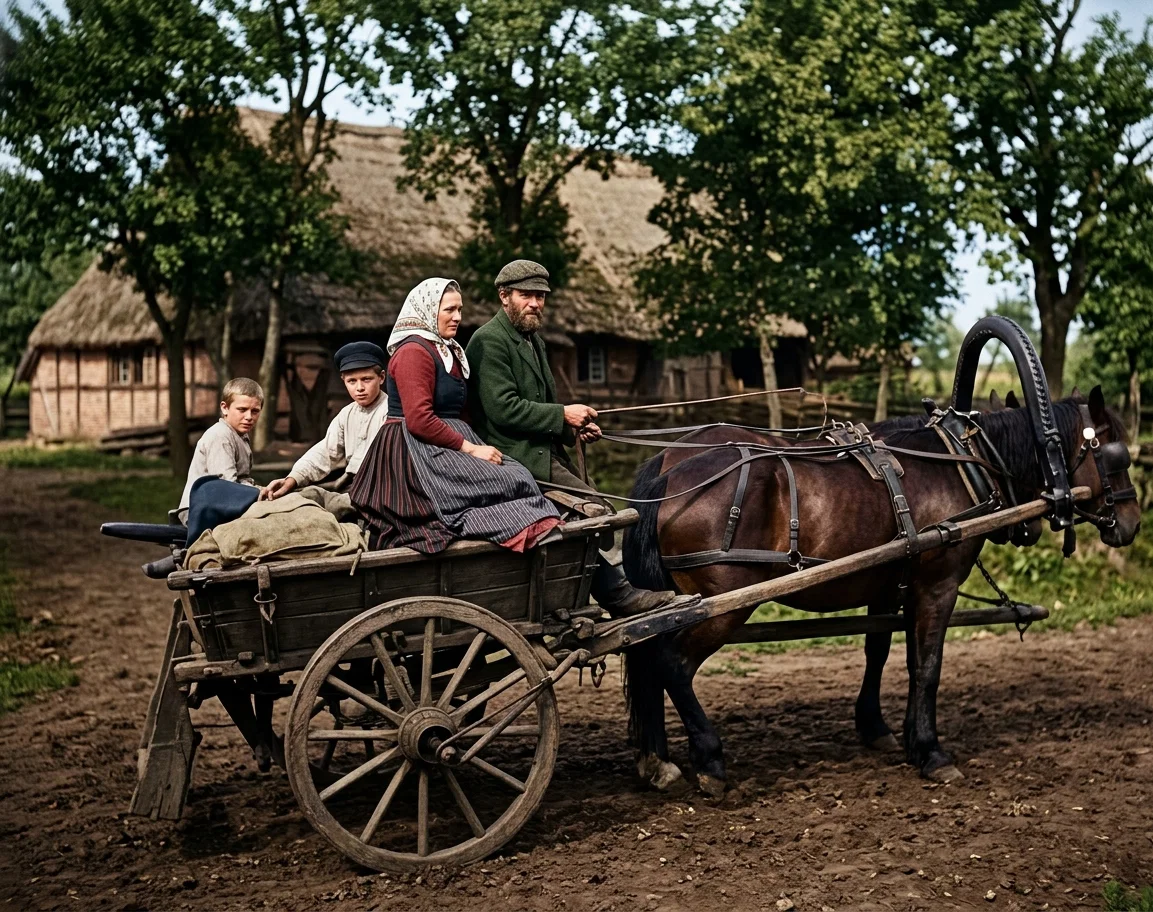
NORTH GERMAN PEASANTRY
North Russian Mission Field.—In this field are included the German colonies along the Baltic and in western Russia, and the Letts, Esthonians, and Poles of Russia—about fourteen millions in all. Since its organization, the field has shown a remarkable growth. There are now churches in St. Petersburg, Riga, Reval, but the largest increase has been in the province of Volhynia. The field has sixteen companies and churches, with a membership of three hundred and fifty-six. While thegrowth last year (1902) was fifty-five, last quarter, sixty-six were added. There now is but one ordained minister here, the director of the mission, but probably another will be ordained soon, and there are only five other workers.
Middle Russian Mission.—This really includes the ninety millions of Russians in the empire. There are at present two hundred and forty-five members, divided into eight churches and companies. There are more than as many again who are keeping the Sabbath, but these have not yet been fully organized and brought into harmony with us. In fact, it has been quite a task to take hold of this work, as we did not have the proper men to put in charge of it. Until recently we have had very little opportunity to instruct the natives, but we have brought several over to the Friedensau school at quite an expense, to do what we could for them: even then they felt such a burden to return to their field that the work has not been done as thoroughly as we would like to have seen it. With the proper men and organization, we surely shall see many souls added to the faith among this class. One great difficulty is with the payment of the tithe. This amounted to one hundred and forty-four dollars in 1902, so the union really has to sustain the three workers employed there. However, we believe there are better days in store for the field. We hope soon to enter the Transcaucasus. It has nearly seven millions of people; about one million of these are Armenians, among whom Dr. Pampaian is expected to labor. We believe that our brethren in America ought to come forward to help sustain this work with their contributions, for this Armenian field will prove to us an open door to Persia and Central Asia.
Hamburg, Germany.
(To be concluded)