The first annual meeting of the Natal-Transvaal Mission Society was held at Sweetwaters, Natal, Nov. 6–11, 1902. At the second meeting of the session it was decided to organize the Natal-Transvaal Mission Society into the Natal-Transvaal Conference. The reasons for this change were that the constituency of the field has nearly doubled during the past year, and the increase of our funds will enable us to carry on the advance work in the field, for the evangelization of the European population within our borders, without calling upon our brethren in America for financial aid.
Our tithes and offerings for the period of thirteen months, since our society was organized, are considerably in excess of three thousand dollars. The present worth of the conference is nearly five thousand dollars, the major portion of this amount being cash; and in addition to this, we have every reason to expect a tithe of more than three thousand dollars for the year 1903. Thus we shall have available resources to the extent of approximately eight thousand dollars, for the support of the laborers for the coming year. The average amount of tithe paid by each member for the thirteen months, was nearly ninety dollars. Taking these things into careful consideration, it was thought that we should relieve the Mission Board, which has thus far carried the financial responsibility of the work in this field, so that it may give more attention and assistance to more needy fields. The new conference has but two organized churches, two companies as yet unorganized, and a few scattered members. Our entire constituency will scarcely number as many as the family of Jacob when they went to sojourn in the northern part of Africa, but we hope for a host when we get ready for the final march to the heavenly Canaan.
The increase in our membership has not been due so much to accessions to the truth, but rather to returning refugees after the close of hostilities between Britain and Boer. In fact, we have had no minister who could spend sufficient time in one locality to complete a series of meetings, and but one Bible worker,—Sister M. A. Cornwell Chaney,—whose time has been somewhat divided between laboring for the white people and the natives.
Our great need is more workers. For these we have been sending urgent appeals to the Lord of the harvest, and to the Mission Board, for some months in the past, and we live in daily expectation that our appeals will be answered. We are prepared to support at least four ministers and two trained nurses. We believe this to be one of the most promising English-speaking countries in the world. This conference has numerous towns and villages, where the last message which15must go to the world ere the coming of the King, has never been proclaimed. Truly this is “virgin soil.” Who will offer himself to the Lord and to our Mission Board, to come to this land, where he can proclaim the truth in his own tongue, and thus have a part in the home-gathering of the sheaves, which must be near at hand?
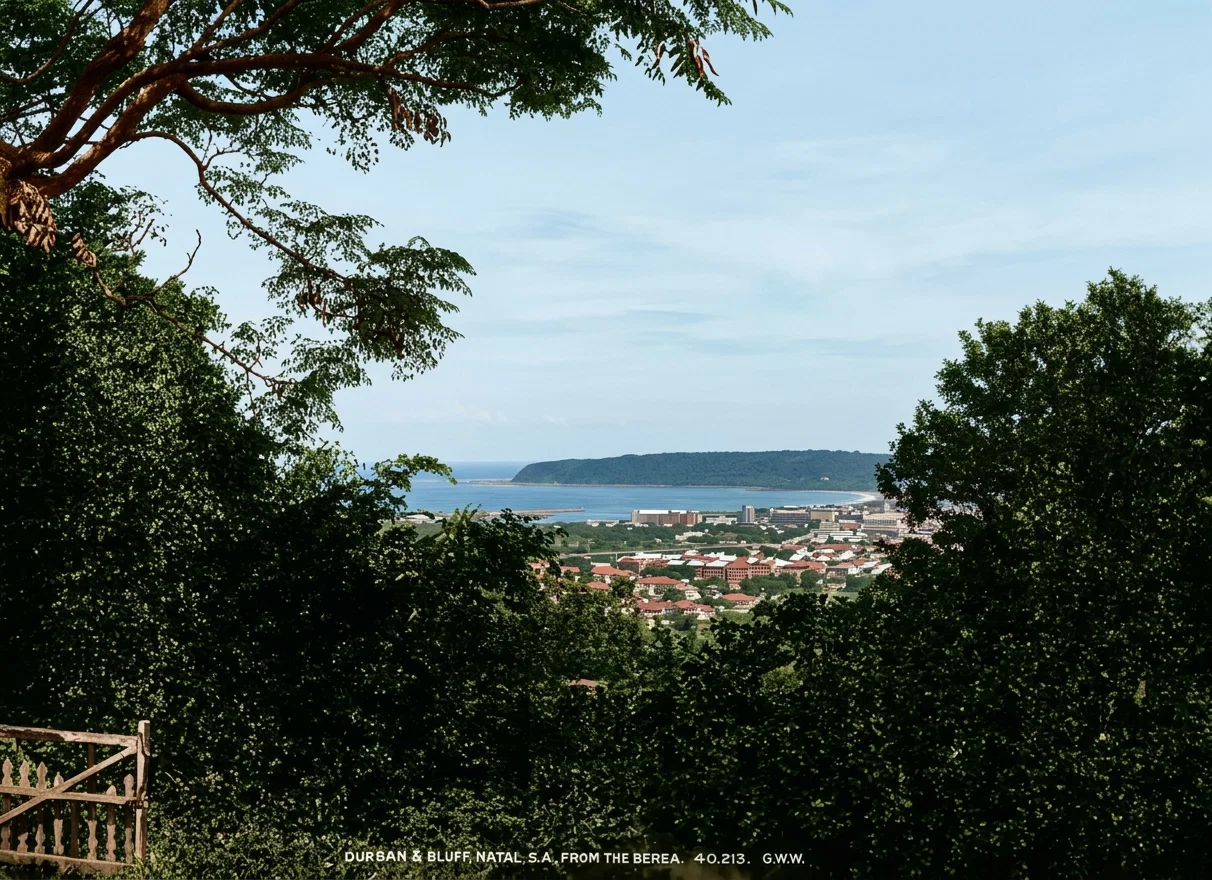
DURBAN, NATAL, SOUTH AFRICA, AS SEEN FROM THE BEREA
Young men who can speak both the Dutch and the English, would be the most valuable workers in this field; but we need workers at once, even if they have not the use of the Dutch language. If such will apply themselves to acquiring the Dutch, they can master it in a short time. Those who come here for commercial purposes, readily acquire three languages, at least so that they can converse on matters of business. It should not stagger any of our younger workers to undertake to acquire a new language for the purpose of presenting the message of life and salvation to a people who are now more ready than ever before to hear something which may differ from the tenets of the church wherein they have been nurtured.
The writer was elected President of the new conference, Brother J. H. Camp, is the Vice-President, and C. H. Pretyman, Secretary, Treasurer, and Business Manager.
While we are confident that we shall not hereafter be obliged to appeal to our brethren in America to support laborers who advance the message among the white people; yet we cannot carry the financial responsibility of giving the truth to the millions of natives and East Indians within our borders. We now have workers to equip a good, strong missionary training station, but no money with which to establish the same.
We have looked over the field quite thoroughly for a location for a mission farm, to be used as a station for training native teachers, for giving white laborers an experience in native work before sending them out to take charge of pioneer stations beyond the bounds of civilization, and also for a health-recruiting station for our missionaries, who must have occasional changes from the debilitating climate of the up-country districts, or be prematurely laid away, to rest from their labors. Will not the Lord hold us responsible if we fail to heed the lessons so dearly learned by other missionaries, and by our workers in Matabeleland, relative to taking sacred care of the health of our missionaries?
The most favorable place that we have yet found for the location of such a mission station is at a point near the convergence of the Transvaal, the Orange River Colony, Basutoland, Natal, and Zululand. This is reputed to be one of the best farming districts, and most healthful locations for man and beast, in all South Africa. Many men in this locality have lived from eighty-five to one hundred years, while a number have lived from one hundred to one hundred and seven years. Also many invalids, coming from other countries and climes and locating in this district, have fully regained their health. We might with propriety speak of this district as “the sanitarium of South Africa,” and as it is thickly peopled with natives, and is perhaps one of the most accessible places to the up-country districts, where the deadly fevers lurk to a greater or less degree,—owing to local conditions,—it seems to us that we should secure a farm here, and begin operations at the earliest possible date. We believe that this plan, which has been approved by the South African Union Council, and most heartily by Brother and Sister Booth as well,—for they are well aware that the stations where they and their fellow workers are located are in one of the fever districts,—will appeal to the good judgment of our people in America, and to a share in their liberality in the support of the great missionary enterprise of carrying the “everlasting gospel . . . to every nation, and kindred, and tongue, and people.”
A station established at the place mentioned would enable us to reach and evangelize many of the most populous nations of natives in South Africa. We believe that such a station, after being established and equipped, would be largely self-supporting. We hope to devote all the missionary funds which accumulate in South Africa for the year 1903 to this enterprise, but we shall need several thousand dollars besides. We should be thankful beyond words to express, if some of our union conferences in America would supply capital for starting this health-recruiting, and thereby life-saving station, the primary object of which is to wrest many captives from the enemy, and in co-operating with our Captain, to bring “many sons unto glory.”
The conference meetings were held in the new schoolhouse at Sweetwaters, around which ten buildings have been erected during the past eight months, and four more are in process of construction, while still others are in contemplation, and will doubtless be erected in the near future. Until work upon our school building was begun, the only habitations which marked the portion of the farm which we purchased, were a few thatched cooly huts. Within full view of the school grounds may be seen numerous native kraals (villages), occupied by hundreds, perhaps thousands, of Zulus, which indicate that our new seat of learning is located in Darkest Africa.
The school building is surrounded by eight acres of land, suitable for cultivation, and capable of producing oranges, bananas, papaws, pineapples, figs, naartjes, mandarins, and other subtropical fruits, as well as the fruits and vegetables of the temperate zone. Brother Chaney has had charge of the erection of the school building, which is now nearly completed; and as our teacher, Sister Cora Blodgett, is expected to arrive by the next mail steamer from London, the hearts of our people will soon be gladdened by having the first church school in our young conference in full operation.
Two encouraging features of our school enterprise are that the property is entirely free from debt, and the support of the teacher is fully guaranteed.
During the conference, about one hundred and fifty dollars in cash was raised, with which to secure five hundred copies of “Christ’s Object Lessons,” to be sold for the benefit of our school work in Natal. We expect to secure a like amount at Johannesburg at the beginning of the year, to start a school in that city.
Our canvassing work has made excellent progress, the sales of a recent month amounting to over $2,800. The blessing of the Lord has manifestly been over his work in this field. For this we praise him from full hearts, and take new courage for the future. Our conference meetings were characterized by a most desirable spirit of union and brotherly love, and by the manifest presence of him who said, “Go ye into all the world, and preach the gospel to every creature,” “and, lo, I am with you alway, even unto the end of the world.”