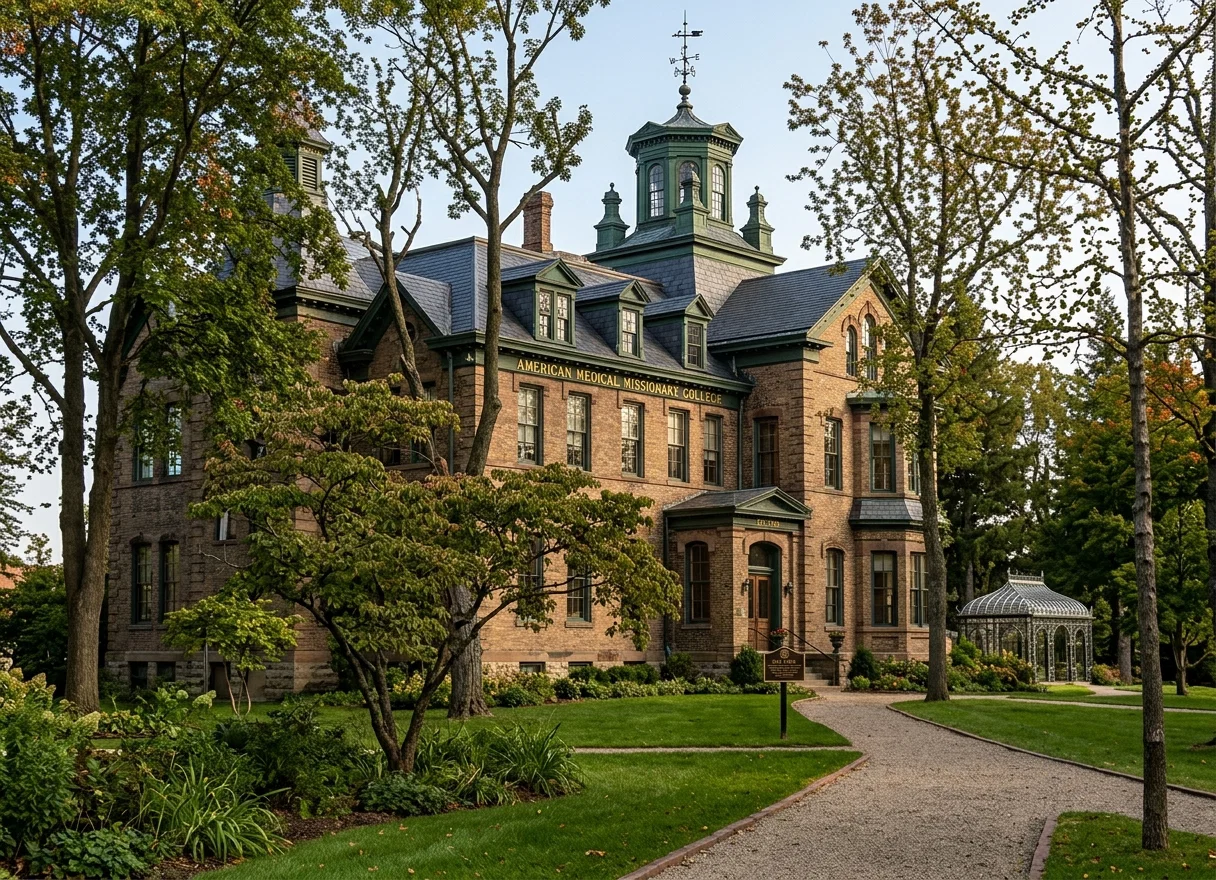
MORE than one hundred years ago a Christian gentleman, dying in the West Indies, left a considerable sum of money to be used in the establishment of a college for the education of medical missionaries. The instructions in his will were never carried out, consequently the college was not organized, and the world remained a hundred years without the benefit of an educational institution which might have rendered untold service to humanity, and have done noble work in the advancement of the cause of Christ.
A medical missionary society was organized in Edinburgh over sixty years ago, the London Medical Missionary Association twenty-four years ago; and more than twenty years ago, Dr. George Dowkont organized, in New York City, a medical society on a similar plan. The purpose of all these organizations is apparent, to encourage in the student missionary aspirations, which he is too apt to lose sight of during his medical studies, and to give him more or less training in actual Christian and missionary work.
None of these institutions, however, were incorporated as medical schools, nor did they undertake to give a regular medical education, or to issue medical diplomas. Those who had dedicated their lives to medical missionary work had obtained their medical education at the already established medical schools, and received their missionary training under the auspices of these associations.
The American Medical Missionary College, with a full and thorough course of study in medicine and a corps of efficient instructors, and, being incorporated under the laws of Illinois, prepared to issue diplomas to those who should satisfactorily complete the course, was the first medical missionary college established, and, as far as we know, is the only one at present in existence which has exclusively for its purpose the education of medical missionaries, unless Dr. Valentine’s medical school in North India may be an exception. The beginning of this missionary school may be traced to the organization of the Battle Creek Sanitarium, nearly thirty-six years ago.
At quite an early date in the history of this institution the reasons which made the formation of the various medical missionary associations necessary were recognized as having an even greater bearing upon our young people who were preparing to carry to a world in need not only the gospel as it is generally understood, but also the great principles of physical reform and Christian philanthropy for which the institution stood as a part of the message which was to prepare a people for the coming of the Lord.
Meantime a training school for missionary nurses had been established, and was in successful operation, and the International Medical Missionary and Benevolent Association had been organized and incorporated.
The Sanitarium had sent several classes of students to the best medical colleges of the country for the required medical course, giving them at the same time special training in the principles peculiar to itself. This training consisted, not only of the drill in rational methods of treatment, which they received at the Sanitarium during vacation; but wherever the students were located during the school year, they found more or less work to do for the needy around them, the sick in soul and body. Dispensary work for the poor where opportunity offered, work for children, Christian Help work, visiting among the poor and discouraged, and church work formed part of the duty of the student, and much excellent work was done in spite of the fact, generally acknowledged, that a medical course is the meanest of university courses.
The facilities and scientific equipment of the Sanitarium had grown rapidly, so that in the summer of 1895, when the subject was again broached, it was deemed possible to organize and carry forward a thorough and creditable medical school. A sufficient number of physicians who were qualified to act as teachers were available, and were ready to devote themselves to the work in a self-sacrificing way. The north wing of the Battle Creek College was, through the discontinuance of the Bible school, left vacant, and this provided the school with class rooms and laboratories.
By action of the Sanitarium board, it was agreed that if the physicians employed in the Sanitarium would undertake to fill the position of professors, without salaries, the board would undertake to meet the incidental running expenses, so as to make the school a free school for all who were ready to devote their lives to the relief of suffering humanity, and to the propagation of the principles of9the greater gospel, which offers salvation for the body as well as for the soul.
A portion of the course is given in Battle Creek, including considerable laboratory study, the analysis of the secretions and blood, stomach fluids, etc., an experience which is most necessary to the physician in the scientific treatment of disease. But the college is incorporated in Chicago, and its headquarters are necessarily located there, so that the school may receive the benefit of the clinical advantages afforded by that great city. The special needs of the medical school are also better supplied in Chicago than in a small city like Battle Creek.
It was necessary, therefore, to secure a building of considerable size for the accommodation of the students, for dispensary and hospital work, etc.
The old Home for the Friendless, 1926 Wabash Ave., situated in the heart of one of the most needy parts of the city, was leased for the work of the college, and the Chicago department of the nurses’ training school was carried on here for five years. The difficulties encountered were numerous, as the first class that was graduated can testify; but those five years were filled with blessed experiences in practical missionary work for the needy at their doors, as well as in steady progress in their studies.
Since the expiration of the lease, the college has been domiciled in a building at Thirty-third Place, near the Branch Sanitarium, pending the erection of a suitable building, which the growing importance of its work imperatively demands. Dispensary and other kinds of mission work are still carried on by the students under the supervision of experienced instructors. As facilities have been needed, they have been providentially supplied.
The college is still housed, however, in rented buildings, and the need of better and more permanent quarters is pressing. A fine lot has been secured between the Chicago Branch Sanitarium and the building used by the medical school, on which it is proposed to erect a building when funds can be obtained.
The securing of this lot was one of the marked providences that have attended this branch of the work from the first. A patient who had been greatly benefited at the Sanitarium, and had become interested in missionary work, several months ago deeded to the college a piece of property, valued at ten thousand dollars, which he held on the North Side in Chicago. Several sites had been considered, but none seemed so desirable as the vacant lot adjoining the Branch Sanitarium.
The price of this made it seem unlikely that it could be obtained. Mr. —, the donor of the property on the North Side, not knowing of the preference of the trustees for this special lot, suggested it as an appropriate location for the college, and offered, if desired, to arrange an exchange of the North Side property.
His kind offices were accepted, the trustees feeling that if he succeeded, it would be another evidence that it was the place where the Lord would have the work located. The transfer was made without difficulty, on the basis of an even exchange.
Meantime the class has grown from the original class to about one hundred and twenty students, earnest young men and women, who have decided to dedicate their lives to the Master’s service to labor wherever God may call.
The college has recently graduated its fourth class, making eighty-four who have completed the course, besides a number of others who for various reasons have taken a partial course, or have taken their last year at other colleges. These graduates and their work are referred to elsewhere.