MRS. S. JESPERSSON

5%

Seventh-day Adventist Publishing Association · Battle Creek, Mich. · May 13, 1902

FromReview and Herald, Vol. 79, No. 19.

Read the full edition

MRS. S. JESPERSSON

From Jaffa to Jerusalem

MRS. S. JESPERSSON
On reaching Jaffa from Basel, Switzerland, we shared the hospitality of Brother and Sister Horner, also nurses who had been sent out from the Institut Sanitaire. They are doing a prosperous work, with treatment rooms well equipped for the locality, and many people, some of quite high standing, take treatments daily.
Four hours on the Ottoman train covered the distance between Jaffa and Jerusalem. The first part lay through a beautiful landscape, abounding in orange groves, olive, and fig trees; but as we neared Jerusalem, the aspect of the country changed. Desolate mountains bare of trees and without water, reared themselves, and we wondered almost anxiously if the holy city itself would produce as sad an impression.
At the station Brother Krum awaited us, and half an hour's drive brought us to the house, a massive building of Oriental style, entered by a small door, which led into immense rooms, each one like a chapel with high vaulted roof.
From the roof a fine view is had of a great part of the city and the Mount of Olives. On every side may be seen by scores the rounded towers of temples and synagogues.
The city is not beautiful, the streets are narrow, tortuous, and filthy, and it is difficult to pick one's way among the people of all sorts and the throng of camels and asses. To take a walk for pleasure one must go beyond the walls.
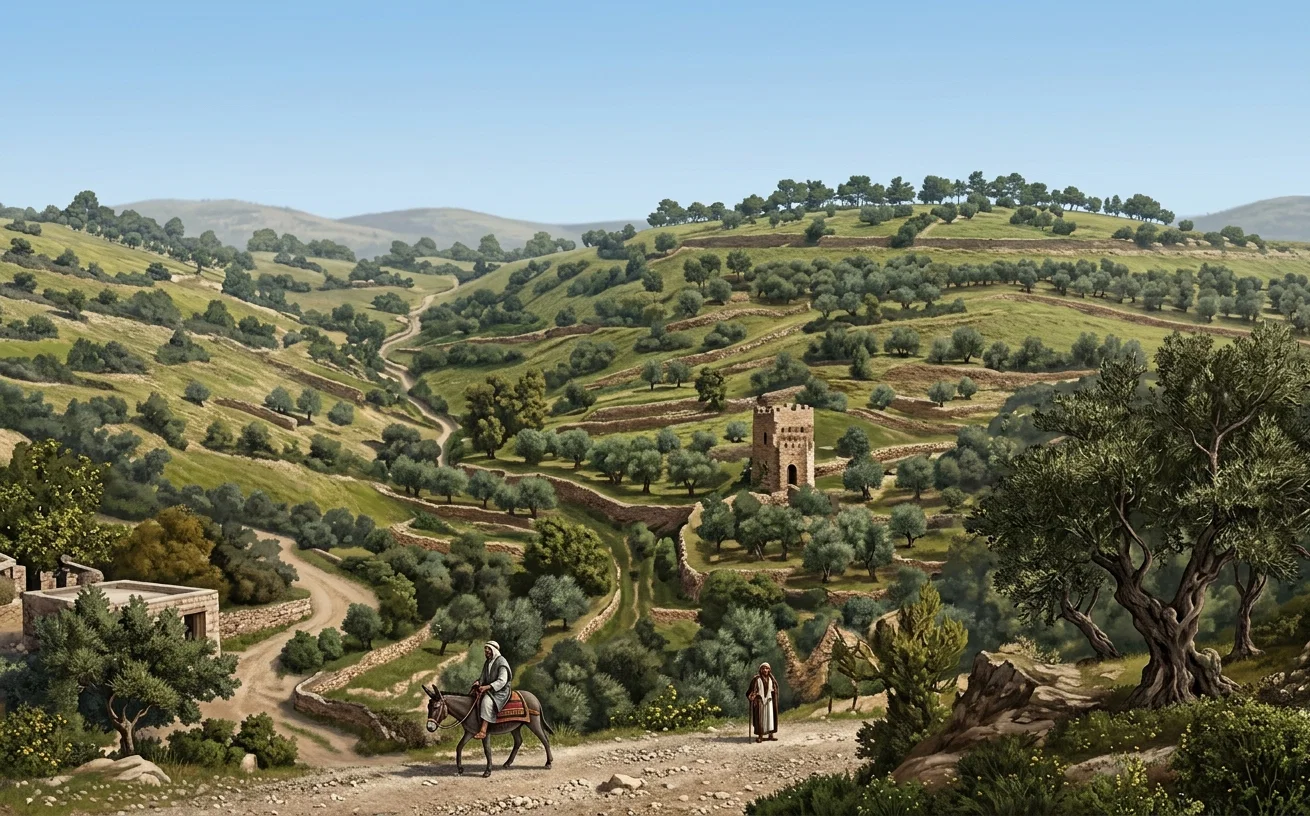
This we have done the last two Sabbaths. After the morning service we have taken our dinner and gone to the Mount of Olives to hold Sabbath school. The view from the mountain is impressive, not because of the beauty of the landscape, but because each village, each point we see, recalls some scene in the life of the Saviour. One better understands the histories of the New Testament when he is acquainted with the places where they occurred and the manners of the people.
Our hearts are heavily oppressed as we contrast the Jerusalem described in the Bible, so glorious and resplendent,with this poor people crushed to the lowest depths; for here the Jews are hated of all other people. They can scarcely traverse the street with the dead body of one of their fellow Jews because of the insults of the populace. So they bury their dead in the night, without coffin or any ceremonies. One or two persons take the body as they would carry any other burden, and place it in a hole prepared beforehand, only too happy if they can pass unnoticed from the house of death to the grave. They do not always succeed in this, and we have already been awakened during the night by cries which sounded like the howling of beasts. This was occasioned by the attempt of some poor Jew to bury the body of a dead friend, followed by the curses and threatenings of the people.
It is pitiful to see all these poor people weeping every Friday over the ruins of their temple, men and women beating the breast and praying the God of heaven to come and restore the temple, and deliver them from their present misery. These are the Jews which are such at heart as well as in name. Others more prosperous have built themselves beautiful residences in the suburbs, and live in luxury, not even observing the Sabbath, expecting Christ to come and establish a kingdom on earth. What a disappointment awaits them!
Seven miles from the Mount of Olives is the village of Emmaus, where the risen Christ appeared to two of his disciples; also, in the other direction is Bethany, where is shown the house of Mary and Martha and the tomb of Lazarus, now in ruins. The villages about Jerusalem now are composed of huts of one room, without chimneys, where the whole family lives, and often the ass, the faithful servant of the family.
On the summit of the mountain a church has been erected by the Roman Catholics. At the entrance is a stone surrounded by a grating, pointed out as the place where Christ ascended into heaven. Pilgrims attach great importance to it.
At the foot of the mountain surrounded by a thick wall pierced only by a small door is the garden of Gethsemane. An immense olive tree occupies a part of it, at the foot of which we are told Jesus prayed. Farther on is pointed out the place where the disciples slept. The place is picturesque and imposing, but it is a pity that fanaticism has left its marks; for here and there images and crosses indicate a blind worship.
THE MOUNT OF OLIVES
THE MOUNT OF OLIVES
Nearly a mile from the city is a heap of stones, the place where Stephen drew his last breath. Farther on a grotto of immense stones is presented to us as the spot where Jeremiah wrote his Lamentations. Along the valley of the Kidron, not far from the city walls, are sepulchers hewn in the rocks. These are still inhabited by lepers and poor Arabs, whom one sees during the day near the city gates, begging of the passers-by.
Calvary is upon a little elevation; not a tree nor a blade of grass grows there. The great stones scattered about indicate only tombs. The scenes of the crucifixion come crowding upon the mind as one treads the spot, and it is sweet to contemplate, by faith, Christ our Saviour in glory, surrounded with his Father and the angels.
After visiting all these sacred cities, after the view from the Mount of Olives, of the desolated city, the ruined temple, the Dead Sea stretching in the distance, one can but long for the heavenly city.
O, pray with us for this city! Pray for this people, that the light of the gospel may reach their hearts. Pray for us also, for we are so weak for a task so great.
The time is short, the hour draws nigh. Let us pray, watch, and work. The Master will soon come.