In India

10%

Seventh-day Adventist Publishing Association · Battle Creek, Mich. · May 13, 1902

FromReview and Herald, Vol. 79, No. 19.

Read the full edition

In India

J. L. SHAW
During the winter months the climate of India on the plains is delightful,—not too cold nor too hot; but just cool enough to make work a pleasure,—similar to our early autumn. One who has not been in India cannot imagine how the cool months of November, December, January, and February are appreciated. After eight months of incessant heat, with the thermometer fluctuating between 90° and 125° above zero, the cool zephyrs are refreshing, and work becomes a pleasure.
Notwithstanding the fact that the heat is trying, among the natives of India there is far less sickness in the hot weather than in the cool season. The bubonic plague and smallpox number their victims by thousands in the winter. When the sun strikes India with its most direct rays, the native has his best health, and the plague makes least headway. This is accounted for easily, when we remember the effect of the sun’s rays upon disease germs. In the cool season the filth that exists about native houses forms a good medium for germ culture, and various diseases multiply and spread; but when the mighty Indian sun returns in all his power, he checks these agents of destruction. So it is that, although we fear this fiery monster as it beats upon our heads, and do our utmost to protect ourselves from its direct rays, yet at the very time it is most intense, it is our greatest benefactor, and destroys the enemies that seek our lives.
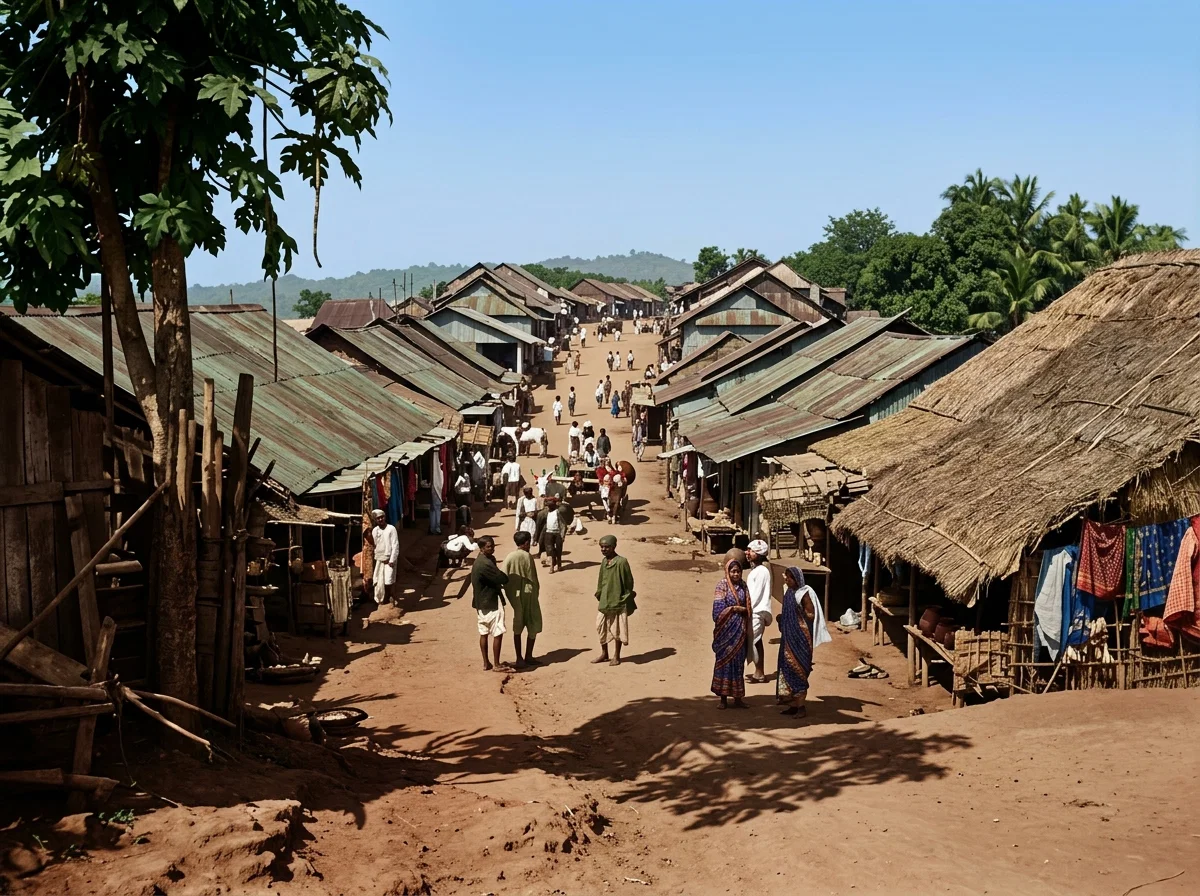
A VILLAGE IN INDIA
A VILLAGE IN INDIA
We thank God for India’s mighty sun, whose brightest beams give its people health; and we long to see the Maker of this sun, the Sun of Righteousness, shine forth with greater power, and pierce through this awful pall of caste and superstition that hides the millions of this land from the light of life. Some are beginning to see the gleams, and the name of Jesus is wending its way among the multitudes; a spirit of inquiry prevails, and many are waiting to hear the news of salvation; and most naturally, they look to the agent who carries this message of good news to see if his life conforms to his teaching. Unfortunately, self has too often had the mastery, and the Christian religion has been judged by the character of its professors.
Just now I am at Karmatar, where our orphanage is located. The orphans are all doing well, save one who has the fever. We are opening a small school in connection with the orphanage, to afford an opportunity for our people and others to give their children a Christian education. Education among the English and Eurasians is calling loudly for reform. The system of cramming, which now prevails, is one of the curses of the country. The mind is made to comprehend a large number of subjects at one time, many of which are impractical. A boy of fourteen gives the following list of studies which he is carrying: Latin, English grammar, English prose, geography, Urdu, English poetry, drawing, Indian history, map drawing, and arithmetic. With all these studies that read like a college curriculum, he is learning but little that will be of practical help to him in life. His Scripture study has been the memorizing of a few texts. As regards this wonderful house in which we live, he knows nothing. He has had no practical training, and has not learned to wait on himself. In nearly all the schools, servants are employed, and in some of them they dress and undress the pupils. Lads of fifteen have servants who dress them as if they were dolls. They become so dependent that they are unable to wait upon themselves. A day or two ago, while I was on the train, a forcible illustration of this occurred. A young man boarded the train, who had a basket weighing perhaps fifteen pounds, which a servant brought and placed in the car. After riding some distance, we came to the place where he wished to stop. As the train drew up to the platform, he began calling for a cooly to assist him, but when he saw no one coming, he rushed out, shouting, “Cooly, cooly,” and after many oaths and some much searching he found a man to remove his fifteen-pound parcel from the train just as the guard’s whistle blew for “all aboard.”
Sisters Black and Orr are conducting the school, orphanage, and medical work, and have their hands well filled. Our medical dispensary is for the natives. Dr. Ingersoll comes up from Calcutta twice a month for special work, and people come from miles around to get help. At other times Sister Black prescribes for the patients, and the older students help her in giving treatments. This affords them a good opportunity to learn how to treat the sick, which in this country is very important. People know little or nothing about their bodies, and they have very peculiar ideas about diseases and their cure.
Our work at Karmatar has been much crippled since Brother Brown died, as no one has been able to speak the language to any extent. Although the medical work is gaining the confidence of the people, yet in order to reach their hearts, the workers must be well acquainted with the language, and be able to tell them about the love of God.
While speaking with some natives, I told them that God loved them, and that we had come to tell them of his love. With astonishment one of them said that he did not know that God loved them. What a pity! These people do not know that God is a God of love, and that he loves them. No doubt this man’s acknowledgment is only a revelation of the feelings of millions of men and women in India. Their religion is a religion of fear, and all their worship is to appease the wrath of the gods. May God put it into the hearts of many in the home land to come to this land and tell the people that our God is a God of love, that these feelings of fear may all be expelled from the heart, because “perfect love casteth out fear.”